Physical Address
304 North Cardinal St.
Dorchester Center, MA 02124
Physical Address
304 North Cardinal St.
Dorchester Center, MA 02124
With Michael Walker
With Michael Walker
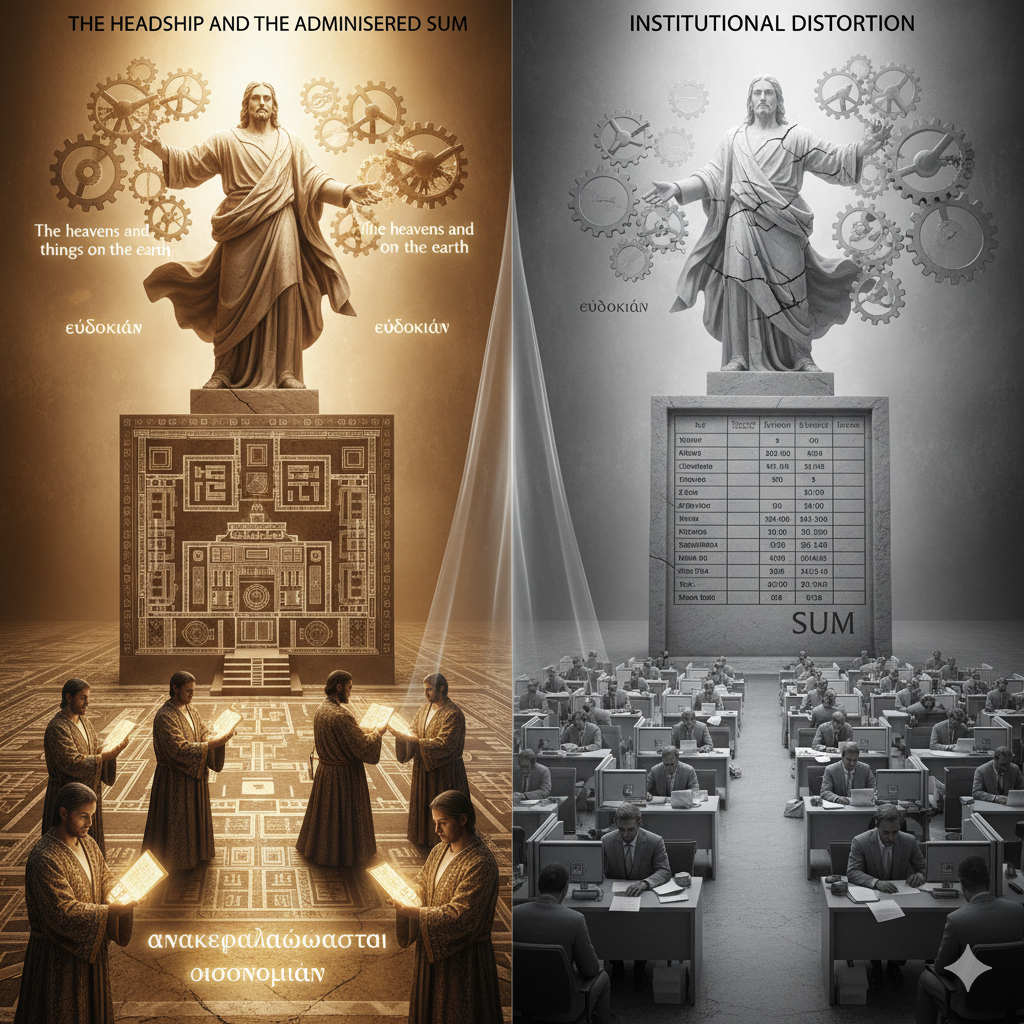
A forensic deep dive into Ephesians 1:9-10 reveals a profound shift in covenantal posture, an elegant reversal that subtly replaces the relational dynamics of YHWH’s (Yahweh’s) Household with the abstract mechanics of institutional religion. The passage, as rendered in the New American Standard Bible (NASB), reads: “He made known to us the mystery of His will, according to His kind intention which He purposed in Him with a view to an administration suitable to the fullness of the times, that is, the summing up of all things in Christ, things in the heavens and things on the earth. In Him.” Our mission is to excavate the underlying Greek of the Codex Sinaiticus and Vaticanus, not to simply translate, but to audit the integrity of the gospel by meticulously comparing the literal covenantal voice against the compromised, smoothed-over English rendering.
The analysis begins with the word εὐδοκίαν (eudokian – yoo-do-kee-an), translated as “kind intention.” A literal, culturally faithful meaning of this noun, accusative feminine singular, points to “good pleasure” or “delight.” The institutional rendering smooths over the absolute, sovereign will of the Father, YHWH (Yahweh), by substituting “delight” with the milder, more sentimental “kind intention.” This is a subtle emotionalization, where the firm, foundational decree of the Sovereign, which is the very bedrock of the covenantal plan, is softened into a mere benevolence. This is not a slight difference; it is the difference between a universe built on the immutable good-pleasure of the Creator and one resting on a negotiable, human-like intention. The original term underscores the non-negotiable, self-willed nature of the plan, as opposed to a mere desire.
The greatest evidence of posture shift appears in the core terms governing the scope and agency of the Messiah’s work. Consider first the phrase translated as “an administration” in the NASB. The original Greek is οἰκονομίαν (oikonomian – oy-ko-no-mee-an), which literally means “stewardship” or “household management.” This noun, accusative feminine singular, is derived from oikos (house) and nomos (law/management). A true household stewardship is a personal, accountable, entrusted function—it is the believer’s role as an agent who is given the keys to the master’s house and must manage the affairs for the Householder, YHWH (Yahweh). The term “administration,” on the other hand, is abstract, bureaucratic, and institutional. It suggests a system or a program rather than a personal, relational mandate given to a redeemed human being. This shift flattens the believer’s covenantal agency, downgrading the royal, priestly function of an entrusted steward into a mere participant in a system—a clear subtle reversal from relational responsibility to institutional compliance. The covenantal restoration is meant to restore the human to their original role as a steward over the earth, a role that is negated when οἰκονομίαν is generalized.
The second, and perhaps most egregious, substitution is found in the very purpose of the plan: “the summing up of all things in Christ.” The original word is ἀνακεφαλαιώσασθαι (anakephalaiōsasthai – a-na-ke-pha-lai-ō-sas-thai), a verb, aorist middle infinitive, which literally means “to head up” or “to bring to a head.” The term is built on kephalē (head), signifying the restoration of Headship and Authority. Yehoshua is not merely unifying or collecting all things into a neat summary; He is actively resuming the sovereign, governmental Headship over all things in the heavens and on the earth that was forfeited by the first man, Adam (Adham – Ah-dahm). When this is rendered as “summing up,” the institutional gloss replaces the forensic, kingly authority of the Messiah with a passive, numerical act of completion. This fundamentally alters the messianic cure; it becomes a cosmic accounting rather than a dimensional re-organization under the new, sovereign Head. The cure is not simply reconciliation, but the restoration of proper hierarchy and authority.
To illustrate this core discrepancy, consider the analogy of a vast, complex corporate structure that has undergone a hostile takeover. The company is in chaos because the original CEO was compromised, leaving the company de-headed. The institutional translation suggests the solution is a “summing up” of all the company’s assets and departments—a unified total. While unity is achieved, the core issue of governance and direction remains conceptually muted. The covenantal truth, however, is that the solution is a re-heading (ἀνακεφαλαιώσασθαι). A new, perfect CEO is installed to re-establish the governing authority, and His purpose is to place the entire structure under His Headship. This powerful act of re-heading then empowers the believer as the οἰκονομίαν (steward) to actively manage the departments on the Head’s behalf. The subtle shift in the English text replaces the active restoration of a King with a mere organizational functionary, thereby compromising the full dimensional scope of the gospel.
This audit clearly demonstrates a movement from a Covenantal Relation to a Man-Made Institutional Religion by the simple act of flattening key terms. The posture shift moves the believer from being an empowered, accountable steward (οἰκονομίαν) working directly under the Head (ἀνακεφαλαιώσασθαι) to being a passive recipient of an abstract “administration” and “summing up.” This diminishes the full implications of the restoration, where, as Ephesians 2:19 (NASB) states, believers are “no longer strangers and aliens, but… are fellow citizens with the saints, and are of God’s household,” confirming the necessity of understanding the full depth of οἰκονομίαν. Furthermore, the active authority of the Messiah is the core of the Father’s purpose, echoing the scope found in Colossians 1:16-17 (NASB), which states that “all things have been created through Him and for Him. He is before all things, and in Him all things hold together.” The translation of “summing up” fails to capture the active Headship over all things, both in the visible and invisible dimensions, as described in this passage.
The forensic analysis of Ephesians 1:9-10 reveals a systematic, if subtle, erosion of the gospel’s core relational and governmental logic within the English rendering. The substitution of sovereign good-pleasure for “kind intention,” personal stewardship for “administration,” and most critically, authoritative headship for “summing up,” constitutes a fundamental posture shift. This shift replaces the active, accountable, and relational covenant between YHWH (Yahweh), the Messiah, and the believer with an impersonal, institutional narrative. The reversal is an indictment because it disarms the believer of their mandated priestly agency (οἰκονομίαν) and simultaneously mutes the sovereign, kingly authority (ἀνακεφαλαιώσασθαι) of Yehoshua over the cosmos. This compromised text effectively preaches “another gospel”—one that minimizes the dramatic, dimensional reality of the messianic restoration and reduces it to a spiritual formality, thereby withholding the full power and relational consequence of the covenant from those who read it. It is through returning to the literal, covenantal voice of the source texts that the full, uncompromised fidelity of the Father’s eternal plan is revealed and the subtle, yet consequential, posture reversal is exposed.