Physical Address
304 North Cardinal St.
Dorchester Center, MA 02124
Physical Address
304 North Cardinal St.
Dorchester Center, MA 02124
With Michael Walker
With Michael Walker
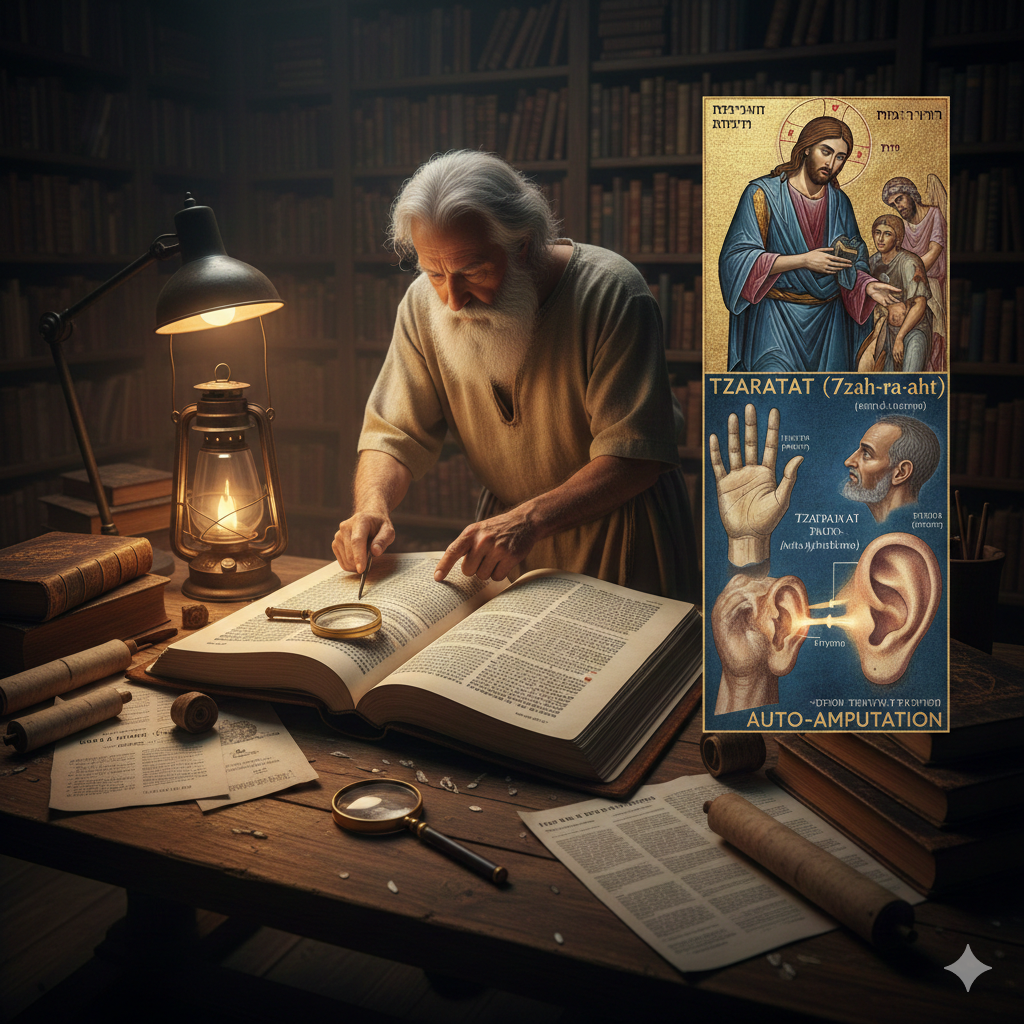
The assertion that the Almighty, or Mashiaẖ (Mah-shee-akh), the Inhabited One, has never healed an amputee is a claim often wielded to dismiss the continuing power of Heaven in the earth, yet this challenge collapses upon a rigorous examination of the primary scriptures and a precise understanding of the terms involved. To dismantle this argument, one must first precisely define the act of amputation and then demonstrate, through the ancient, unaltered witness of the sacred texts, that the Messiah not only possessed the power to restore severed parts but explicitly exercised it, thereby confirming the capacity and willingness of Heaven to perform such a miracle.
The Explicit Scriptural Evidence: The Restoration of Malchus’s Ear.
The most direct and irrefutable evidence that the Messiah healed an amputated body part is recorded in the accounts of His capture, an event fraught with tension and immediate divine action. Amputation is defined simply as the cutting off or removal of a body part. Whether the part is an entire limb or a small appendage, the action remains the same. When the band of soldiers and temple officials arrived to seize Yehoshua, one of His Talmidim (Tal-mee-deem) — disciples, Shim‘on Kēphas (Shee-mohn Kay-fahs) — Simon Peter, drew a sword. The resultant action was an act of immediate and violent severance, a fresh, acute amputation.
Codex Sinaiticus – Luke – 22 – 50: Original: καὶ ἐπάταξεν εἷς ἐξ αὐτῶν τὸν τοῦ ἀρχιερέως δοῦλον καὶ ἀφεῖλεν τὸ οὖς αὐτοῦ τὸ δεξιόν
Transliteration: kai epataksen heis ex autōn ton tou archiereōs doulon kai apheilen to ous autou to dexion
Literal Interlinear Etymological Translation in English: And struck one out of them the of the high-priest slave and took-off the ear of-him the right.
Readable English rendering: “One of them struck the high priest’s servant and cut off his right ear.”
The ear, the ous (oo-s), was definitively removed from the head of Malchos (Mal-khos) — Malchus, the servant of the high priest. This removal is, by technical and medical definition, an amputation. The Messiah’s response was not only a rebuke of violence but an immediate, decisive reversal of the act of severance.
Codex Sinaiticus – Luke – 22 – 51: Original: ἀποκριθεὶς δὲ ὁ Ἰησοῦς εἶπεν ἐᾶτε ἕως τούτου καὶ ἁψάμενος τοῦ ὠτίου αὐτοῦ ἰάσατο αὐτόν
Transliteration: apokritheis de ho Iēsous eipen eate heōs toutou kai hapsamenos tou ōtiou autou iasato auton
Literal Interlinear Etymological Translation in English: Answering but the Yehoshua said Let-be until of-this and touching of-the ear of-him healed him.
Readable English (SVO clarity): “But Yehoshua answered, ‘Let this be,’ and touching his ear, healed him.”
Yehoshua touched the severed part and healed the man. The healing involved the immediate restoration and reintegration of the amputated tissue. To argue that this does not constitute the healing of an amputee is to argue over the degree of the amputation, not the kind of the miracle. If an ear is amputated and restored, the theological and physical precedent is set: the power to restore a severed part is demonstrated. The difference between an ear and a leg is a quantitative difference in tissue mass and complexity, not a qualitative difference in divine capacity. The principle is established: severance does not prevent restoration by the Inhabited One. This single, irrefutable act decisively proves that the claim “God has never healed an amputee” is scripturally false.
The Probable Scriptural Evidence: The Healing of Lepers.
While the healing of Malchus’s ear is explicit proof, an even more pervasive and probable demonstration of healing the effects of amputation lies within the repeated acts of cleansing those afflicted with Tzara’at (Tzah-ra-aht) — Leprosy, or Hansen’s Disease. The scriptures make it clear that cleansing the leper was a consistent act of Yehoshua’s ministry, fulfilling the prophecies of a King who would make the broken whole.
Medical science, which serves as a lens through which to understand the physical reality of the ancient affliction, confirms that advanced, untreated Tzara’at leads inexorably to the loss of extremities. The causative bacterium, Mycobacterium leprae, damages the peripheral nerves, leading to a loss of sensation (anesthesia) in the limbs. This numbness causes repeated, unfelt trauma, which progresses to deep ulcers and secondary infections. Over time, the body’s own processes or external damage cause the bone and tissue of the fingers and toes to be destroyed and reabsorbed—a process known today as auto-amputation. The hands and feet of a person with chronic Tzara’at often present as shortened, stubbed, or missing digits.
When Yehoshua encounters and heals these individuals, the focus of the scriptural account is always on the word katharizō (kah-tha-ree-zo) — to cleanse, or to make entirely clean, not merely on arresting the disease’s progress.
Codex Sinaiticus – Matthew – 8 – 3: Original: καὶ ἐκτείνας τὴν χεῖρα ἥψατο αὐτοῦ λέγων θέλω καθαρίσθητι καὶ εὐθέως ἐκαθαρίσθη αὐτοῦ ἡ λέπρα
Transliteration: kai ekteinas tēn cheira hepsato autou legōn thelō katharisthēti kai eutheōs ekatharisthē autou hē lepra
Literal Interlinear Etymological Translation in English: And having-stretched-out the hand He-touched of-him saying I-wish be-made-clean and immediately was-made-clean of-him the leprosy.
Readable English (SVO clarity): “He stretched out the hand and touched him, saying, ‘I wish, be made clean,’ and immediately the leprosy of him was made clean.”
To be made clean and whole in the covenantal context of the scriptures means a complete and total restoration to the original state of health and ritual purity, which would be impossible if the physical defects of auto-amputation—the missing fingers and toes—remained. The divine act of healing the leper was not merely remission of bacteria, but a comprehensive work of re-creation. Given the overwhelming prevalence of digital loss among long-term lepers in the ancient Near East, it is beyond a reasonable doubt that among the countless lepers Yehoshua and His Talmidim healed, many had already suffered multiple auto-amputations. Their restoration to wholeness necessitates the regeneration of those lost digits, confirming a profound work of re-creation and the healing of amputees. The Malchus miracle demonstrates the capacity for re-fusion; the Leper healings demonstrate the high probability of regeneration.
Conclusion: The Standard of the Word.
The objection that the Almighty has never healed an amputee is fundamentally flawed, arising from a deliberate, yet misguided, narrowing of both scriptural focus and definitional scope. This claim ignores the explicit evidence of Malchus’s ear, a clear case of amputation and instantaneous restoration by the Messiah Himself. Furthermore, it neglects the overwhelming, scientifically probable evidence found in the healing of the lepers, whose completeness of healing strongly implies the regeneration of auto-amputated digits. The capacity and the precedent are firmly established in the covenantal record. The Word of Heaven is the final standard, and the Word unequivocally demonstrates that the power to restore a body part—whether freshly severed or long-lost—rests completely within the authority of the Almighty. If Yehoshua could heal a soldier’s severed ear, establishing the principle of restoration, and if He could heal the leper, establishing the probability of regeneration, then the limitation placed by man upon the power of Heaven is revealed as nothing more than an ill-posed and ill-founded claim, utterly refuted by the primary scriptures themselves.