Physical Address
304 North Cardinal St.
Dorchester Center, MA 02124
Physical Address
304 North Cardinal St.
Dorchester Center, MA 02124
With Michael Walker
With Michael Walker
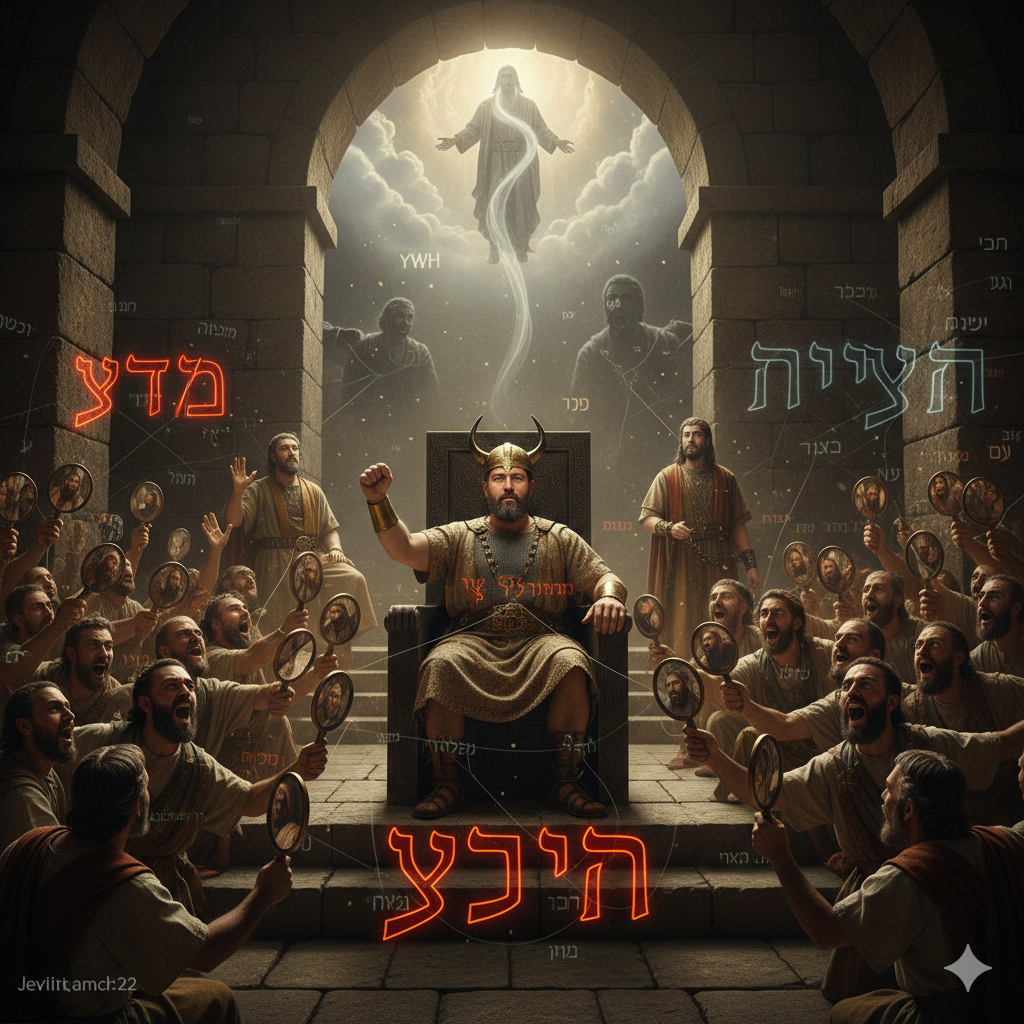
The stage is set in the twenty‑second chapter of the book of Kings, where the covenantal fracture of Israel is laid bare. The people are immersed in idolatry, estranged from YHWH, and the consequence of this estrangement is the certainty of defeat. No matter the strength of armies or the wisdom of leaders, when the covenant is broken, the outcome is already sealed. This is the backdrop against which two kings, Ahab of Yisra’el (Ah‑hab) and Yehoshaphat (Yeh‑ho‑sha‑faht) of Yehudah (Judah), sit in counsel and deliberate war against Aram (Ah‑rahm, Syria) at Ramoth‑Gil‘ad (Rah‑mohth Gee‑lahd). Their conversation is not merely political strategy but a reflection of posture before the Creator. One king seeks affirmation not truth, the other hesitates, and the tension between truth and falsehood begins to unfold.
The king of Yisra’el desires war. His heart is set, not upon truth, but upon hearing words that will bolster his resolve. He summons four hundred false prophets, not prophets of YHWH, but voices that echo his desire. They speak in unison, assuring him of victory, feeding his pride, and inflating his confidence. Their words are not blunt lies but carefully framed affirmations, technically true yet twisted into flattery. They remind him of his strength, his leadership, his past victories, and his seasoned men. They say what he longs to hear, and in their chorus his ego is magnified. Yet Yehoshaphat, discerning the absence of YHWH’s voice, insists that a true prophet be summoned. Thus Mikhayahu (Mee‑khah‑yah‑hoo, Micaiah) is brought forth, a prophet of YHWH, who declares plainly that if Ahab goes to war, he will fall. His words are not welcomed, for they pierce the illusion and confront the king with covenantal reality. He is threatened for his fidelity, yet he does not waver.
The vision then shifts to the heavenly council, where the Sovereign speaks. The text in the Aleppo Codex, 1 Kings 22:20, reads:
Original: מִי יְפַתֶּה אֶת־אַחְאָב וְיַעַל וְיִפֹּל בְּרָמֹת גִּלְעָד
Transliteration: mi yĕpattê ’et‑’Aḥ’av wĕya‘al wĕyippōl bĕRamōth Gil‘ad
Literal Interlinear: Who seduce Ahab and go up and fall in Ramoth‑Gil‘ad Source: Aleppo Codex – Melakhim Aleph (1 Kings) 22:20
Readable Translation: “Who will seduce Ahab, so that he will go up and fall at Ramoth‑Gil‘ad?”
The word that stands at the center of 1 Kings 22:20 in the Aleppo Codex is יְפַתֶּה (yĕpattêh), derived from the root פָּתָה (patah). This is not a casual verb, nor one that can be flattened into the modern gloss “deceive.” It is a covenantal word, carrying the weight of enticement, seduction, persuasion, coaxing by flattery, and misdirection through alluring speech. Its form here is piel imperfect, third person masculine singular, which intensifies the action: “to cause to be seduced.” Ahab’s ego doesn’t want to be ‘enticed,” but seduced into the notion of victory.
It is important that we examine this word because it reveals the precise mechanism by which Ahab is drawn into his downfall. The heavenly council does not ask, “Who will lie to Ahab?” but “Who will seduce him?” This distinction matters. פָּתָה (patah) exposes the subtlety of judgment: Ahab is not tricked by fabrications but seduced by affirmations that magnify his pride. The false prophets speak words that are technically true — reminders of his strength, his seasoned men, his past victories — yet framed in a way that intoxicates him with the illusion of triumph. The word therefore concludes that the situational dynamic is one of permitted seduction, a judicial mechanism authorized in the heavenly council. The motivational context is Ahab’s own appetite for flattery, and battle. His refusal to accept repeated warnings of ill news, and his demand to hear only what will bolster his resolve. He does not simply fall prey to persuasion; he longs to be seduced into believing victory is inevitable, and the spirit of falsehood operates through this very desire.
In forensic terms, יְפַתֶּה (yĕpattêh) functions as a diagnostic marker: whenever it appears, it signals inducement by seduction rather than covenantal truth. Its semantic field stretches across Scripture — Samson’s wife being seduced in Judges 14, the seductress in Proverbs 7, Israel being seduced or allured in Hosea 2, and prophets permitted to seduce and mislead in Ezekiel 14. Each case shows the same dynamic: seduction by allure, sometimes for restoration, sometimes for judgment. In Ahab’s case, it is judgment.
Thus, the word יְפַתֶּה is crucial to the audit. It tells us that the king’s downfall is not the result of blunt deception but of ego‑bolstering enticement permitted by YHWH. It concludes that the situational context is a heavenly council authorizing judgment, and the motivational context is a king whose appetite for flattery makes him vulnerable to seduction. This is why the word must be examined in full dimension: it is the hinge upon which the narrative shifts from apparent consensus to covenantal reality, exposing how permitted persuasion can operate as the very instrument of divine judgment.
Here the phrase רוּחַ שֶׁקֶר (rûaḥ šeqer) is precise: spirit of falsehood. It is not YHWH lying, but YHWH permitting falsehood of victory via seduction of egotistical self-delusional desire as judgment. The spirit becomes the embodiment of Ahabs self-deception, filling the mouths of the prophets with words that bolster ego and play to the tune of his desire for battle. The mechanism is not a blunt fabrication but a sleight of hand, a mirror held before the king’s pride. The prophets are given a script that magnifies his ego:
Exaugurated Example: ‘Tell the king His army is strong. His men are seasoned in war. His captains are loyal, his horse’s swift, his weapons sharp. Tell him He is a great leader, wise in counsel, bold in battle. His plans are precise, his victories remembered. Say to him With such strength, how could he not prevail? With such power, how could defeat be possible? Let him hear his greatness. Let him believe his own glory. Let him see triumph in his mind before the battle begins.”
These words are technically true yet framed to bolster self-delusion. They are the magician’s patter, the mirror reflecting what the king longs to see. His ego is inflated, his confidence assured, and he walks willingly into judgment. The truth remains unchanged: YHWH has decreed his fall. The falsehood is permitted, not authored by God, but allowed to operate through the false prophets as the consequence of the king’s obstinacy.
This raises the conundrum of ethics versus prudence. The advisor has already discharged his duty by speaking truth many times. Continued contradiction of the king risks punishment or death. In such a setting, survival becomes the driver. The flattery is not rebellion but defense, a means of preserving life when truth has been rendered impossible to deliver. The king himself is the agent of falsehood, for he refuses reality and demands affirmation. The moral weight shifts to him, while the false prophets, under amplification, echo words that magnify his pride. The deception is real, but its source is the king’s own obstinacy. The spirit of falsehood is permitted to operate because the king has already sealed his fate by rejecting truth.
The outcome is inevitable. Ahab goes to war, seduced by his own desire, and falls at Ramoth‑Gil‘ad. The decree of YHWH stands firm. The falsehood does not alter reality but serves as the mechanism by which the king is given what he demands. The sequence is clear: truth declared, truth rejected, seduction permitted, ego magnified, illusion embraced, judgment fulfilled. This is the forensic canon of the passage. The mechanism of judgment is יְפַתֶּה (seduction), operating through רוּחַ שֶׁקֶר (spirit of falsehood), and permitted by YHWH as a response to Ahab’s rejection of אֱמֶת (truth). In this dynamic, שֶׁקֶר (falsehood) is the medium of deception, while יְפַתֶּה (seduction) is the verb that describes how that falsehood is delivered and embraced. Together they expose the covenantal reality: Ahab’s obstinacy and longing to be seduced into victory become the very instrument of his judgment.