Physical Address
304 North Cardinal St.
Dorchester Center, MA 02124
Physical Address
304 North Cardinal St.
Dorchester Center, MA 02124
With Michael Walker
With Michael Walker
I. The Anatomy of the Appointed Time.
The manifestation of divine decree within the material realm is never a matter of chance but follows a rigorous and ancient protocol of fullness, displacement, and consumption. When the weight of a promise becomes too heavy for the unseen world to hold, it must necessarily spill into the physical geography of human existence through a specific portal of time. This transition is not a quiet arrival into a welcoming world, but a forceful occupation of space that requires the systematic clearing of previous burdens. To understand the birth of a revelation or the arrival of abundant provision, one must look past the sanitized narratives of modern tradition and observe the biological and rhythmic pressures of the covenantal timeline. The process begins with a vessel reaching its absolute capacity, where every period of light is occupied by the looming reality of what is about to be brought forth. Just as a river overflows its banks when the headwaters are filled to the full, the divine decree saturates the minutes and hours of the appointed season until the pressure of existence demands an exit. This is the emergence of the male offspring into a world that has no inherent room for the magnitude of His presence.
The arrival of the Inhabited One, known in the covenant as Yehoshua, demonstrates that the highest frequency of divine truth is often relegated to the most primitive points of contact. There is a profound mechanical necessity in the movement from the guest room to the animal quarters. The human structures of commerce and institutional lodging are perpetually crowded with the noise of census and taxation, leaving no space for the quiet weight of a new beginning. Consequently, the revelation must seek out the loosening-down place, the specific location where the laboring beast is unyoked and the heavy sandals of the traveler are cast aside. It is only in this environment of unburdening that the provision can be properly positioned. The revelation is not merely placed; it is caused to recline, taking the posture of a free man at a banquet within a vessel designed for the most basic form of sustenance. The feeding trough becomes the altar of the immediate, transforming a place of animal hunger into a station of spiritual life. For any seeker to truly participate in what has been birthed, they must move beyond the busy gates of human industry and find the humble trough where the truth is laid out to be eaten and made a part of the internal man.
The etymological foundation of this journey begins with the concept of the periods of light being filled to the full. In the ancient mind, time was not a series of empty boxes to be checked on a calendar, but a fluid substance that could be poured into a vessel. When the scripture speaks of the days being completed, it uses a term that suggests a saturation point. Imagine a sponge that has absorbed every drop of water it can possibly hold; it is no longer just a sponge, but a carrier of the water. Similarly, the period of light assigned to the birthing of a promise becomes so heavy with the intent of the Creator that the very atmosphere begins to sag under the weight of the coming manifestation. This is the biological reality of the covenant. It is a pregnancy of time itself. When this filling reaches its peak, the environment must change to accommodate the output. The transition from the internal state of being filled to the external state of bringing forth offspring is the most violent and transformative moment in the life of a revelation. It is the moment where the abstract becomes concrete, and the invisible becomes a tangible male offspring.
As the fullness of time pushes the revelation into the physical world, it immediately encounters the friction of human systems. The search for a loosening-down place is the search for a functional rest that human institutions cannot provide. The guest room or the inn represents the established order of society, where everything is categorized, taxed, and accounted for. In these spaces, there is no topos, no specific coordinate of space, for that which is truly new and divine. The institutional lodging is already full of the old, the weary, and the bureaucratic. To find the space required for the birth of a God-breathed provision, one must descend. The loosening-down place is not a place of failure or poverty, but a place of strategic unyoking. It is the location where the beast of burden is finally freed from its harness. In the same way, the seeker must loose their own religious and commercial burdens to enter the space where the revelation is reclining. If one remains within the confines of the crowded inn, they will miss the moment of reclining entirely, for the guest of honor has moved to the lower floor to meet those who are unburdened and hungry.
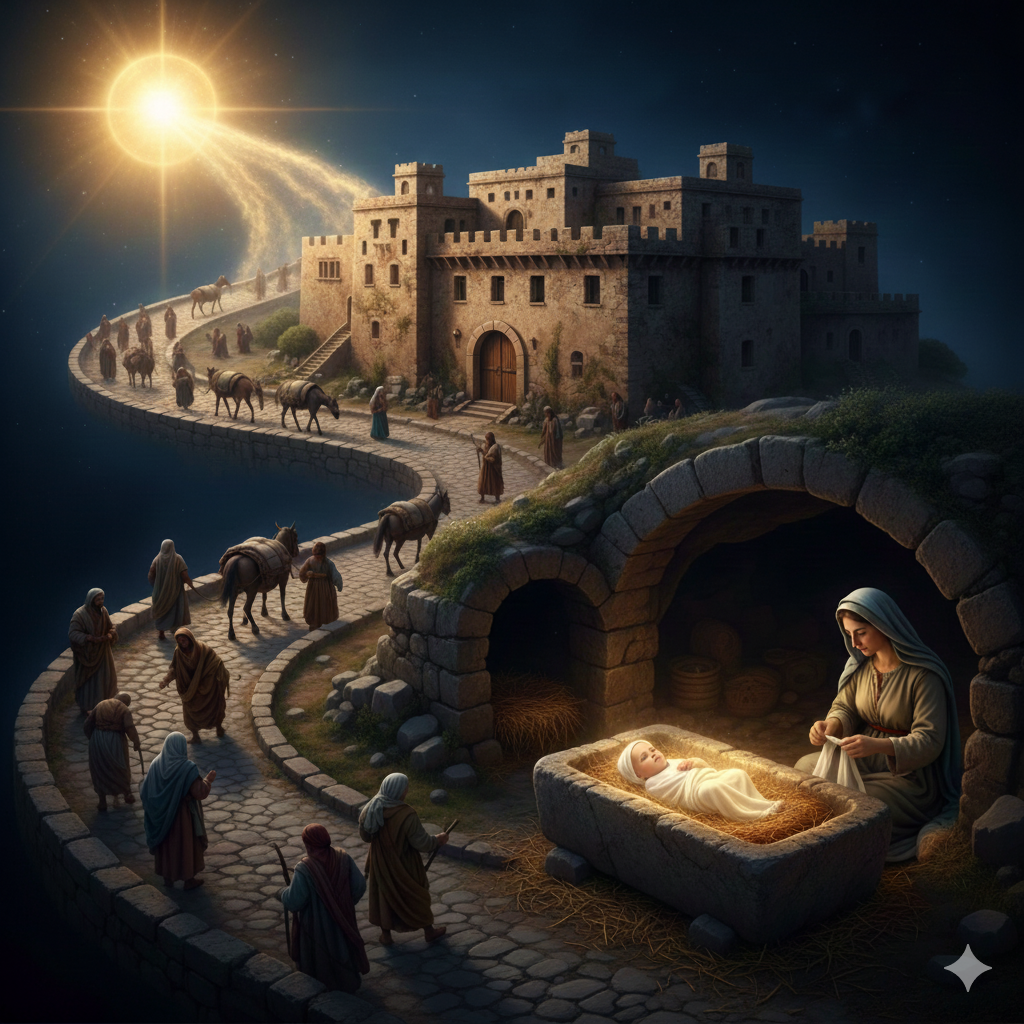
This descent into the feeding trough is the ultimate signature of the covenantal process. The trough, or the place of consuming, is the most honest piece of furniture in the ancient home. It does not exist for decoration or status; it exists to be emptied so that the living may be sustained. By causing the first-born to recline in this specific vessel, the narrative bypasses the vanity of the cradle and moves directly to the necessity of the bread. The feeding trough is the intersection of divine provision and human survival. It suggests that the revelation is not a relic to be viewed from a distance behind a velvet rope of religious tradition. Instead, it is a substance to be ingested. The act of reclining in the trough is an invitation to a feast of the spirit. It is the placement of the highest treasure in the lowest common denominator of life. This ensures that the revelation is accessible to all who recognize their own emptiness and are willing to come to the trough to be filled.
Then it came to pass within their existing in that place, the periods of light were filled for her to bring forth offspring. And she brought forth the male offspring of her, the first-born; and she bound Him in binding strips and caused Him to recline in a feeding trough, because no space was existing for them within the loosening-down place. (Codex Vaticanus – Loukas – 2 – 6 through 7, Literal Interlinear Etymological Translation, Covenantally Faithful, Minimal Copular, SVO Format).
The binding strips mentioned in this foundation serve as the final layer of this introductory deep dive. These are not merely cloths of poverty, but the precise tools of security for the newly birthed. In the ancient world, to bind the newborn was to ensure the straightness of the limbs and the protection of the soft body from the harshness of the new environment. When a revelation is first brought forth, it is fragile and requires the binding of covenantal discipline and etymological truth to keep its form. Without these strips, the revelation would be scattered and distorted by the winds of human opinion. The binding keeps the provision intact while it reclines in the feeding trough. It represents the boundaries of the word that protect the essence of the promise. As we move deeper into this series, we will see that every element, from the binding to the reclining, is a deliberate step in a divine protocol designed to move the seeker from a state of wandering to a state of being nourished by the very presence of the Inhabited One. Yehoshua.
The culmination of this first section serves as a powerful proclamation of the path ahead. We are embarking on a journey that requires the total abandonment of institutional gloss and the recovery of the original, sounded-out reality of the word. The standard of validity for this deep dive is not found in the lecture halls of modern academia or the pews of corporate religion, but in the ancient scripts of the Sinaiticus and Vaticanus witnesses. The word of God is the living standard that validates itself through the recovery of its own native voice. To enter into this study is to leave the crowded inn of man’s interpretations and to step into the loosening-down place where the burdens of tradition are cast aside. Only there, in the quiet presence of the feeding trough, can the seeker find the substance that was birthed in the fullness of time. We stand at the threshold of a great unfolding, where the periods of light are once again being filled with the weight of a revelation that is ready to be consumed by those who have the courage to recline at the table of the King.