Physical Address
304 North Cardinal St.
Dorchester Center, MA 02124
Physical Address
304 North Cardinal St.
Dorchester Center, MA 02124
With Michael Walker
With Michael Walker
III. The Posture of Authority.
The war between the covenantal record and institutional religious contrivance is fought on the battlefield of language, where the replacement of ancient etymological roots with sanitized Western glosses has effectively veiled the functional mechanics of divine manifestation. Institutional religion operates through a lens of sentimental abstraction, reducing the visceral reality of the birth of the Inhabited One to a series of static, decorative images designed for comfort rather than transformation. This contrivance is seen most clearly in the shift from a rhythmic, biological understanding of time and posture to a linear, commercialized framework that serves the ego of the institution. When the modern translation claims that the days were completed, it employs a sterile, chronological marker that suggests the mere passing of time on a calendar, much like a traveler reaching a destination on a map without ever engaging the terrain. However, the ancient witness of the Sinaiticus and Vaticanus codices reveals a reality of eplēsthēsan hēmerai (eh-PLAY-sthay-san hay-MEH-rye), where the periods of light were filled to the full. This indicates that time is not an empty void but a vessel designed to receive the weight of a divine decree. Just as a potter fills a jar with water until the surface tension bulges and eventually overflows, the light of the appointed season becomes saturated with the presence of the coming revelation until it can no longer be contained within the unseen realm.
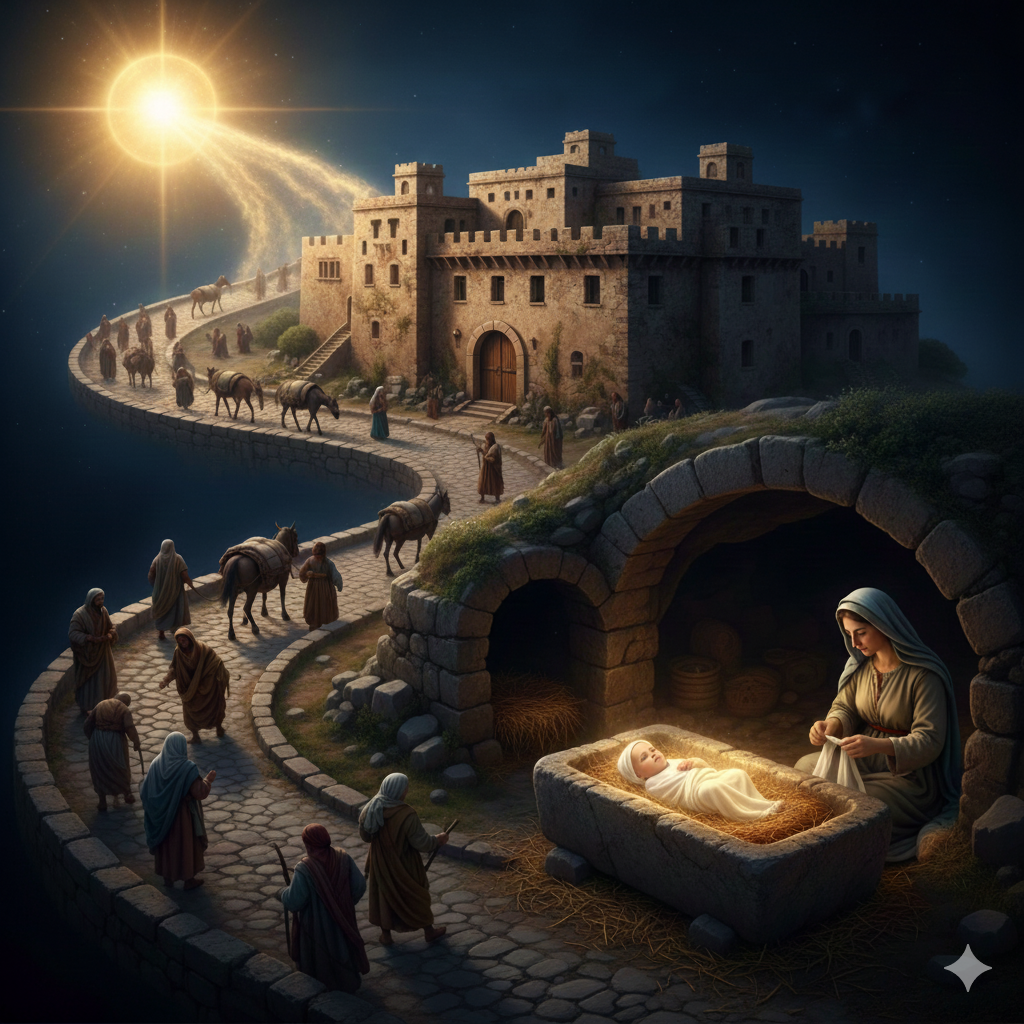
The institutional move to translate the loosening-down place as an inn is one of the most significant deceptions in the history of religious interpretation. By utilizing the word inn, the modern system injects a commercial, profit-driven concept into a scenario of covenantal unyoking. This creates a false narrative of a heartless hotel manager rejecting a pregnant mother, which serves to emotionalize the text while stripping it of its functional etymology. The Greek witness of the katalyma (kah-TAH-loo-mah) arises from the roots of kata, meaning down, and lyō, meaning to loose or untie. This is the functional coordinate of rest where the traveler looses their burdens and the beast of burden is unyoked from its labor. It is a place of transition from the weariness of the journey to the relief of the destination. When the institutional translation ignores this, it obscures the spiritual reality that a divine revelation cannot be birthed in the crowded rooms of human commerce or religious bureaucracy. It must occur in the loosening-down place where the seeker has finally cast aside the heavy sandals of tradition and the harnesses of societal expectation. The absence of space in the lodging area was not a tragedy of poverty but a strategic displacement to ensure the birth happened in a location of true unburdening.
Furthermore, the institutional distortion of the posture of the offspring reveals a deep-seated fear of the inherent authority of the revelation. Modern religious texts state that she laid Him in a manger, using a neutral and passive verb that describes the simple placement of an object. This reduces the male offspring to a helpless infant in a wooden box, a figure of pity rather than a figure of power. The ancient witness, however, declares that she aneklinen (ah-NEH-klee-nen) Him, or caused Him to recline. This is the posture of the anaklinō, the specific leaning back of a free man or a guest of honor presiding over a banquet. Even in His first moments in the physical realm, the male offspring, Yehoshua, is positioned with the dignity of a ruler. He is not merely put down; He is seated as the head of the table. This posture shift is a direct challenge to the institutional desire to keep the divine decree in a state of perpetual infancy and weakness. To recline is to claim ownership of the space and to invite others to the feast of the covenant. It suggests that the revelation is not a problem to be managed but a presence to be honored.
The vessel of this reclining, which the institution calls a manger, is etymologically revealed as the phatnē (PHAT-nay), or the feeding trough. The word manger has become a sanitized piece of religious furniture, often depicted in art as a quaint wooden cradle. In contrast, the feeding trough is a crude, functional stone basin carved for the singular purpose of holding sustenance for the living. The etymology of phatnē is tied to the act of consuming and eating. By placing the first-born in the feeding trough, the covenantal script is proclaiming that the bread of life has been served in the only appropriate container. A trough is not for sleeping; it is for feeding. This highlights the stark contrast between the institution’s focus on the scenery of the birth and the covenant’s focus on the consumption of the revelation. The feeding trough is designed to be emptied so that the animal may be filled; likewise, the revelation is reclining in the trough so that the seeker may consume the truth and be filled with the life of the Creator. To ignore this etymological root is to miss the entire purpose of the manifestation.
This transition from the institutional inn to the covenantal feeding trough represents the path of every true seeker of a revelation from God. The institutional inn is a place of noise, crowd, and transaction, where everyone is competing for space and recognition. It is the realm of man-made religious corporate academia, where the word is discussed and debated but never ingested. The feeding trough, however, is found in the quiet, lower places where the animals and the unburdened dwell. It is here, in the place of consuming, that the provision is actually found. One must be willing to bypass the high seats of the lodging place to find the reclining King in the stone basin. This is not a descent into poverty, but a descent into reality. The feeding trough is the most honest place in the house because it deals directly with the necessity of survival. When a revelation is birthed, it is not given for the sake of intellectual curiosity; it is given to sustain the spirit through the harshness of the wilderness. The institutional focus on the manger as a symbol of humility misses the point that the trough is a symbol of abundant provision.
The standard of validity for these findings must always be the ancient scriptures themselves, as preserved in the primary codices, rather than the shifting sands of corporate religious interpretation. The Word of God is a living standard that does not require the gloss of later doctrinal abstractions to be powerful. In fact, it is the removal of these abstractions that allows the native voice of the covenant to be heard. Then it came to pass within their existing in that place, the periods of light were filled for her to bring forth offspring. And she brought forth the male offspring of her, the first-born; and she bound Him in binding strips and caused Him to recline in a feeding trough, because no space was existing for them within the loosening-down place. (Codex Vaticanus – Loukas – 2 – 6 through 7, Literal Interlinear Etymological Translation, Covenantally Faithful, Minimal Copular, SVO Format). This witness provides the correction to every institutional error, pointing the seeker away from the commercial inn and toward the functional relief of the loosening-down place.
The conclusion of this section of the deep dive serves as a final proclamation of the necessity of consumption over admiration. Institutional religion has taught the world to admire the manger from a distance, turning the birth of the first-born into a seasonal ornament. The covenant, however, demands that we approach the feeding trough with the hunger of the unyoked. We must recognize that the filling of the periods of light was done for our benefit, so that a provision could be birthed that is capable of sustaining us. The shift in posture from the neutral laying to the authoritative reclining is a call to recognize the sovereign headship of the revelation in our lives. We are not invited to look at the provision; we are invited to eat it. The loosening-down place is where we cast off the burdens of the institution and finally enter the rest that the King has prepared for us in the place of consuming. The path to revelation is a path of unburdening, a descent into the reality of our own hunger, and a final filling at the trough of the first-born.
In the final validation of this study, we see that the etymological roots of the Sinaiticus and Vaticanus codices provide a blueprint for spiritual breakthrough that is entirely consistent with the ancient Hebrew tradition. The manifestation of the divine does not follow the rules of human lodging. It follows the rules of the covenantal fill. When the cup is full, it must overflow. When the burden is heavy, it must be loosed. When the hunger is real, the provision must be reclined in the trough. We stand before the feeding trough of the inhabited one, not as members of an institutional organization, but as covenantal seekers who have found the bread of life in the most primitive and powerful of places. The word stands, the light is filled, and the table is set in the feeding trough for all who have the ears to hear and the hunger to eat.