Physical Address
304 North Cardinal St.
Dorchester Center, MA 02124
Physical Address
304 North Cardinal St.
Dorchester Center, MA 02124
With Michael Walker
With Michael Walker
II. The Collision with Reality.
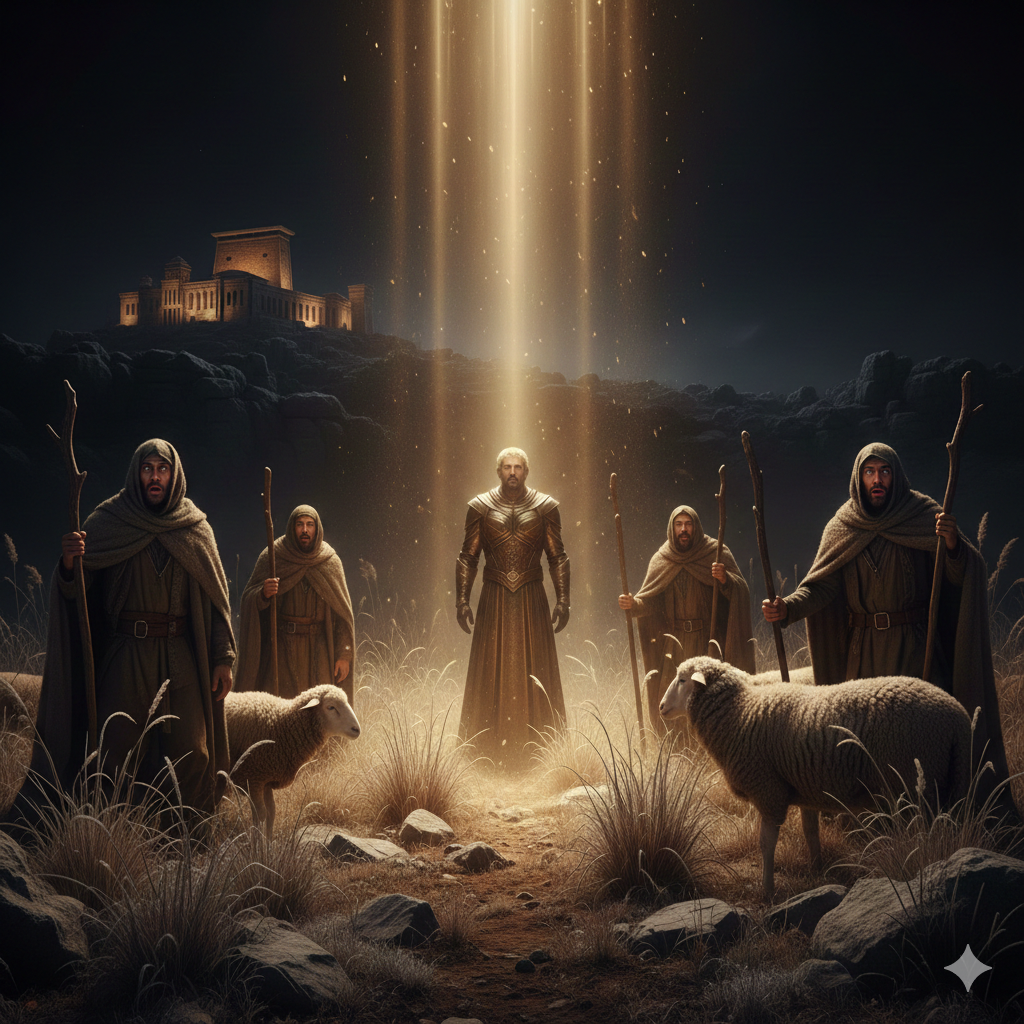
The sudden arrival of the messenger represents a violent collision between the sovereign jurisdiction of the heavens and the fragile constructs of human narrative. When the text of the Sinaiticus records that an angelos (ang’-el-os) – messenger – stood before the herdsmen, it describes a functional herald arriving with the cold precision of a legal summons. In the framework of the Contrived Institutional Narrative (CIN), the messenger has been reimagined as an ethereal, romanticized figure—a wispy inhabitant of a distant religious dreamscape. This poetic softening serves a specific purpose for the religious institution: it distances the message from human responsibility by moving the encounter into the realm of the fantastic. However, in the covenantal reality, a messenger is a ranking officer of a higher authority whose presence demands immediate jurisdictional alignment. Just as an envoy from a high king carries the full weight and terror of the throne he represents, this messenger arrives not to suggest a new feeling, but to announce a change in the governance of the region. The institution prefers a messenger who whispers to the heart, but the covenant reveals a herald who commands the vessel.
Original: ἄγγελος
Transliteration: angelos Phonetic: ang’-el-os
Literal Meaning: messenger, an envoy sent with specific instructions, a functional herald representing a superior authority.
Grammatical Role: noun, nominative, masculine, singular, root: ἄγγελος, subject of the verb. (Codex Sinaiticus – Luke – 2 – 9)
Original: κυρίου
Transliteration: kyriou Phonetic: koo-ree-oo
Literal Meaning: of the Master, of the one possessing supreme legal authority and ownership.
Grammatical Role: noun, genitive, masculine, singular, root: κύριος, showing the source of the messenger. (Codex Sinaiticus – Luke – 2 – 9)
Original: ἐπέστη
Transliteration: epestē Phonetic: ep-es’-tay
Literal Meaning: stood over, came upon suddenly with authority, to take a stand in a confrontational or authoritative manner.
Grammatical Role: verb, aorist, active, indicative, 3rd person, singular, root: ἐφίστημι. (Codex Sinaiticus – Luke – 2 – 9)
The impact of this encounter is amplified by the doxa (dox’-ah) or heavy-radiance of the Master that shone around them. In the cultural etymology of the Greek lexical witnesses, doxa is not a vague spiritual glow or a warm inner feeling; it is the visible, pressurized manifestation of reputation and weighty substance. It is a physical weight that descends upon the environment, exposing the structural integrity of everything it touches. The Contrived Institutional Narrative (CIN) has reduced this radiance to a spiritualized aesthetic, a light that illuminates without ever demanding a change in the vessel. But in the presence of the true heavy-radiance, the hollowness of the man-made structure is laid bare. If a gold-plated crown is placed under a hydraulic press, the pressure reveals whether the core is solid gold or cheap lead. The doxa is that press. It seeks out the core of the man. The herdsmen, standing in the open field, were forced to reckon with the sheer mass of the Master’s presence, a weight that effectively crushes any narrative not rooted in the truth of the covenant.
Original: δόξα
Transliteration: doxa Phonetic: dox’-ah
Literal Meaning: heavy-radiance, weighty reputation, the visible manifestation of honor and substantial presence.
Grammatical Role: noun, nominative, feminine, singular, root: δόξα, the subject that performs the action of shining. (Codex Sinaiticus – Luke – 2 – 9)
Original: περιέλαμψεν
Transliteration: perielampsen Phonetic: per-ee-el’-amp-sen
Literal Meaning: shone all around, to illuminate from every side simultaneously, to enclose in light.
Grammatical Role: verb, aorist, active, indicative, 3rd person, singular, root: περιλάμπω. (Codex Sinaiticus – Luke – 2 – 9)
The reaction of the herdsmen—that they feared with great fear—provides the ultimate verdict on the state of the human vessel when confronted with the unfiltered presence of the Creator. The Greek text employs a cognate accusative, ephobēthēsan phobon megan, which literally describes the act of fearing a fear that is massive in scale. This is not the reverent awe often preached in the halls of ritual; it is the terror of a creature who realizes its own fragility in the presence of absolute power. The religious person, comfortably housed within CIN (Sin), uses their contrived institutional narrative as a shield against this very reality. They have built a wall of doctrines and anachronisms specifically to keep the heavy-radiance at a distance where it can be observed but not felt. The doxa threatens to crush CIN because it demands a level of fidelity that the institution cannot provide. When the shield of the narrative is stripped away, the religious person is left exposed, and the fear they feel is the realization that their institutional residence is a hollow shell that offers no protection against the Master’s jurisdiction.
Original: ἐφοβήθησαν
Transliteration: ephobēthēsan Phonetic: ef-ob-ay’-thay-san
Literal Meaning: they were struck with fear, they were put to flight by terror, to be seized by a sense of dread.
Grammatical Role: verb, aorist, passive, indicative, 3rd person, plural, root: φοβέω. (Codex Sinaiticus – Luke – 2 – 9)
Original: φόβον
Transliteration: phobon Phonetic: fob’-on
Literal Meaning: fear, terror, a state of alarm caused by the presence of a superior power.
Grammatical Role: noun, accusative, masculine, singular, root: φόβος, internal object of the fear. (Codex Sinaiticus – Luke – 2 – 9)
Original: μέγαν
Transliteration: megan Phonetic: meg’-an
Literal Meaning: great, massive in scale, exceedingly intense.
Grammatical Role: adjective, accusative, masculine, singular, root: μέγας. (Codex Sinaiticus – Luke – 2 – 9)
To understand this collision, consider the difference between a man watching a storm through a thick, reinforced window and a man standing on a flat plain with no cover as a lightning strike hits the ground ten paces away. The window represents CIN (Sin). It allows the observer to see the flashes and hear the rumbles while maintaining the illusion of safety and control. The man behind the glass can even write poems about the beauty of the lightning because he is not in danger of being incinerated by it. But the herdsmen were the man on the plain. There was no glass, no institution, and no narrative to buffer the strike. The messenger did not appear in the distance; he stood over them. The light did not flicker; it shone all around them. This is the catastrophic reality of the covenantal encounter: it is unmediated. The institution exists to mediate the presence so that it never becomes a collision. It wants to turn the lightning into a candle so that the people can sing songs around it without ever being burned. But a candle cannot power a kingdom, and a romanticized messenger cannot rescue a people from bondage.
The heavy-radiance acts as a jurisdictional boundary marker. In ancient times, the reputation of a ruler was tied to the weight of his coinage and the splendor of his court; to enter the presence of the king was to feel the weight of his doxa. When the heavy-radiance of the Master appeared in the field, it signaled that the region was no longer under the shadow of the current age but had been reclaimed by the legal owner. The herdsmen’s fear was the natural response to a sudden change in laws. If a man has been living in an abandoned house for years and the true owner suddenly walks through the door with a deed and a sheriff, the man is struck with fear. He realizes his squatter’s rights are over. CIN (Sin) has encouraged the religious to be squatters in a vessel they do not own, filling their minds with anachronistic names like Jesus and Christ as if these labels were enough to grant them ownership of their own destiny. But when the messenger of the Master—representing the covenant name Yehoshua arrives with the doxa, the squatter’s narrative is crushed. The fear is the weight of the realization that the Master has come for His property.
The messenger’s first words—Do not fear—are not a polite suggestion, but a command to stabilize the vessel for the transmission of the message. The herald recognizes that a vessel consumed by terror cannot properly receive the victory announcement. This is the difference between the rescue and the ritual. The ritual uses fear as a tool of control, keeping the people dependent on the institution for comfort. The rescue uses the command to move the people past fear and into agency. The messenger must bring the herdsmen into a state of focus so they can hear the specifics of the city of David, the Rescuer, and the Inhabited One. CIN (Sin) often stays in the fear, or moves directly to a manufactured, emotional peace that lacks the weight of the doxa. But the covenantal path requires a confrontation with the heavy-radiance first. You must feel the weight of the Master’s reputation before you can understand the message of His victory. Without the crushing weight of the doxa, the news of a rescuer is merely a story. With the weight, it becomes the only hope for survival in a region that has just been reclaimed by its Creator.
Original: εἶπεν
Transliteration: eipen Phonetic: i’-pen
Literal Meaning: said, spoke with authority, articulated a specific message.
Grammatical Role: verb, aorist, active, indicative, 3rd person, singular, root: εἶπον. (Codex Sinaiticus – Luke – 2 – 10)
Original: φοβεῖσθε
Transliteration: phobeisthe Phonetic: fob-ice’-theh
Literal Meaning: be afraid, to be terrified.
Grammatical Role: verb, present, middle or passive, imperative, 2nd person, plural, root: φοβέω. (Codex Sinaiticus – Luke – 2 – 10)
Original: εὐαγγελίζομαι
Transliteration: euangelizomai Phonetic: yoo-ang-ghel-id’-zo-mee
Literal Meaning: I bring a message of victory, I announce the reward of good news.
Grammatical Role: verb, present, middle, indicative, 1st person, singular, root: εὐαγγελίζω. (Codex Sinaiticus – Luke – 2 – 10)
In the finality of this section, we must acknowledge that the collision with reality is the necessary death of the Contrived Institutional Narrative (CIN). The religious must be terrified of the doxa because the doxa is the end of their autonomy. CIN (Sin) teaches that the presence of the Master is something to be managed by the priests and processed by the church. The Sinaiticus declares that the presence of the Master is a weight that arrives unbidden, stands over the workers, and demands a total surrender of the narrative. This is the hidden truth for those in the institution today: you are terrified of the true spirit because you know it will crush the walls you have built. You prefer the romanticized messenger because he doesn’t ask for your jurisdiction. But the rescue is coming, and it will not ask for an invitation. It will shine all around you, and in that moment, the only question that will matter is whether your vessel is hollowed out and ready to be inhabited, or whether it is full of CIN (Sin) and destined to be crushed under the weight of the Master’s heavy-radiance.