Physical Address
304 North Cardinal St.
Dorchester Center, MA 02124
Physical Address
304 North Cardinal St.
Dorchester Center, MA 02124
With Michael Walker
With Michael Walker
III. The Architecture of Agency.
The examination of agency and narrative within the ancient record requires a surgical separation of the covenantal reality from the layers of institutional gloss that have obscured the functional mechanics of the Kingdom. At the center of this investigation stands the nature of the Son, identified in the Greek witnesses not by a religious surname, but by a functional description of His state of being. While the institutional posture focuses on Christ as a sacred title or a mystical status reserved for distant veneration, the covenantal agency recognizes Christos (Krees-tohs) — Christ as a mechanical reality of inhabitation. Yehoshua (“Iesous”) is the human vessel specifically inhabited by the Spirit of the Father to execute the Authority of the master on the earth. This is a relational occupation rather than a theological category. It is the difference between a vacant house and a headquarters filled with the active staff and the presence of the executive officer. Inhabitation signifies that the vessel is no longer autonomous but is the physical conduit for the will and jurisdiction of the Occupant. This functional state allows for the preservation of the people because the Spirit within the vessel possesses the legal right to override the decay of the land and the fragmentation of the previous order.
Because on this day a deliverer was produced for you in the walled city of Dauid, who is Yehoshua (“Iesous”) the Authority, the Inhabited One. (Luke 2:11, Sinaiticus/Vaticanus, Covenantally Faithful, Minimal Copular, SVO Format).
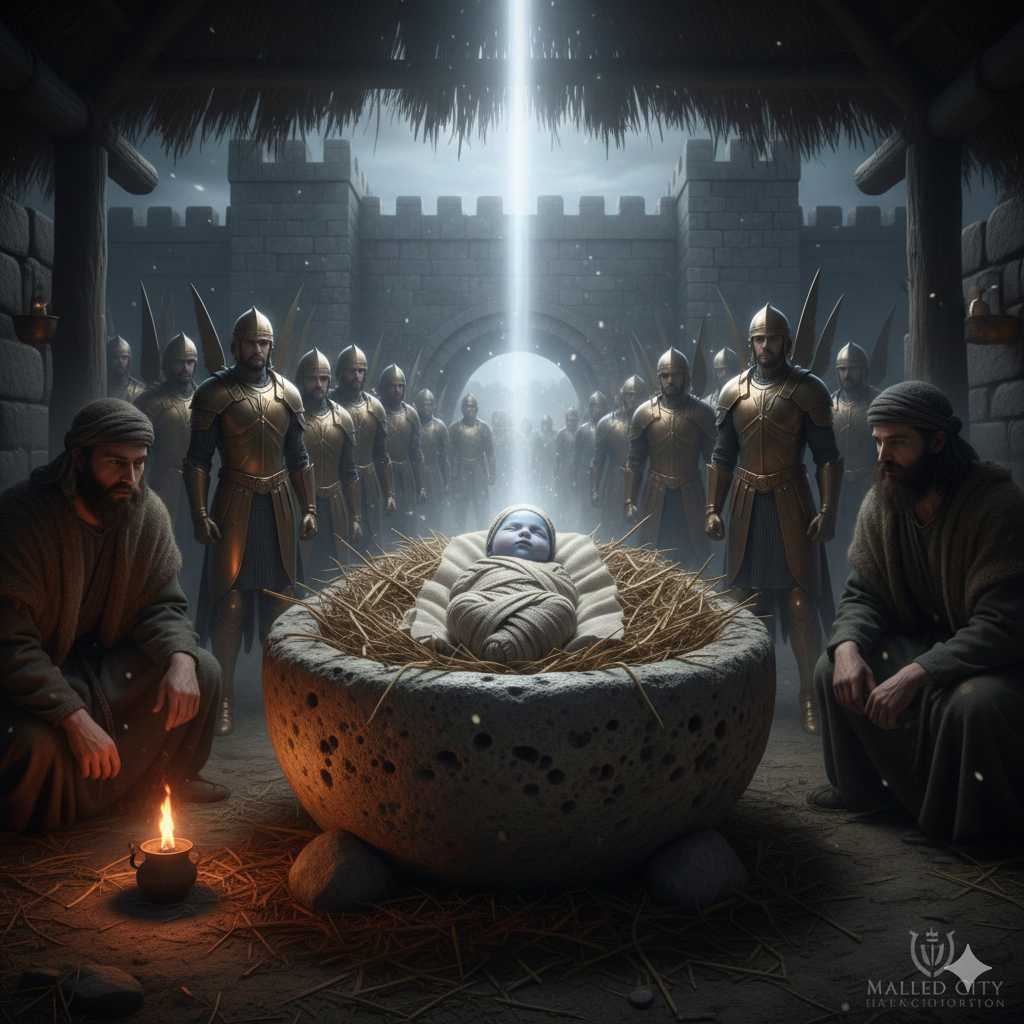
The role of the Strateia (Strat-ee-ah) — Celestial Army further clarifies the military and governmental nature of this event, contrasting sharply with the institutional depiction of a heavenly host providing a musical soundtrack. The institutional posture softens this manifestation into a performance for the senses, but the covenantal witness identifies a military body appearing in the field. This celestial army signifies a royal coronation and a transition in government. Their presence is an enforcement of the sovereign decree, announcing the arrival of the rightful Authority to the local residents who serve as the first witnesses to the shift in power. They do not merely utter praise; they proclaim the splendor and weight of the Deity in the highest places, manifesting the reputation of the Father in the visible realm. This is a diplomatic and military intervention designed to secure the land for the newly produced deliverer. Just as a general’s arrival is preceded by the presence of his guard to secure the perimeter, the production of the Inhabited One is backed by the full disciplined force of the celestial regions to ensure the restoration of wholeness is recognized as a legal fact.
Suddenly there appeared with the messenger a great number of a celestial army lauding the Deity and saying: Splendor to the Deity in the highest places, and upon the land restoration of wholeness among mankind of His favorable will. (Luke 2:13-14, Sinaiticus/Vaticanus, Covenantally Faithful, Minimal Copular, SVO Format).
The jurisdictional context of this proclamation is rooted in the Walled City, which the institutional narrative often reduces to a sleepy, agrarian village viewed through the hazy lens of a nativity story. However, the cultural etymology of the Polis (Pol-is) — City highlights a seat of jurisdiction and legal protection. The birth of the deliverer in the city of Dauid (Dah-weed) — David is a direct, legal claim to the Davidic covenant and the throne of Yisra’el (Yis-rah-el) — Israel. It establishes that the child is not a random birth but a jurisdictional fulfillment of an ancient property deed. A walled city represents the boundary where the law of the king is enforced and where the citizens find safety from the chaos of the wilderness. By producing the Inhabited One within these walls, the Father is asserting that the government of the heavens has now taken up residence within the established legal centers of the earth. This is the reclamation of a throne, not the starting of a religion. It is the assertion of ownership over the territory and the people who reside within its boundaries, shifting the focus from a sentimental location to a jurisdictional headquarters.
The signal of humility found in the Phatnē (Fat-nay) — Feeding Trough serves as the specific identifying mark that verifies the authenticity of the messenger’s word. While the institutional posture treats the feeding trough as a prop used to generate pity or emotional sweetness, the covenantal agency recognizes it as a Sēmeion (Say-mi-on) — Signal, which is a token of accessibility. The feeding trough is the place where the beasts of the field come to find their life-sustaining nourishment. By placing the deliverer in a feeding trough, the Father is bypassing the institutional gates of the Temple or the Herodian palace, making the King directly accessible to the common man and the unrefined. This is a tactical maneuver that ensures the restoration of wholeness begins at the most fundamental level of society. It is a signal that the Bread of Life is not locked behind religious bureaucracy but is available in the open stall for all who hunger for the truth of the covenant. The feeding trough is the voucher of the King’s intent, proving that His authority is founded on provision and the mending of the breach between the Creator and the creature.
And this the signal for you: you shall encounter a newborn child bound in strips and lying in a feeding trough. (Luke 2:12, Sinaiticus/Vaticanus, Covenantally Faithful, Minimal Copular, SVO Format).
The superimposition of these two postures reveals a deliberate attempt by man-made systems to obscure the relational agency of the Father. Religion seeks to turn the military force of the heavens into a passive choir because an army requires an immediate response of submission, whereas a choir only requires an audience. Religion seeks to turn the inhabited vessel into a theological object of worship because an occupied master requires active alignment, whereas an object of worship can be kept at a distance. The depth of the covenantal reality is that the Inhabited One is the prototype for the entire community. He is the first vessel to demonstrate what it means to be fully occupied by the Spirit to execute jurisdiction on the land. This is the hidden message that must be birthed and executed today: that those who are inhabited are called to function as the current envoys of the same Authority, carrying the weight of the Father’s reputation into every fragmented area of human existence.
The restoration of wholeness, which the institution calls peace, is the primary objective of this government. It is a functional state where the legal breach is repaired and the wholeness of the Father’s intent is re-established in the life of the people. This restoration is enforced by the celestial army and verified by the signal of the feeding trough. It is not a temporary ceasefire but a permanent structural repair. To live in this wholeness is to walk in the favorable will of the Deity, aligned with the jurisdictional laws of the walled city. The messenger does not bring a suggestion; he brings a declaration of fact. The army does not provide a background; it provides the security for the coronation. The entire narrative is a mobilization of celestial resources to ensure that the deliverer produced in the walled city of Dauid is recognized as the sole Authority over the land.
The analysis of agency and narrative must therefore move beyond the religious abstractions of institutional religion and into the functional reality of the covenant. We must see ourselves not as spectators of an ancient story, but as participants in a jurisdictional reality that is currently in effect. The Inhabited One remains the master of the household, and His presence within the vessel is the means by which the land is preserved from peril. The signal of the feeding trough remains our standard for accessibility, ensuring that we bring the wholeness of the Kingdom to those who are most in need of the Father’s provision. We are the envoys who carry the diplomatic dispatches of the King, backed by the same celestial army that appeared in the fields of the walled city. This is the standard of the word, validated by the ancient witnesses and executed in the time of today.
When we consider the weight of the Splendor of the Deity, we realize that it is the tangible reputation of His character made manifest through His agents. The institutional narrative has replaced this weight with the light air of sentimentality, but the covenantal voice restores the heavy importance of the Father’s presence. This presence is not a feeling but a governing force. It is the power that repairs the breach and establishes the wholeness of the covenant in the hearts and minds of the people. The production of the deliverer was the first step in this global restoration, and the inhabitation of the vessel remains the ongoing mechanism for its fulfillment. We stand as the evidence of this restoration, walking in the authority of the Inhabited One and manifesting the favorably willed wholeness of the Deity in every sphere of influence.
The final word of these findings is that the institutional narrative is a veil that must be torn away to reveal the raw power of the covenantal agency. The Word of God is not a book of religious myths but a manual for the execution of the Kingdom on earth. It is validated by the ancient scriptures, not by the corporate religious structures that have sought to domesticate its power. We return to the Sinaiticus and Vaticanus witnesses to find the unfiltered voice of the messengers and the army, and we align our lives with the jurisdictional reality they proclaim. The King is not in the feeding trough of history; He is inhabited within His people, and the government of the walled city is expanding through every vessel that recognizes His Authority. This is the executable protocol for the current hour, the fulfillment of the signal, and the final victory of the restoration of wholeness.