Physical Address
304 North Cardinal St.
Dorchester Center, MA 02124
Physical Address
304 North Cardinal St.
Dorchester Center, MA 02124
With Michael Walker
With Michael Walker
IV. Luke’s Role Compared to the Twelve and Paul.
The orchestration of the apostolic record is not a chorus of identical voices but a complex assembly of distinct roles, each functioning with a specific covenantal purpose. To understand Loukas (loo-kahs) — Luke, one must first contrast his office with that of the Twelve and the unique apostleship of Sha’ul (shah-ool) — Paul. The Twelve stand as the foundational pillars of the internal witness, the Jewish oracular transmitters who were hand-selected during the earthly ministry of the Messiah. These men, such as Shim‘on (shee-mohn) — Simon Peter and Yochanan (yoh-khah-nahn) — John, operated from the immediacy of physical proximity. They walked the dusty paths of Galil (gah-leel) — Galilee, shared meals at the table of the King, and witnessed the execution and resurrection of Yehoshua with their own eyes. Their authority is that of the primary source; they are the living vessels who received the Spirit and spoke from a place of direct inhabitation, translating their physical memory into a spiritual proclamation. They are the insiders, the kinsmen who hold the tribal memory of the covenant. Their role was to be the original witnesses to the house of Yisra’el (yees-rah-ale) — Israel, ensuring that the roots of the new movement remained firmly planted in the soil of the prophets.
Original: ο ην απ αρχης ο ακηκοαμεν ο εωρακαμεν τοις οφθαλμοις ημων ο εθεασαμεθα και αι χειρες ημων εψηλαφησαν περι του λογου της ζωης
Transliteration: ho ēn ap archēs ho akēkoamen ho eōrakamen tois ophthalmois hēmōn ho etheasametha kai hai cheires hēmōn epsēlaphēsan peri tou logou tēs zōēs
Literal Interlinear Etymological Transliteration: Which was from beginning, which we have heard, which we have seen with the eyes of us, which we looked upon and the hands of us touched concerning the word of the life. (Codex Vaticanus – 1 Yochanan 1:1)
While the Twelve provide the foundational eyewitness testimony, Sha’ul (shah-ool) — Paul occupies a second distinct category: the post-resurrection witness. Unlike the Twelve, he did not walk with Yehoshua during His earthly ministry, yet he was granted a direct encounter with the risen Christ on the road to Damaskos (dah-mahs-kohs) — Damascus. Sha’ul functions as the apostle to the nations, a confessional writer whose letters are reactive and pastoral, dealing with the theological implications of the Spirit’s inhabitation in real-time. He is the bridge between the ancient Torah and the new reality of the indwelt life, arguing for the inclusion of the Gentiles through the logic of covenantal fulfillment. His role is experiential and revelatory, speaking from a position of supernatural commission that bypasses the physical training of the original disciples. He is the voice of the Spirit explaining the work of the Messiah to an expanding world.
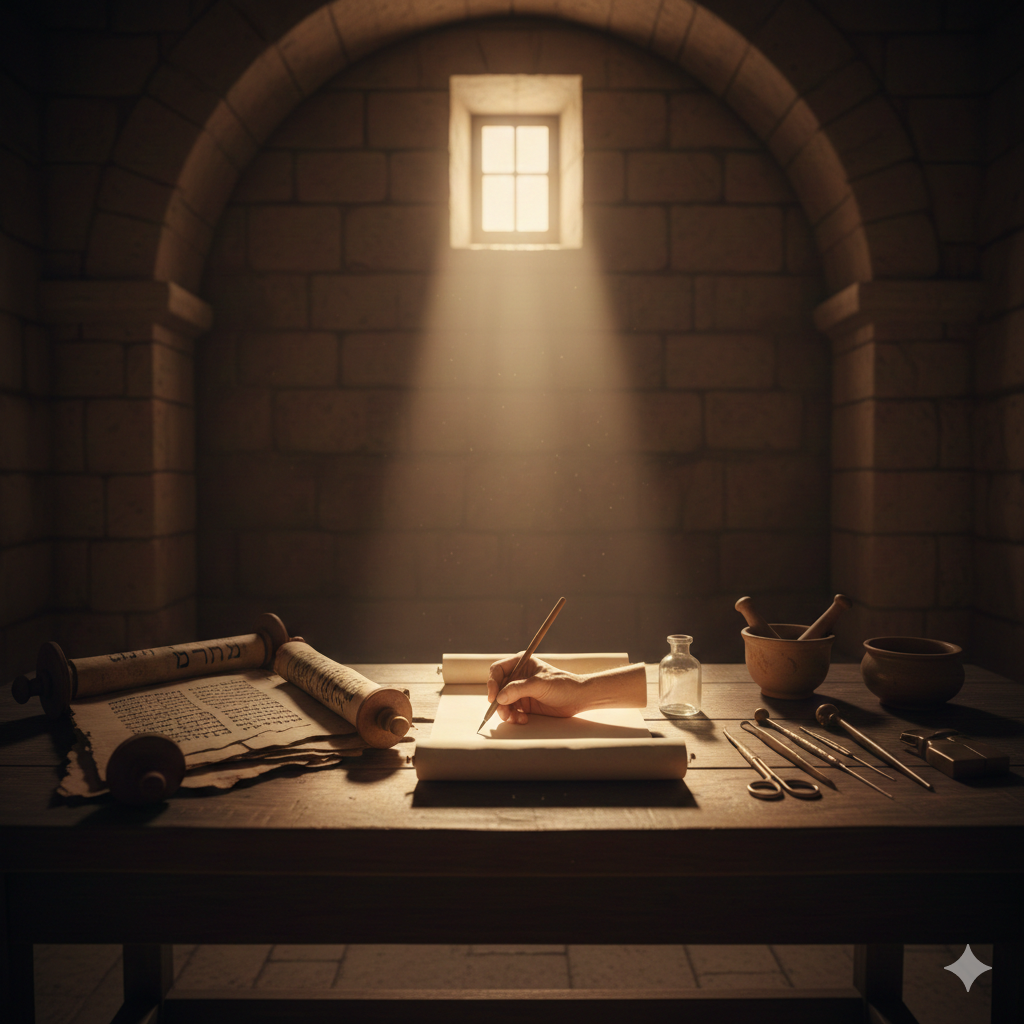
Loukas (loo-kahs) — Luke, however, occupies a third and entirely unique office that is neither primary eyewitness nor post-resurrection visionary in the traditional sense. He is not part of the Twelve, nor does he claim a Damascus-style encounter. He enters the narrative decades after the resurrection, joining the missionary efforts as an investigator and archivist. If the Twelve are the primary witnesses in a courtroom and Sha’ul is the passionate advocate arguing the significance of the evidence, Loukas is the forensic scientist who has compiled the case file. He is the only one who approaches the narrative from the outside looking in, using his scientific lens to verify what the others have experienced. He serves as the Gentile steward of Jewish revelation, taking the oracular testimony of the insiders and processing it through the rigorous standards of Greek historical inquiry. His role is not to innovate theology but to document it, ensuring that the claims of the insiders can withstand the scrutiny of the external world.
Original: επειδηπερ πολλοι επεχειρησαν αναταξασθαι διηγησιν περι των πεπληροφορημενων εν ημιν πραγματων
Transliteration: epeidēper polloi epeicheirēsan anataxasthai diēgēsin περι tōn peplērophorēmenōn en hēmin pragmatōn
Literal Interlinear Etymological Transliteration: Since indeed many took in hand to set in order a narration concerning the things having been fully carried among us matters. (Codex Vaticanus – Loukas 1:1)
The distinction between Loukas and the Twelve is essentially the difference between the eye and the lens. The Twelve saw the events, but Loukas provides the magnification that allows the nations to see the details clearly. Because he was not there when the bread was broken or the blind eyes were opened, he had to interview those who were. This required him to function as a historian, cross-referencing accounts and verifying timelines with clinical precision. This distance is his greatest strength; it removes the suspicion of tribal bias. A member of the Twelve might be accused of exaggerating the deeds of their King, but a Greek physician—a man of science—investigating the claims twenty years later and finding them to be physically and historically accurate carries a different kind of legal weight. Loukas is the objective validator who proves that the experiences of the Twelve were not hallucinations or local myths, but forensic realities.
When compared to Sha’ul, the role of Loukas is descriptive rather than prescriptive. While Sha’ul writes letters to correct behavior and define doctrine, Loukas writes a narrative to establish certainty. Sha’ul focuses on the “what now,” while Loukas focuses on the “exactly how.” It is Loukas who preserves the anatomical and physical details that the others might have taken for granted. He is the one who records the specific medical condition of a patient or the exact cultural mechanics of a Roman census. He is the archivist of the physical world as it was disrupted by the spiritual. By joining the story later, he acts as the bridge for all subsequent generations who must also believe without having seen. He models the investigative posture of the indwelt mind, showing that the Spirit does not bypass the intellect but empowers it to search out the deep things of God with accuracy.
Original: εδοξε καμοι παρηκολουθηκοτι ανωθεν πασιν ακριβως καθεξης σοι γραψαι κρατιστε θεοφιλε
Transliteration: edoxe kamoi parēkolouthēkoti anōthen pasin akribōs kathexēs soi grapsai κρατιστε theophile
Literal Interlinear Etymological Transliteration: It seemed good also to me, having followed closely from above all things with precision, in order to you to write, most powerful Theophilos. (Codex Vaticanus – Loukas 1:3)
The beauty of this tripartite structure—the Twelve, Sha’ul, and Loukas—is that it covers every angle of validation. The Twelve provide the historical root; Sha’ul provides the theological expansion; and Loukas provides the forensic documentation. Loukas is the only one whose name remains purely Greek, signaling his role as the permanent ambassador for the nations. He is the steward of a revelation that was not originally his, yet through his investigation and inhabitation, he becomes its most vital defender. He proves that the Jewish Messiah is the universal King by documenting the movement of the Spirit from the heart of Yerushalayim (yeh-roo-shah-lah-yeem) — Jerusalem to the capital of the Roman world. He is the historian of the transition, the man who recorded how the oracular inhabitant left the temple to dwell within the hearts of men of all tongues.
This comparison reveals that Loukas was not a secondary figure but a strategic instrument designed to prevent the message of Yehoshua from being lost to time or dismissed as a local superstition. By arriving decades later, he ensures that the testimony is codified while the witnesses are still alive to be cross-examined. He is the bridge from memory to history. His work stands as the definitive case file for the faith, a document that relies not on the “ecstasy” of the visionary but on the “precision” of the researcher. He is the prototype of the scholarly indwelt, the one who uses the tools of the world to prove the works of God. Through Loukas, the Spirit demonstrates that the most rigorous scientific inquiry leads not away from the Messiah, but directly to Him.
In the final assessment, the role of Loukas is that of the ultimate bridge-builder. He stands between the Jewish insiders and the Gentile outsiders, between the primary eyewitnesses and the future generations, and between the physical world of medicine and the spiritual world of the indwelt life. He does not need the title of the Twelve or the direct vision of Sha’ul to validate his work; his work is its own validation. He remains the Spirit-inhabited archivist whose forensic precision ensured that the light of the Messiah would shine clearly through the centuries, providing a foundation of certainty for all who seek the truth. He is the proof that the outsider, when guided by the Spirit, can become the most accurate narrator of the inside story.