Physical Address
304 North Cardinal St.
Dorchester Center, MA 02124
Physical Address
304 North Cardinal St.
Dorchester Center, MA 02124
With Michael Walker
With Michael Walker
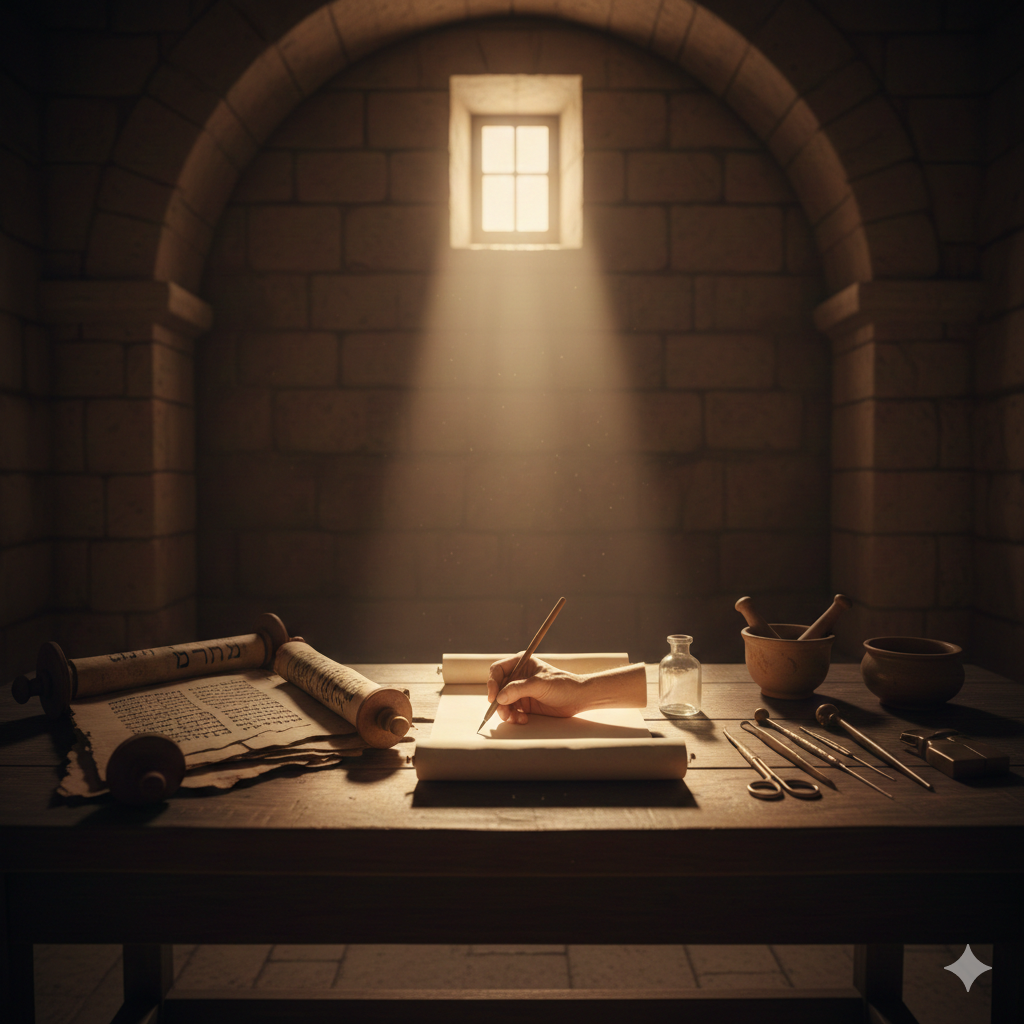
V. Why God Used Luke: The “Distance Lens.”
The divine selection of Loukas (loo-kahs) — Luke as a primary chronicler of the new covenant is a masterpiece of strategic distance and forensic validation. In the economy of the Father, the testimony of an insider is essential for foundation, but the testimony of an outsider is required for universal adjudication. By utilizing a Gentile historian to verify Jewish prophecy, the Spirit provides a legal weight that transcends tribal boundaries. This “Distance Lens” functions like a cold, clear mountain stream that filters the sediment of ancestral bias, leaving only the transparent truth of the events. When a kinsman speaks of his King, the world suspects loyalty; when a physician from the nations, trained in the Hellenic schools of reason, documents the supernatural fulfillment of ancient Hebrew oracles, the world encounters a forensic fact. Loukas provides the external corroboration necessary to silence the accusation of a purely sectarian myth. He is the independent observer whose presence ensures that the movement of Yehoshua is recognized not as a hidden cultic secret, but as a public reality that can withstand the clinical gaze of the scientific mind.
Because Loukas approaches the narrative from a distance, he possesses an outsider perspective that allows him to ask the questions an insider would never think to ask. To the Twelve, the cultural air of Yerushalayim (yeh-roo-shah-lah-yeem) — Jerusalem was so familiar it required no explanation, yet to the mind of the nations, every detail was a mystery to be solved. This investigative curiosity is precisely why Loukas preserves the most intimate and unique details found in the scriptural record. It is only through the reconstruction of Loukas that we witness the private angelic dialogues with Mariam (mah-ree-ahm) — Mary and the internal wrestling of Yosef (yo-safe) — Joseph. An insider might focus on the Messianic lineage, but the physician-historian focuses on the mechanics of the incarnation. He documents the manger not as a religious icon, but as a feeding trough, grounding the miracle in the raw physicality of a stable. He records the specific mechanics of the census under Kyrenios (koo-ray-nee-ohs) — Quirinius and the exact naming formulas of the Hebrew house. His scientific lens captures the prophecies of Shim‘on (shee-mohn) — Simeon and Anna (ahn-nah) — Anna in the temple, and the specific encounter of the shepherds in the fields. These details exist because Loukas went back to the source and interrogated the evidence, extracting the human and historical fiber that others overlooked.
Original: εδοξε καμοι παρηκολουθηκοτι ανωθεν πασιν ακριβως καθεξης σοι γραψαι κρατιστε θεοφιλε
Transliteration: edoxe kamoi parēkolouthēkoti anōthen pasin akribōs kathexēs soi grapsai kratiste theophile
Literal Interlinear Etymological Transliteration: It seemed good also to me, having followed closely from above all things with precision, in order to you to write, most powerful Theophilos. (Codex Vaticanus – Loukas 1:3)
Loukas functions as the bridge between the high, ancient walls of Jewish revelation and the vast, logical plains of the Greek world. He writes his deposition specifically to Theophilos (the-of-ee-lohs) — Theophilus, a name meaning lover of God, representing the high-ranking Gentile mind seeking certainty. The Gospel of Loukas is the intellectual pipeline through which the Spirit translates the depth of the covenant into a format that the Greco-Roman world can process. He strips away the impenetrable layers of local tradition to reveal the universal Rescuer of all nations. He does not diminish the Jewishness of the Messiah; rather, he uses his outsider status to explain that Jewishness to the world. He shows that the King of Yisra’el (yees-rah-ale) — Israel is the legal and biological fulfillment of a plan that encompasses the entire human race. In this role, he is the prototype of the post-resurrection oracle. He did not walk with Yehoshua in the physical flesh; he did not witness the resurrection with his physical eyes; yet he speaks from a place of profound inhabitation and rigorous investigation.
This positioning of Loukas mirrors the reality of the indwelt today. He represents every believer who must navigate the distance of time and culture to find the core of the truth. By demonstrating that the Spirit can lead an investigator to the same “certainty” as an eyewitness, Loukas validates the faith of all who follow. He proves that inhabitation is not restricted to those who were present at the inception but is available to all who apply their intellect and heart to the evidence of the Word. He is the living proof that the Spirit of the Living God can sharpen the mind of a scientist and the pen of a historian to produce a record that is both spiritually inhabited and forensically accurate. His distance was not an obstacle to his calling; it was the very condition that qualified his forensic touch to reach the ends of the earth.
Original: ινα επιγνως περι ων κατηχηθης λογων την ασφαλειαν
Transliteration: hina epignōs peri ōn katēchēthēs logōn tēn asphaleian
Literal Interlinear Etymological Transliteration: So that you might know concerning which things you were taught words the certainty. (Codex Vaticanus – Loukas 1:4)
The strategic use of the “Distance Lens” by Loukas highlights the divine intent for the word to be scrutinized and found true. If the account was only for the insiders, the details of the birth and the early prophecies might have remained as unrecorded family memories. But because God intended for the world to have a forensic case file, He chose the outsider to reconstruct the origins. Loukas is the bridge builder who stands in the gap of twenty years, proving that the testimony of the King is consistent across time and space. He provides the nations with a document that is not built on mystical abstractions, but on the firm foundation of investigated history. Through Loukas, the Spirit declares that the truth of Yehoshua is not a tribal secret to be guarded, but a universal fact to be proclaimed, examined, and embraced by every mind that seeks the light.
The conclusion of this perspective is the realization that Loukas was the essential instrument for the legal and historical transition of the movement. He provided the forensic seal that allowed the nations to enter the house of the covenant with confidence. His status as an outsider allowed him to preserve the very heart of the inside story, ensuring that the intimate details of the King’s arrival would never be forgotten. He remains the model of the indwelt investigator; the man whose scientific lens became the vehicle for the most profound spiritual revelation. Loukas is the proof that God uses the distance of the outsider to validate the intimacy of the insider, creating a testimony that is unbreakable, unshakeable, and eternally certain for all who read with a desire for the truth.