Physical Address
304 North Cardinal St.
Dorchester Center, MA 02124
Physical Address
304 North Cardinal St.
Dorchester Center, MA 02124
With Michael Walker
With Michael Walker
VII. Luke as Forensic Scientist.
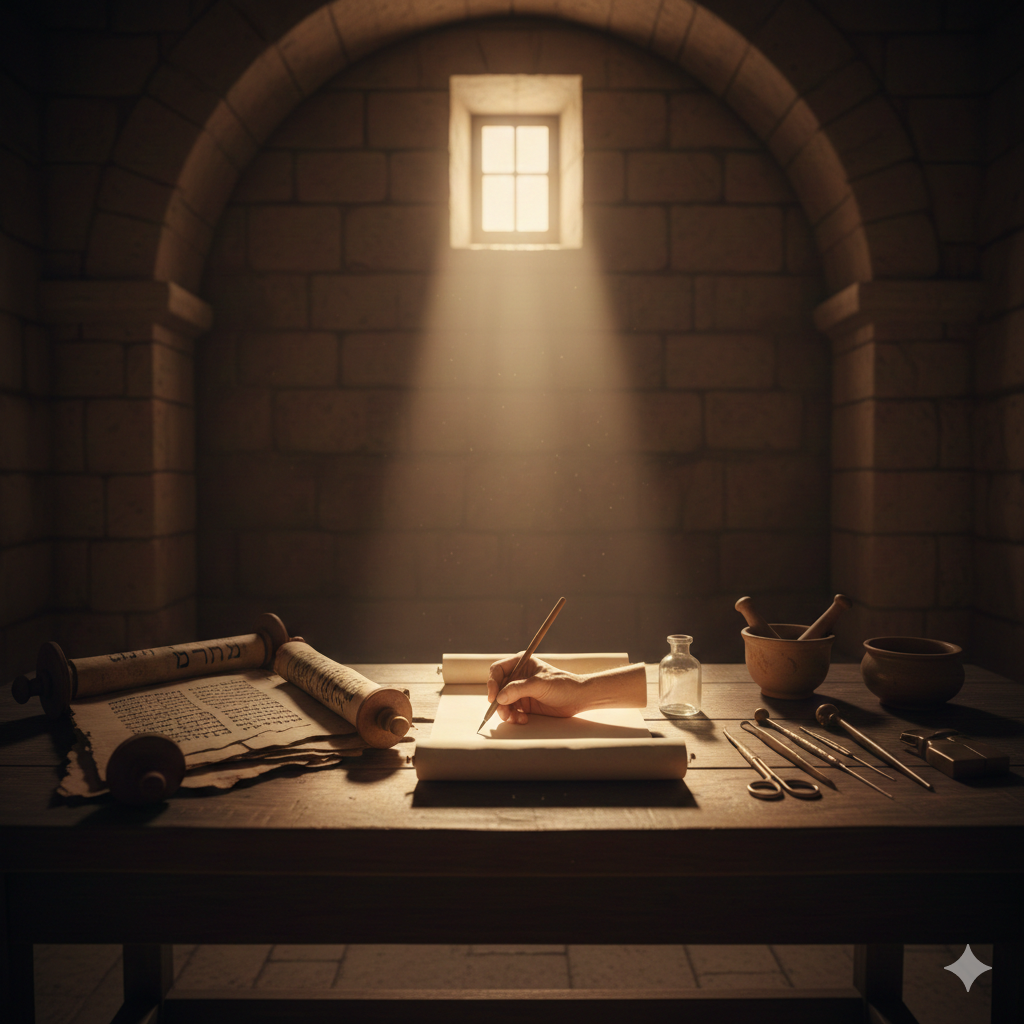
The identification of Loukas (loo-kahs) — Luke as a forensic scientist reveals the structural integrity of the second testament as a document of unshakeable legal and biological reality. While the other gospel writers provide the testimony of the heart and the memory of the tribe, Loukas provides the case file of the investigator. He operates with a methodology that mirrors the clinical precision of a medical examination. His evidence gathering was not a passive reception of oral tradition but an active, aggressive pursuit of primary source depositions. He interviewed the eyewitnesses who had remained in the regions of Yehudah (yeh-hoo-dah) — Judea and Galil (gah-leel) — Galilee, extracting the raw data of the events. He functioned as a chronological architect, reconstructing the timelines of the Messiah’s life by cross-checking accounts against the secular benchmarks of the Roman Empire. This was a process of triangulation; by comparing the diverse recollections of the original followers, he filtered out the subjective variations to reveal the hard, historical core of the occurrence. This labor was performed with a cold, investigative eye that sought to verify every claim before it was committed to the permanence of the scroll.
Original: καθως παρεδοσαν ημιν οι απ αρχης αυτοπται και υπηρεται γενομενοι του λογου
Transliteration: kathōs paredosan hēmin hoi ap archēs autoptai kai hypēretai genomenoi tou logou
Literal Interlinear Etymological Translation: According as they delivered to us the ones from the beginning eyewitnesses and under-rowers having become of the word. (Codex Vaticanus – Loukas 1:2)
The forensic detail preserved by Loukas is the signature of his professional pedigree. He records cultural, legal, and physical specifics that are unique to his account because his scientific lens demanded the preservation of the tangible. He is the one who notes the specific nature of physiological distress, the precise cultural mechanics of a Hebrew naming ceremony, and the intricate legal requirements of a Roman census. His record of the birth of the King is not a pastoral poem but a documented physical event, anchored by the mention of the feeding trough and the specific administrative order of Kyrenios (koo-ray-nee-ohs) — Quirinius. He preserves the intimate details of the prophetic utterances of Shim‘on (shee-mohn) — Simeon and Anna (ahn-nah) — Anna because he recognized them as legal fulfillments of ancient Hebrew oracles. These details are not decorative; they are the forensic markers that allow a third-party observer to verify the truth of the claim. He treats the incarnation as a biological disruption of history that must be documented with the same care as a physician recording a diagnosis.
The legal structure of his second volume, the Acts of the Apostles, functions as a master case file designed for an appellate review. The narrative is constructed around a series of legal trials and defenses, documenting the progress of the word through the hostile courts of the religious and secular authorities. Loukas provides a detailed record of the proceedings before the Roman governors Phelix (fay-liks) — Felix and Phēstos (fay-stohs) — Festus, and the royal hearing before King Agrippa (ah-greep-pah). Within this forensic narrative, Loukas inserts interpretive statements that serve as his own expert conclusions. When he records that the word of God increased or that the Lord added to the number of the gathered, he is documenting the statistical expansion of a new reality. When he notes that the Spirit prevented a specific path or that God opened the heart of Lydia (loo-dee-ah) — Lydia, he is providing a forensic analysis of the invisible mechanics of inhabitation. These are not mere theological flourishes; they are the conclusions of a researcher who has observed the consistent patterns of the Spirit’s work in the physical world.
Original: ο δε κυριος προσετιθει τους σωζομενους καθ ημεραν επι το αυτο
Transliteration: ho de kyrios prosetithei tous sōzomenous kath hēmeran epi to auto
Literal Interlinear Etymological Translation: The but Lord added the ones being delivered according to day upon the same. (Codex Vaticanus – Acts 2:47)
The forensic theology of Loukas is the ultimate manifestation of his scientific investigation. He does not simply declare the identity of Yehoshua, he builds a legal argument for that identity based on the weight of the evidence. He presents the Messiah as the Son of God and the Savior of the nations, but he does so by demonstrating how the physical life and resurrection of the King perfectly align with the ancient Hebrew templates. To Loukas, the resurrection is the ultimate forensic fact—the final proof that the biological laws of death have been overridden by a higher covenantal authority. He presents the Messiah as the fulfillment of prophecy not through mystical assertion, but through historical demonstration. His goal is to provide a testimony that is so robust and so well-documented that it can withstand the most rigorous cross-examination by the skeptics of the world.
Original: εδοξε καμοι παρηκολουθηκοτι ανωθεν πασιν ακριβως καθεξης σοι γραψαι κρατιστε θεοφιλε
Transliteration: edoxe kamoi parēkolouthēkoti anōthen pasin akribōs kathexēs soi grapsai kratiste theophile
Literal Interlinear Etymological Translation: It seemed good also to me, having followed closely from above all things with precision, in order to you to write, most powerful Theophilos. (Codex Vaticanus – Loukas 1:3)
This forensic posture is the divine mechanism for ensuring that the message of the Messiah would not be dismissed as a piece of localized, tribal folklore. By utilizing a physician with a scientific lens, the Spirit provided a record that speaks the language of fact and evidence to the entire world. Loukas acts as the bridge that allows the Greco-Roman mind to approach the Hebrew reality of the covenant. He proves that the works of Yehoshua are not only spiritually significant but historically certain. He provides a case file that remains as sharp and piercing today as it was in the first century, providing a foundation of certainty for all who seek the truth. His objectivity is his anointing, and his scientific precision is his gift to the nations.
The conclusion of this forensic investigation is the realization that Loukas was the essential instrument for the preservation and validation of the oracle. He did not walk with the King in the flesh, yet he knew Him with a forensic intimacy that surpassed those who did. He proved that the most rigorous scientific inquiry leads not to doubt, but to the unshakeable certainty of the identity of the Son of God. His work stands as a permanent witness to the reality of the incarnation, providing a document that is spiritually inhabited and historically irrefutable. Loukas remains the prototype of the indwelt researcher, the man who used the tools of the physical world to document the glory of the spiritual world, ensuring that the light of the Messiah would shine clearly through the centuries.
Original: ινα επιγνως περι ων κατηχηθης λογων την ασφαλειαν
Transliteration: hina epignōs peri ōn katēchēthēs logōn tēn asphaleian
Literal Interlinear Etymological Translation: So that you might know concerning which things you were taught words the certainty. (Codex Vaticanus – Loukas 1:4)
Through this forensic lens, Loukas demonstrates that the faith is not a blind leap but a reasoned conclusion based on the examination of historical facts. He invites the reader to step into the role of the investigator, to look at the evidence, and to find the same certainty that he found. He proves that the Word of God is not a myth to be believed, but a reality to be investigated and confirmed. His legacy is the document that bridges the gap between the ancient prophecy and the modern mind, providing a case file that is as relevant today as it was when the first ink was laid upon the papyrus. Loukas stands forever as the Spirit-inhabited forensic historian who ensured that the testimony of the King would never be lost to the mists of time.