Physical Address
304 North Cardinal St.
Dorchester Center, MA 02124
Physical Address
304 North Cardinal St.
Dorchester Center, MA 02124
With Michael Walker
With Michael Walker
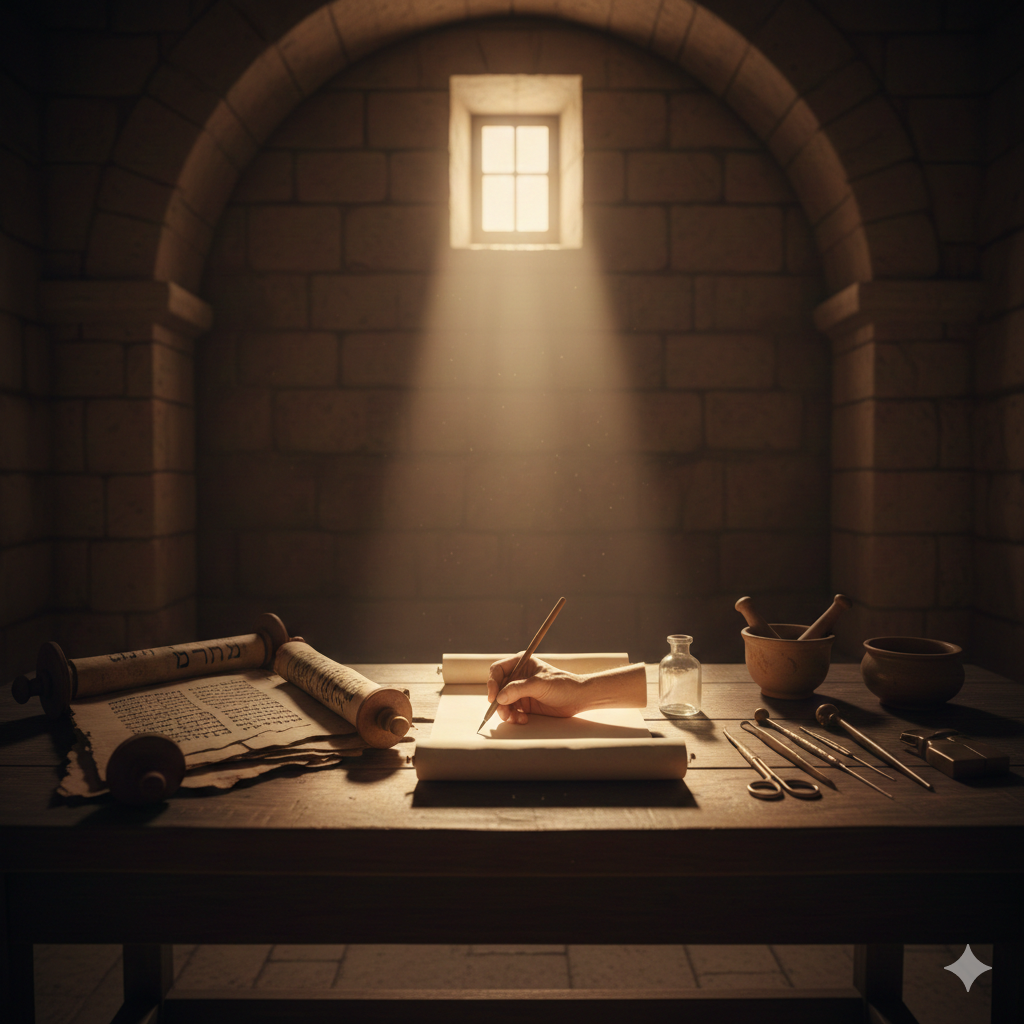
IX. Final Insight: Luke’s Forensic Objectivity Is His Inhabitation
The final summation of the forensic investigation into Loukas (loo-kahs) — Luke reveals a profound spiritual paradox: his clinical objectivity is not a lack of spirit, but the very evidence of his inhabitation. In the divine architecture of the second testament, Loukas stands as the outsider oracle, the bridge specifically engineered by the Father to span the chasm between the localized Jewish revelation and the vast, logic-driven landscape of the Gentile world. His status as an outsider is not an accidental detail of history, but a strategic credential of his office. Just as a bridge must be anchored on both sides of a river to be functional, Loukas is anchored in the precision of the Greek intellectual tradition while being firmly rooted in the oracular reality of the Hebrew covenant. He does not ask the nations to abandon their reason to find the Messiah; he demonstrates that the highest application of reason leads directly to the feet of the King. This is the essence of his role as the outsider oracle, providing a gateway for the mind of the world to enter the heart of the covenant without compromising its demand for truth and evidence.
Original: εδοξε καμοι παρηκολουθηκοτι ανωθεν πασιν ακριβως καθεξης σοι γραψαι κρατιστε θεοφιλε
Transliteration: edoxe kamoi parēkolouthēkoti anōthen pasin akribōs kathexēs soi grapsai kratiste theophile
Literal Interlinear Etymological Translation: It seemed good also to me, having followed closely from above all things with precision, in order to you to write, most powerful Theophilos. (Codex Vaticanus – Loukas 1:3)
As a forensic theologian, Loukas fundamentally shifts the landscape of belief by proving the incarnation through evidence rather than mere experiential assertion. While the Twelve speak from the internal fire of their memories, Loukas speaks from the cold, clear light of his investigation. He treats the appearance of Yehoshua in the physical world not as a mystical apparition, but as a biological and historical event that left measurable tracks in the soil of the first century. He documents the physical mechanics of the birth, the anatomical reality of the healings, and the forensic certainty of the resurrection. This methodology is his anointing. By refusing to rely on prophetic ecstasy or subjective feelings, he provides a record that is spiritually inhabited yet intellectually unassailable. He proves that the Spirit of the Living God does not bypass the human faculties of observation and analysis but sharpens them to a razor’s edge to slice through the mists of legend and reveal the core of the historical fact.
Loukas stands as the ultimate prototype of the indwelt believer for all generations who follow the initial apostolic era. He models what it means to speak from a place of inhabitation, investigation, and Spirit-guided clarity without having seen the Messiah in the physical flesh. He did not witness the resurrection, yet he speaks of it with more precision than any other writer. He did not hear the Sermon on the Mount, yet he records the ethical demands of the King with an architect’s eye for structural integrity. This mirrors the condition of the indwelt today; we are all investigators who must find the certainty of our faith through the Spirit-guided examination of the word and the world. Loukas proves that the distance of time and culture is no barrier to the intimacy of inhabitation. He shows that the Spirit can take a man of science, a man of the nations, and a man of the library, and transform him into a vessel of the most profound oracular revelation. His methodology is the map for the modern mind, demonstrating that true faith is the reasoned conclusion of a Spirit-led investigation.
Original: ινα επιγνως περι ων κατηχηθης λογων την ασφαλειαν
Transliteration: hina epignōs peri ōn katēchēthēs logōn tēn asphaleian
Literal Interlinear Etymological Translation: So that you might know concerning which things you were taught words the certainty. (Codex Vaticanus – Loukas 1:4)
The distance of Loukas is not a hurdle but a design. Throughout the history of the covenant, the Father has consistently used outsiders to validate the insiders, ensuring that the truth is never confined to a single tribe or a closed circle of participants. In the divine strategy, the testimony of the observer is often more powerful than the testimony of the participant because it carries the weight of independent verification. By choosing a Greek physician to be the steward of the most intimate details of the Messiah’s life, God ensured that the record would be universal, forensic, and unshakeable. The distance of Loukas allowed him to see the whole pattern of the covenantal work from a perspective that those in the midst of the action might have missed. He is the master weaver who stands back from the loom to ensure the symmetry of the design, while the Twelve are the threads being woven into the fabric.
Original: καθως παρεδοσαν ημιν οι απ αρχης αυτοπται και υπηρεται γενομενοι του λογου
Transliteration: kathōs paredosan hēmin hoi ap archēs autoptai kai hypēretai genomenoi tou logou
Literal Interlinear Etymological Translation: According as they delivered to us the ones from the beginning eyewitnesses and under-rowers having become of the word. (Codex Vaticanus – Loukas 1:2)
The conclusion of this deep dive into the identity and work of Loukas is the realization that his forensic objectivity is the highest form of worship. He did not worship through the songs of the temple or the sacrifices of the altar, but through the precision of his pen and the accuracy of his research. He surrendered his medical training, his linguistic skill, and his historical discipline to the Spirit of the Living God, allowing his scientific lens to become the window through which the world sees the King. He remains the most important instrument for the mind that seeks certainty in an age of confusion. He provides the case file that proves that the resurrection is not a myth, the Messiah is not a dream, and the inhabitation is not a metaphor. Through Loukas, we are reminded that the Word of God is a reality that can be tested, measured, and found to be true by any who approach it with the same rigorous heart and Spirit-led intellect.
Loukas stands forever as the Spirit-inhabited researcher whose singular name and unique methodology were the perfect tools for a universal mission. He bridges the gap between the ancient prophecy and the modern inquiry, proving that the King of Yisra’el (yees-rah-ale) — Israel is indeed the Rescuer of the world. His legacy is the unshakeable certainty of the things we have been taught, a certainty grounded in the forensic facts of history and the living reality of the Spirit’s work. He is the witness for the world, the historian of the inhabited, and the man who proved that the light of Yehoshua is a light that shines for all people, in all times, with a clarity that can never be extinguished. In the quiet precision of his orderly account, we find the loudest declaration of the glory of the Risen Lord.