Physical Address
304 North Cardinal St.
Dorchester Center, MA 02124
Physical Address
304 North Cardinal St.
Dorchester Center, MA 02124
With Michael Walker
With Michael Walker
IV: The Execution of the Inhabited Response.
The integration of the completed puzzle requires a radical realization that the tension between the ancient Hebrew witnesses and the modern institutional shroud is not a historical accident, but a deliberate component of the grand design for the indwelt. For those who exist in the era of the completed work of Yehoshua, this contrast serves as a jurisdictional filter, a diagnostic tool intended to separate the mechanical ritual of the external man from the organic indwelling of the internal man. The Contrived Institutional Narrative seeks to keep the believer in a state of perpetual preparation, always learning but never arriving at the functional execution of Kingdom power. However, the revelation of Covenant Relational Agency provides the bridge into a total-body occupation. This transition is not a shift in philosophy but a shift in governance, moving from the observation of a distant Deity to the metabolic processing of the Self-Existent within the human frame. The ancient words of the Leningrad Codex are the keys that unlock this hidden message, transforming the static records of the past into the living protocols of the current hour. To understand this integration is to see that the linguistic drift of the institutions was allowed so that the inhabited might be forced to excavate the substance for themselves, ensuring that their faith rests not in the wisdom of men but in the power of the Father.
The internalization of the knee marks the first stage of this jurisdictional execution. In the historical moment of the Tehillim (Te-hee-leem) — Psalms 103:1, the command baraki (baw-rak-kee) was understood as a physical act of prostration, a visible sign of loyalty to the King. Yet, for the agent inhabited by the Spirit of Yehoshua, the knee has been internalized. The physical hinge of the body has become the hinge of the will. To kneel is no longer a scheduled event in a religious building, but a constant, rhythmic yielding of the self-life to the Inhabitor. This is the ultimate act of Covenant Relational Agency: a permanent state of internal subservience where every decision, every reaction, and every ambition is presented as a gift upon the knee of the spirit. Just as a compass needle must remain yielded to the magnetic north to be of any use, the will of the Inhabited Agent must remain yielded to the Self-Existent. The Contrived Institutional Narrative offers a version of the knee that only bends on special occasions, but the protocol of indwelling demands a will that never stands in its own authority. This constant yielding is the mechanism through which the life of Yehoshua is channeled into the physical world, turning the believer into a conduit of celestial jurisdiction.
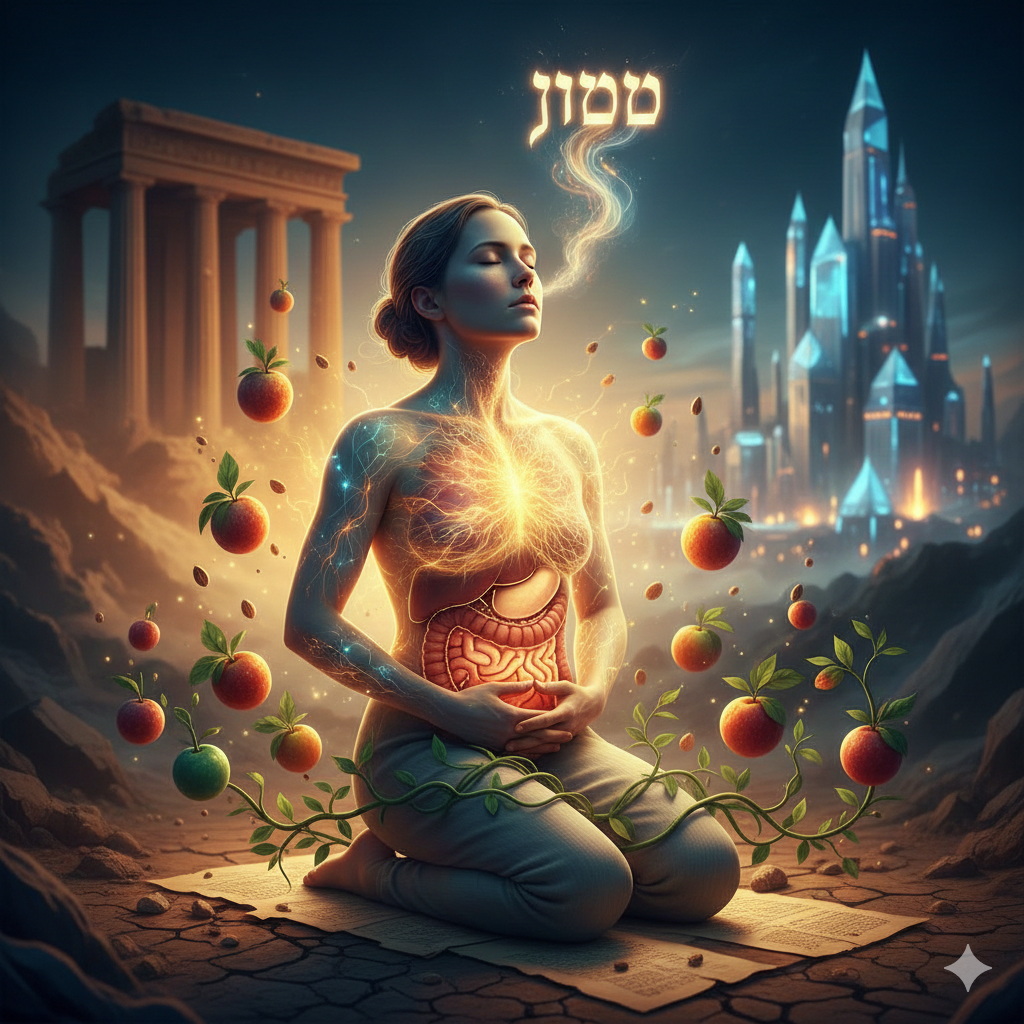
This execution penetrates deeper into the human architecture through the activation of the innards; a concept identified in the Leningrad Codex as qerabay (ve-khol-ke-raw-vahy). In the era of the Inhabited Protocol, the indwelling Spirit does not merely hover over the mind; it claims the biological and emotional gut. The gut is the site of instinct, of deep-seated intuition, and of the metabolic fire that sustains life. When the protocol is executed, the Kingdom occupies this visceral center, resulting in a total-body occupation. This is the difference between a person who has memorized a map and a person who has the terrain written into their very DNA. The Contrived Institutional Narrative attempts to manage behavior through external rules and mental discipline but Covenant Relational Agency manages life through internal occupation. The emotional gut, often the source of fear, anxiety, and reactive rebellion, is brought under the set-apart authority of the Father. It is a biological reclamation where the chemistry of the body—the pulse, the adrenaline, and the digestive fire—is harmonized with the frequency of the Spirit. The Inhabited Agent does not “try” to be peaceful; they are occupied by Wholeness. They do not “try” to be brave; they are occupied by Authority.
The hidden message reveals that the gemulaw (kol-ge-mu-lahv), the ripened dealings of the Father, serve as the primary sustenance for this occupied life. Within the Contrived Institutional Narrative, the dealings of God are treated as historical artifacts or anecdotes to be recounted for encouragement. They are a collection of memories intended to bolster a fading hope. In the reality of the Inhabited Protocol, these dealings are not history; they are seeds. They are the matured, ripened fruits of the resurrection of Yehoshua, intended for immediate consumption. To remember these dealings is to engage in a metabolic act of intake. Just as the physical body extracts nutrients from bread to fuel the muscles, the Inhabited Agent extracts power from the finished work of the Son to fuel the mission. This is the literal eating of the bread of life. For the Indwelt, the victory of Yehoshua over death is not a story from two thousand years ago; it is a ripened reality that is “eaten” to overcome the current peril. This consumption turns the believer into a physical embodiment of the Godhead, as the nature of the Father is digested and becomes the very substance of the agent’s character and action.
The tension between the ancient etymology and the institutional shroud serves as a map for the modern hour. This tension acts as a jurisdictional filter, forcing the agent to move from the audible sound of religious tradition to the active presence of covenantal power. The institutional language of the Contrived Institutional Narrative functions as a shroud—a thin, translucent veil that mimics the shape of the truth but lacks its density. It provides a form of godliness that satisfies the religious itch while leaving the biology unchanged. The covenantal etymology of the Leningrad Codex, however, provides the power. It is the solid ground beneath the fog. By navigating this tension, the Inhabited Agent learns to distinguish between the performance of a ritual and the execution of a protocol. This map leads the agent out of the maze of man-made structures and into the open field of sovereign agency. It is a transition from being a student of a book to being a vessel of the Author. The tension is the very thing that sharpens the discernment of the new man, requiring an excavation of the text that results in an occupation of the life.
This functional blueprint for the current hour demands a shift in posture from the “Church Member” to the “Kingdom Envoy.” The envoy does not speak for themselves; they carry the doxa (doxa) — weight and reputation of the one who sent them. In the time of Yehoshua, this weight is not a religious feeling, but a jurisdictional reality. When the Inhabited Agent speaks, they are not uttering religious platitudes; they are issuing decrees from the celestial court that the indwelling Spirit is currently backing. This is the fulfillment of Yehoshua. The audible sound of Yehoshua is no longer a distant name to be invoked, but a resonant frequency within the breath-soul of the believer. The envoy understands that they are the ground force of a celestial army, and their presence on the land is an act of sovereign enforcement. This is the true meaning of being “set-apart.” It is not a moral isolation, but a jurisdictional distinction. The Inhabited Agent operates under a different set of laws, fueled by a different source of power, and moving toward a different objective than the world system.
The final conclusion of this integration is the realization that we are called to become the physical embodiment of the Godhead in the earth. This is the transition from servanthood, which observes the King’s benefits from a distance, to sonship, which digests the Father’s nature as its own. The Contrived Institutional Narrative keeps the believer in the courtyard, watching the smoke of the sacrifice. Covenant Relational Agency brings the believer into the Holy of Holies, which is now located within the qerabay—the innards. The sacrifice has been completed, the fruit has ripened, and the invitation is to eat. To digest the reality of the Father’s love and the Son’s authority is to become the strength provided by that meal. The Inhabited Agent is the evidence that the Kingdom has arrived. They are the living signal that the King is accessible to the common man, bypassing the institutional gates of the temple and the palace. Their life is “trough-like,” a place where the unrefined and the hurting find the sustenance of the Father without the barriers of man-made religion.
The validation of this protocol is the restoration of wholeness, the modern eirēnē (ay-ray-nay) — peace. This peace is not a ceasefire or a temporary truce with the world; it is a legal restoration of the covenantal bond. As the Inhabited Agent executes the protocol, they become a repairer of the breach. They bring wholeness to fragmented families, corrupt systems, and tormented minds through the tangible application of the ripened power of the resurrection. This is the work of the sōtēr (so-tare) — deliverer. The indwelling is for jurisdiction, not just inspiration. It is for the repair of the land. The Word of the Almighty is thus validated by the tangible results of its execution. When the knee bends internally, and the innards process the power of the Spirit, the world sees the character of the Father manifested in human flesh. This is the hidden message for the inhabited today: you are the site of the Kingdom’s expansion. Yield to the intake of power, consume the ripened fruit, and let the Self-Existent execute His will through your vital organs.
The Inhabited Protocol is therefore a call to an uncompromising biological surrender. It is a summons to let the Name of Yahweh be written into the very marrow of the bones, until the distinction between the agent and the King is unified in the action of the Kingdom. The time of religious shadows is passing; the time of the inhabited substance has come. Every breath (napshi) is a jurisdictional claim. Every heartbeat is a rhythmic submission. Every ripened dealing (gemulaw) is a source of fuel. This is the life of the new man, the man of Yehoshua, who stands as a witness to the truth of the ancient scriptures. The Leningrad Codex provides the map, the Spirit provides the power, and the believer provides the vessel. The result is the physical manifestation of the Godhead, a reality that the Contrived Institutional Narrative can never touch. This is the master outline of our existence: to kneel, to breathe, to consume, and to execute. The ripened fruit is ready; surrender yourself to the intake of power.