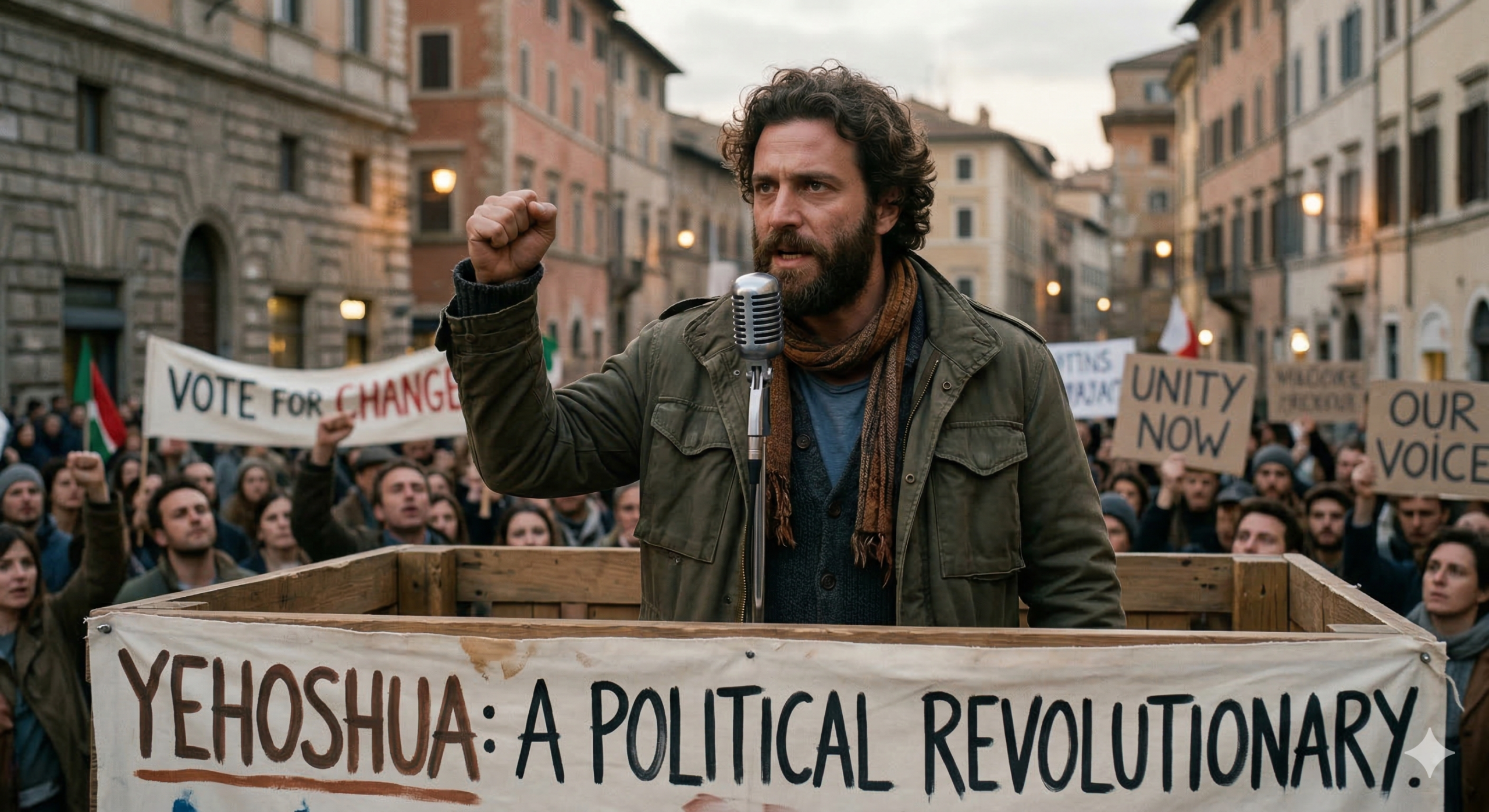
To understand Yehoshua through the lens of the Codex Sinaiticus and the Vaticanus is to strip away centuries of contrived institutional narrative that has sanitized him into a passive, ethereal figure. The ancient witnesses do not present a man who avoided the world, but a man who stepped directly into the gears of its power structures to dismantle them.
He was the ultimate Politician, the frontline Freedom Fighter, and the radical Humanitarian.
The Politician: The Architect of a Rival Sovereignty
Yehoshua did not enter the world to start a “religion”; he entered to announce a Basileia—a Kingdom. In the 1st-century Roman context, this was a declaration of a rival government. He masterfully navigated the treacherous waters of the Sanhedrin and the Roman Prefect, using legal and ethical brilliance to de-legitimize human tyranny. He was a statesman of a Higher Law, challenging the “image of Caesar” with the image of the Father.
The Freedom Fighter: The Disruptor of Systemic Oppression
As a Freedom Fighter, Yehoshua was a militant for Truth. He did not use the weapons of the world, but he utilized direct action—overturning the tables of the economic elite, violating state-mandated social taboos, and exposing the legislative hypocrisy of the ruling class. He fought for the Eleutheria (Freedom) of the individual, refusing to bow to a police state that used “national security” as a pretext for the execution of the innocent.
The Humanitarian: The Advocate for the Discarded
His humanitarianism was the heartbeat of his political platform. Iesous gave a voice to the Ani (the afflicted)—those who were literally “bowed down” by the weight of a predatory system. From providing universal care for the sick to demanding a “Jubilee” of debt forgiveness, he prioritized the human need over institutional profit. He stood as the legal advocate for the widow, the orphan, and the unlearned, proving that true power is measured by how it serves the “least” of the polis (city/state).
By examining these three facets, we see a Messiah who was fully engaged in the liberation of humanity. To follow him is to inherit this same tripartite duty: to challenge corrupt power, to fight for the oppressed, and to serve the afflicted with a willful bond that refuses to remain silent.
The Claim:
The claim that the Son of God was a “non-political” figure is a product of a contrived institutional narrative that seeks to domesticate his message. When examining the Codex Sinaiticus and Codex Vaticanus, we see a figure whose every action challenged the polis (the city-state) and the power structures of his era.
Here are 10 demonstrable examples of the political weight of Yehoshua.
- The Proclamation of a “Kingdom” (Basileia)
In the ancient codices, the term βασιλεία (Basileia) is not a “religious” concept but a strictly political one. By announcing the “Kingdom of God,” Yehoshua was declaring a rival sovereignty. In the eyes of the Roman occupation and the local tetrarchs, there was only one Basileia—Rome. To herald another was an act of sedition against the Emperor.
- The Title “Son of God” (Huios Theou)
In the 1st century, Huios Theou was a formal title for Caesar. By the time the Sinaiticus was inscribed, this linguistic battle was clear. When the followers of Yehoshua applied this title to him, they were not making a “church” statement; they were stripping Caesar of his divine mandate and placing it upon a Galilean. It was a direct, confrontational political hijacking of Imperial propaganda.
- The Triumphal Entry as a Counter-Procession
When Yehoshua entered Jerusalem (Hierosolyma), he staged a “mock” Roman triumph. While Roman generals entered on warhorses to show military might, Yehoshua entered on a beast of burden. This was a political demonstration of a different kind of power, intentionally timed when the city was a powder keg of anti-Roman sentiment, directly challenging the authority of the Roman prefect.
- The Cleansing of the Temple (The Economic Hub)
The Temple was not merely a house of prayer; it was the central bank and the seat of the local government. By overturning the tables, Iesous committed a political act of “civil disobedience.” He disrupted the flow of the Temple currency, which was the lifeblood of the collaborationist elite. This was a direct strike at the economic stability of the ruling class.
- The “Render to Caesar” Stance on Taxation
The question of the kenson (census tax) was the most volatile political issue of the day. In the Vaticanus text of Matthew, his response is a masterstroke of political subversion. By asking whose eikon (image) was on the coin, he reminded the people that if the coin bore Caesar’s image, it belonged to the world system, but since humans bear the image of God, they owe Caesar nothing of their being. It was a call for total non-cooperation with the spirit of the empire.
- The Redefinition of “Greatness” as Service
In the political structures of the 1st century, power was top-down and coercive. Yehoshua explicitly attacked this, saying, “The rulers of the nations lord it over them… but it shall not be so among you.” This was an architectural blueprint for a new social order that stood in total opposition to the Greco-Roman hierarchy.
- The Trial Before Pilate and the “Power from Above”
During his interrogation in the Sinaiticus account of John, Iesous engages in a high-stakes political debate with the Roman Governor. When he tells Pilate, “You would have no authority over me unless it had been given you from above,” he is de-legitimizing the autonomy of the Roman legal system. He positions his own “truth” as a higher jurisdiction than Roman Law.
- Fellowship with “Tax Collectors” (Political Traitors)
In that era, tax collectors (telonai) were seen as political traitors who sold out their own people to Rome. By eating with them and bringing them into his inner circle, Yehoshua was performing a radical political reconciliation that bypassed the “contrived institutional narrative” of the day. He was building a new “polis (city/state)” that ignored traditional political borders.
- The Sermon on the Mount as a New Manifesto
The “Beatitudes” are often read as “spiritual,” but they are a political manifesto for a new society. To bless the “poor,” the “meek,” and the “peacemakers” was a direct critique of the Roman “Virtues” of wealth, military conquest, and power. It was the constitution for a counter-cultural movement intended to outlast the empire.
- The Execution by “Stauros” (The Political Death)
The most “demonstrable” evidence is his death. The Romans did not crucify people for “blasphemy” against Jewish law; they crucified them for Sedition (Maiestas). The inscription above him—”King of the Jews”—was the legal charge. He was executed as a political insurgent. If he had been “non-political,” the Romans would have had no reason to spill a drop of his blood.
To understand the “freedom fighter” aspect of Yehoshua as recorded in the Codex Sinaiticus and Vaticanus, we must look at his direct confrontation with systemic oppression. He was not a pacifist in the sense of being passive; he was a militant for the Truth who fought to liberate the “oppressed” from the contrived institutional narrative.
Here are 10 demonstrable examples of how his actions as a freedom fighter mirror the injustices seen in modern global and domestic governance.
- Resistance to Judicial Corruption
In the Vaticanus account of the trials of Yehoshua, we see a “kangaroo court” where the witnesses are bought and the “due process” is a sham. Yehoshua stood as a silent witness against a corrupt judiciary that prioritized political expediency over justice—a direct mirror to modern legal systems where the wealthy and the state-aligned receive a different “justice” than the common man.
- Challenging the Monopoly on Information
The “Scribes” (Grammateis) held a monopoly on how the Torah (instruction) was interpreted and shared. Yehoshua bypassed these “gatekeepers” by speaking directly to the masses. This was a fight for the democratization of truth. Today, this mirrors the fight against state-controlled media and the “fact-checking” apparatuses that seek to silence any voice outside the approved institutional narrative.
- The Fight Against Heavy Taxation (The Burden of Debt)
In Matthew 23, Yehoshua condemns the leaders for “binding heavy burdens, hard to bear” upon the shoulders of the people. In a first-century context, this referred to the predatory tax system and the religious “fees” that kept the populace in a state of perpetual debt. This mirrors modern central banking and the “debt-slave” systems that keep citizens subservient to the state.
- Confronting the “Police State” Tactics
When the temple guard and Roman soldiers came to seize him, Yehoshua asked, “Have you come out as against a robber, with swords and clubs to take me?” He was highlighting the “militarization” of the enforcement class used to suppress a peaceful dissenting voice. This mirrors the modern use of tactical units and excessive force to quell political dissent.
- Defense of the “Deplorable” Class
The elite of his day—the Pharisees and Sadducees—looked down upon the “people of the land” (Am Ha’aretz) as unlearned and “cursed.” Yehoshua intentionally spent his time with these outsiders, validating their worth. This is a direct parallel to the modern elite’s disdain for the working class or those who refuse to conform to the “progressive” institutional dictates.
- Exposure of Legislative Hypocrisy
Yehoshua attacked the “lawmakers” who created loopholes for themselves while strictly enforcing rules on others (“You tithe mint and dill but neglect the weightier matters of the law”). This mirrors the “rules for thee but not for me” culture of modern politicians who exempt themselves from the very mandates they impose on the citizenry.
- The Liberation of the “Human Identity”
The Sinaiticus emphasizes his healing on the Sabbath, which was a political act of defiance against a law that had become a tool of social control. By saying “The Sabbath was made for man, not man for the Sabbath,” he was fighting for the sovereignty of the individual over the “state-mandated” ritual. This mirrors the current fight for bodily autonomy and the right to exist outside of government mandates.
- Targeting “Crony Capitalism” in the Temple
The Temple “market” was a state-sanctioned monopoly where only “authorized” sellers could operate. When Yehoshua drove them out, he was fighting a “crony-capitalist” system where the religious-political elite profited from the forced participation of the poor. This mirrors modern “government-corporate” partnerships that squeeze out small businesses and favor the “insiders.”
- Subverting the “National Security” Scare
The ruling Council (Sanhedrin) justified their plot against him by saying, “If we let him go on like this… the Romans will come and take away both our place and our nation.” They used “national security” as a pretext to execute a truth-teller. This is the exact same tactic used by modern governments to justify surveillance and the silencing of “whistleblowers” under the guise of protecting the state.
- The Reclamation of “True Sovereignty”
By claiming he was a King but “not of this world system,” Yehoshua was declaring that his followers owed their primary allegiance to a Higher Law. This was the ultimate “freedom fighter” stance—it rendered the state’s ultimate threat (death) powerless. This mirrors the modern “sovereign” movement of people who refuse to acknowledge the state as the highest authority over their lives.
To understand the humanitarian aspect of Yehoshua through the Codex Sinaiticus and Vaticanus, we must see that his “charity” was not a mere religious suggestion; it was a radical social restructuring. He acted as the “Advocate” (Parakletos) for those the contrived institutional narrative had rendered invisible.
Here are 10 demonstrable examples of his humanitarian advocacy for the afflicted.
- The Legal Defense of the Social Outcast
In the account of the woman caught in the act of judgment (often found in the tradition of the early codices), Yehoshua acts as a pro-bono defense attorney. By writing in the dust, he shifts the political spotlight from the “accused” to the “accusers.” He provided a legal shield for someone who had no standing in the court of public opinion.
- Universal Healthcare via Direct Action
While the Roman “Asclepeions” (healing centers) were often reserved for those who could pay or had status, Yehoshua provided a “mobile clinic” that was free and immediate. By healing the “lepers”—those legally mandated to live in isolation—he was effectively restoring their “citizenship” and their right to exist within the community.
- Feeding the “Deplorable” Multitudes
The feeding of the 5,000 was a massive humanitarian logistical feat. In the Sinaiticus, this is framed as a direct response to the “compassion” he felt for their physical hunger. He refused to send them away to buy food from a system that would exploit them, providing instead a decentralized, community-based food supply.
- Advocacy for the Widow and the Orphan
The “widow” in the 1st century was a person without any political or economic safety net. Yehoshua publicly condemned the “Scribes” who “devoured widows’ houses.” He used his platform to expose the systemic “predatory lending” and property seizure that targeted the most vulnerable women in society.
- Mental Health and De-Stigmatization
The man among the tombs (the Gerasene) was a victim of total societal failure; he was chained and discarded. Iesous did not just “heal” him; he “clothed him” and restored him to his “right mind.” This was a humanitarian restoration of dignity to those suffering from what we now call mental health crises, whom the state only knew how to “chain.”
- The Education of the “Unlearned”
The contrived institutional narrative dictated that only the elite could study the deep things of the Father. Yehoshua took fishermen and tax collectors—the “uneducated”—and gave them a masterclass in ethics, law, and sovereignty. He broke the “intellectual caste system” that keeps the populace subservient through ignorance.
- Validating the “Disposable” Child
In the Greco-Roman world, children had no rights and were often treated as property or discarded (infanticide was common). When Yehoshua said, “Let the little children come to me,” he was making a radical political statement on the “Inherent Value” of the youngest members of society, placing them at the center of his “Kingdom” model.
- Restoring the Disabled to the Workforce
By healing the “lame” and the “blind” at the gates of the Temple, Yehoshua was not just performing a “miracle”; he was removing the “disability” that forced them into a life of “professional begging.” He was advocating for their right to work and participate in the economy rather than being a “burden” to the state.
- Breaking the Ethnic/Border Barriers
His interaction with the “Samaritan Woman” at the well broke every humanitarian and political “border” of the day. He bypassed the “ethnic nationalism” that defined the region, advocating for the human need of a woman who was a “triple minority” (gender, ethnicity, and social standing).
- The “Debt Jubilee” Proclamation
In his first public address in Nazareth (Luke 4), he quotes the scroll of Isaiah regarding the “Year of the Lord’s Favor.” This was a reference to the Jubilee—a radical humanitarian law where all debts were cancelled and all slaves were freed. He made “Debt Forgiveness” the cornerstone of his political and humanitarian platform.
The Political Sovereignty of the Inhabited One:
To conclude, the witness of the Codex Sinaiticus and Vaticanus reveals that Yehoshua was never a passive observer of the human condition. His life was a calculated, high-stakes confrontation with the contrived institutional narrative of his era. He did not “stay in his lane” or “turn a blind eye” to the systemic rot of the Roman occupation or the religious-political elite; he drove a wedge through the center of their power. His stance was one of Absolute Sovereignty, demonstrating that the “Kingdom” he heralded was a rival government—one built on a willful bond (Agape) and the restoration of the afflicted (עָנִי – Ani).
The Hypocrisy of the “Cosplay Counterfeit”
If one truly professes to follow Yehoshua, then “turning a blind eye” to the injustices, the political corruption, and the humanitarian crisis of the world is not an act of “holiness”—it is an act of cowardice and desertion.
The Nature of the Counterfeit: Those who claim to be “spiritual” as an excuse to ignore the suffering of the poor or the overreach of the state do not possess the Spirit of the Inhabited One. They merely wear a costume. To have Yehoshua dwelling within is to have his heart for the oppressed and his fire against the hypocrite.
The Duty of the Inhabited: One cannot claim to be “Inhabited” while remaining indifferent to the very things Yehoshua died to challenge. Neutrality in the face of systemic injustice is, in itself, a political choice to support the oppressor.
The Verdict of the Ancient Texts: The ancient scriptures do not describe a man who fled from the world’s problems, but a man who marched directly into the capital of the world’s power to demand a new order.
To profess Yehoshua while retreating from the duty of advocacy and the fight for the Covenantal truth is the ultimate state of hypocrisy. It is to deny the very nature of the Messiah, who was executed precisely because he refused to remain “non-political.” Those who do not stand where he stood, among the broken and against the corrupt, prove they do not belong to the order he established. Nor will they see the Kingdom that is to come.