Physical Address
304 North Cardinal St.
Dorchester Center, MA 02124
Physical Address
304 North Cardinal St.
Dorchester Center, MA 02124
With Michael Walker
With Michael Walker
V. The Bigger Picture:
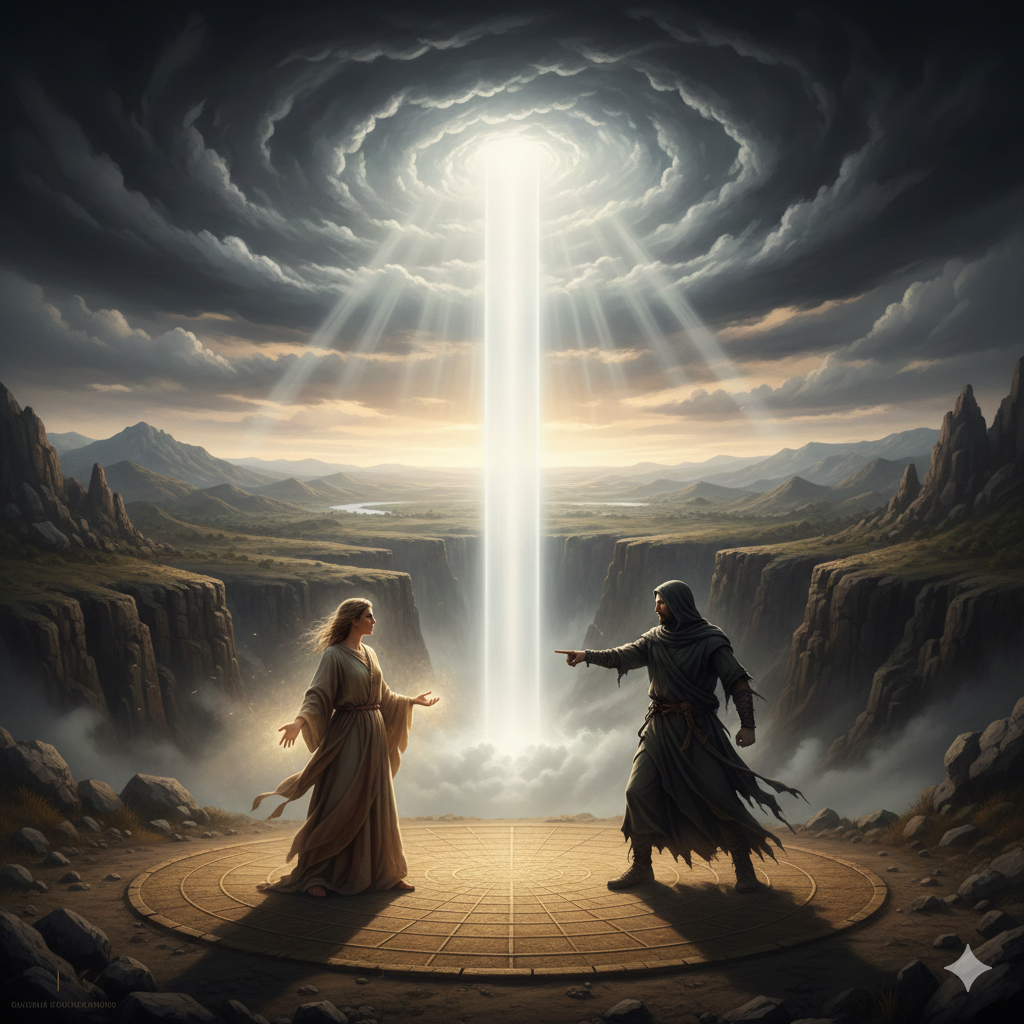
The culmination of this architectural unveiling brings the Inhabited Individual to a precipice of absolute clarity where the mechanics of social conduct meet the majesty of divine jurisdiction. To follow the path of Yehoshua is not to engage in a struggle of human endurance or emotional fabrication, but to participate in a calculated transfer of authority. The instruction μὴ ἀντιστῆναι (may an-tee-stay-nye) found within the Codex Sinaiticus is the master key to this reality. It is a directive that forbids the taking of a reciprocal stand, ensuring that the Inhabited One does not entangle themselves in a horizontal, tit-for-tat struggle that belongs to the logic of the world. When an individual adopts the stance of the adversary, they are effectively seizing ownership of the conflict, attempting to act as their own judge, jury, and executioner. But by refusing to mirror the posture of the hater, the Inhabited One maintains a vertical alignment with the Father, creating a legal and spiritual vacuum that necessitates the intervention of the Master of the Household. This is not a surrender to defeat; it is a strategic withdrawal from personal vengeance to allow the only legitimate Authority to settle the account.
The word ἀντιστῆναι (antistēnai) carries within it a deep legal and military significance that is illuminated by the lexical witnesses of Photius and the Suda. To take a stand is to set oneself in opposition, specifically in a court of law or on a field of battle, to demand personal satisfaction or retributive justice. It is the embodiment of the eye-for-an-eye reciprocity that defines human governance. If a man takes this stand, he is bound by the very law of reciprocity he has invoked. He gets only what he can take with his own hands and defend with his own strength. He has essentially told the Father that His jurisdiction is unnecessary. However, if the Inhabited Individual refrains from this stand and maintains the social warmth of agape (ah-gah-pay), they are operating under a different set of Property Rights. They are acknowledging that the conflict is not their own. This is like a tenant in a great manor who, when a stranger comes to vandalize the property, does not engage in a private brawl that would damage the house further, but instead steps aside and calls for the Owner. The tenant does not have to fear the intruder’s malice, for the Owner of the manor possesses the legal right and the overwhelming force to expel the trespasser.
The ultimate reason for this jurisdictional shift is found in the ancient proclamation that the conflict is a matter of divine ownership. In the record of the Reigns, specifically the seventeenth chapter of the first book as preserved in the Codex Vaticanus, the principle of divine property is established with staggering power. This occurs in the context of Dawid (Dah-weed) — David facing the physical embodiment of hostility. The text declares: For of-the Lord the war… (1 Reigns 17:47, Vaticanus, Covenantally Faithful, Minimal Copular, SVO Format).
Original: ὅτι τοῦ κυρίου ὁ πόλεμος
Transliteration: hoti tou Kyriou ho polemos
Literal Interlinear Etymological Transliteration: Because of-the Master the war.
The Greek grammar of this phrase is inescapable. Using the genitive case, τοῦ κυρίου (too Kee-ree-oo), the text identifies the Master as the possessor of the conflict. The word πόλεμος (po-le-mos), according to the Suda and Dionysius Thrax, refers to a sustained state of war or an unfolding struggle. It is not merely a single fight or a momentary grievance; it is the larger war of which the personal feud is but a small part. By stating that the war is of-the Master, the scripture is identifying the Father as the legitimate owner of the conflict. He is the Kyrios (Kee-ree-ohs), the possessor of authority and the legal owner of all that occurs within His creation. When an Inhabited Individual attempts to settle their own battle, they are committing a form of spiritual trespass, attempting to handle property that does not belong to them. But when they yield the stand, they are honoring the property rights of the Father.
The mechanism of this yield is what allows the Inhabited One to remain clean in the midst of filth. If you mirror the evil of the echthros (ek-thros), you are consumed by that evil, becoming a second version of the very thing you hate. You lose your identity as a Son of the household because you have adopted the language and the stance of the outsider. But when you stay in the volitional warmth of agape (ah-gah-pay), treating the adversary as a human of value while refusing to take a stand in their manner, you are protected by the Father’s jurisdiction. You have remained a Son, and therefore, the Father is obligated by His own nature to defend the integrity of His household. The Father does not step in to fight a battle you are already fighting with your own strength; He steps in when you recognize that the battle is His. This is the strategic vacuum. By removing your own ego and your own retributive stand from the equation, you leave the Father as the only actor left to conclude the matter.
This realization explains why the Inhabited Individual does not have to lie about their feelings. There is no requirement to feel a synthetic love for an enemy because the motivation is not emotional; it is jurisdictional. You provide agape (ah-gah-pay) because that is the protocol of the house you inhabit. You refrain from the stand because you respect the property rights of your Father. You do not have to like the one who hates you to recognize that they are standing on the Father’s ground and breathing the Father’s air. If they have wronged you, they have primarily wronged the Master of the House by disrupting His order. Therefore, the Master is the one who will settle the account with a precision and a justice that no human hand could ever achieve. This is a terrifying reality for the adversary, but it is a place of absolute rest for the Inhabited One. You are freed from the exhaustion of holding grudges and the labor of seeking revenge. You are free to be warm, free to be valuable, and free to let the Master work.
The analogy of a courtroom provides the final lens of clarity. Imagine a man who has been slandered and attacked. He has two choices. He can break into the attacker’s home and attempt to extract a confession through force, or he can bring the evidence to the highest Judge in the land. If he chooses the former, he becomes a criminal himself, regardless of the original grievance. He has taken the stand of a lawbreaker. But if he trusts the jurisdiction of the Judge, he remains a law-abiding citizen, and the full weight of the state’s power is mobilized to rectify the wrong. The Inhabited Individual understands that the Father is the highest Judge. By refusing to take a private stand of retaliation, the individual keeps their own record blameless and allows the divine Court to proceed. The battle is the Lord’s because He is the only one with the wisdom to judge the heart and the power to execute a perfect resolution.
As this deep dive reaches its resonant conclusion, all the threads of the previous chapters are woven into a single garment of truth. We have seen that the echthros (ek-thros) is the personal hater with whom we have a relational grievance. We have learned that agape (ah-gah-pay) is the volitional social welcome that assigns value to that hater despite our feelings. We have discerned the boundary that protects us from the poneros (po-nay-rohs), the embodiment of evil that warrants no such welcome. And finally, we have understood the “why” behind it all: the jurisdictional transfer. We take the stand of agape (ah-gah-pay) because we are Inhabited by the Spirit of the Master who owns the battle. We refuse the stand of antistēnai (an-tee-stay-nye) because we will not trespass on the Father’s authority. We are a people of order in a world of chaos, and our peace is maintained not by the absence of enemies, but by the presence of a jurisdiction that transcends them all.
The Father’s jurisdiction is the ultimate majesty. It is the sovereignty that allows the sun to rise and the rain to fall with an impartiality that mocks the petty divisions of men. When we align ourselves with this jurisdiction, we are no longer victims of our circumstances or prisoners of our emotions. We are Sons of the Household, Inhabited by the very Spirit that governs the cosmos. We walk through the fire of personal enmity without the smell of smoke upon us, because we know that our Father is the Master of the flame. We extend the warmth of the will, we refuse the mirror of malice, and we stand still to see the salvation of our God. The deep dive is complete, and the word of the ancient witnesses stands validated: the path of Yehoshua is the path of a higher sovereignty. We have moved from the lie of institutional religion into the clarity of covenantal reality. We are the Inhabited, and the battle is not ours.
The witness is established, and the word is final. We have tested these findings against the ancient scriptures and the lexical witnesses of the earliest days. The Word of God remains the standard, and it has revealed a life of profound integrity, honesty, and power. We are now ready to live this reality, moving through the world with the warmth of agape (ah-gah-pay) and the rest of those who know that their Master is on the throne. The deep dive has provided the map; the Spirit provides the power to walk it.