Physical Address
304 North Cardinal St.
Dorchester Center, MA 02124
Physical Address
304 North Cardinal St.
Dorchester Center, MA 02124
With Michael Walker
With Michael Walker
I. The Geographic and Postural Foundation.
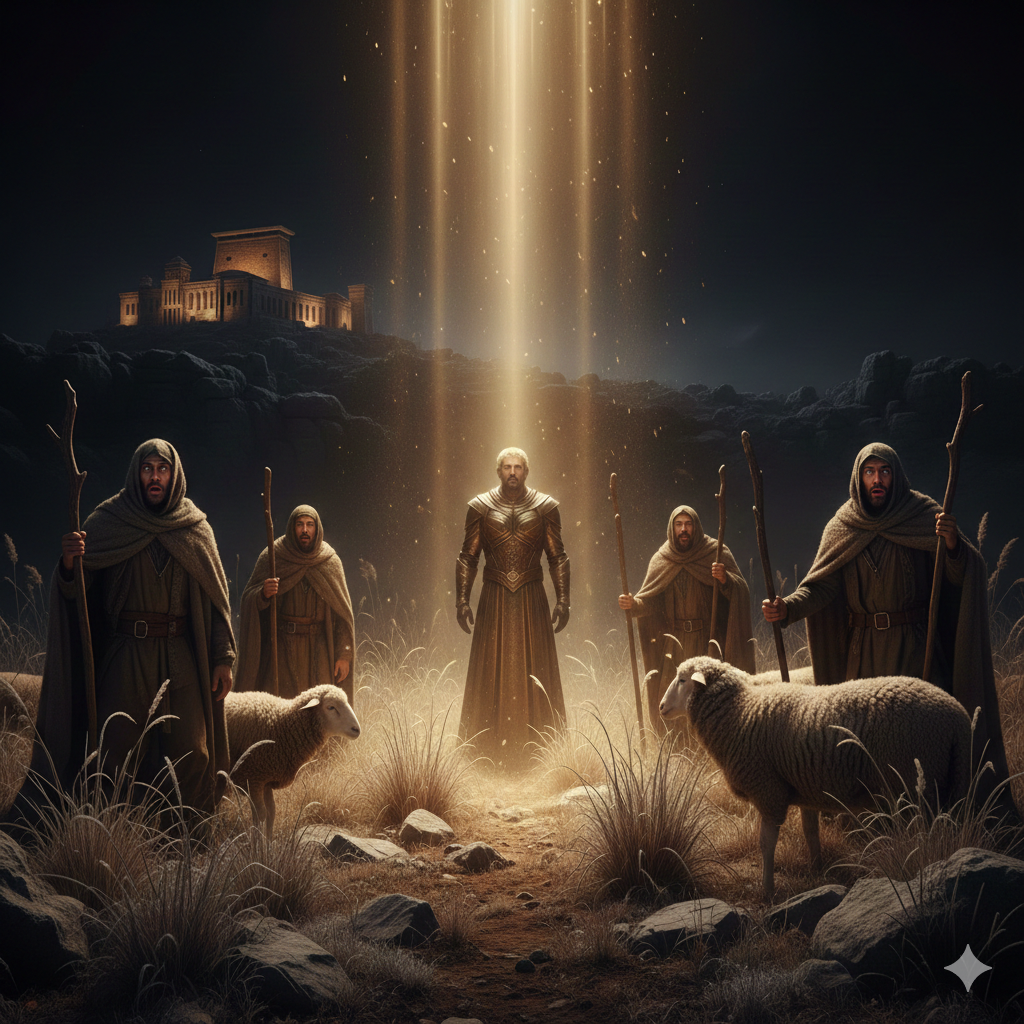
The proclamation of the covenant begins not within the insulated walls of human architecture but in the raw, exposed expanses of the creation where the jurisdiction of the Master is absolute and unmediated. The contrast between the open field and the constructed sanctuary is the primary friction point between ancient covenantal fidelity and the modern Contrived Institutional Narrative (CIN). In the region of the beginning, there were poimenes (poy-men’-es) — herdsmen — residing in the open air, a state of being that stripped away the comforts of social buffering and forced a direct interface with the elements and the entities of the unseen realm. These men did not seek a consecrated building to experience the presence of the Master; they were the functional agents of the harvest, standing in the very place of utility where life and death intersect. The open field is a landscape of high stakes where every sound in the darkness represents a potential threat to the assets of the Master, necessitating a posture of hyper-vigilance that the sanctuary of the institution has systematically dismantled. To understand the beginning of the rescue, one must first abandon the notion that the divine interacts with the religious elite in their self-appointed halls of ritual. The Master bypasses the center of the CIN (Sin) and speaks to those who are physically positioned in the gap of the watches.
The institution requires a sanctuary because it cannot survive the scrutiny of the open field. The sanctuary is a controlled environment designed to filter the weight of the presence into manageable, emotional segments that do not disrupt the status quo of the participants. In the sanctuary, the shepherd is a romanticized figure of peace, but in the Greek witness of the Sinaiticus, the poimenes (poy-men’-es) are gritty, vigilant guardians of property. The institutional narrative has moved the focus from the field of work to the hall of ritual, creating a spiritualized theater where no actual guarding is required. In this theatre, the flock is told they are safe because they are within the walls, but the walls of the institution are often the very enclosures that keep the people from the true Master, replacing the dynamic habitation of the Spirit with a static membership in a narrative. This displacement of geography is the first step in the sterilization of the covenant. When the place of encounter is moved from the functional field to the institutional cathedral, the requirement for agency is replaced by the requirement for attendance. One no longer needs to be inhabited to sit in a pew; one only needs to be compliant with the Contrived Institutional Narrative (CIN).
The vigilance of the watches, defined by the term phylakas (foo-lak-as’), is a militant and high-alert posture that stands in direct opposition to the passive observation encouraged by modern religion. A watch is not a period of time spent in reflection; it is a tactical shift of defense. The herdsmen were guarding the watches because the flock was under constant threat from predators that operate in the dark, and for the Inhabited Few, this is the permanent state of existence. The CIN (Sin) has replaced this militant guarding with a passive watching that lacks any defensive capability. In the institutional model, the people are taught to be spectators of a sermon rather than guardians of a jurisdiction. This removal of urgency leaves the people vulnerable to the predatory narratives of the age because the leaders, the so-called shepherds of the institution, are asleep within the very narrative they promote. They have traded the armor of the watchman for the robes of the orator, and in doing so, they have surrendered the safety of the flock to the thieves of the night. The Inhabited One is he who stands at the gate with eyes wide open, recognizing that the rescue is a present necessity, not a future luxury.
Original: ποιμένες
Transliteration: poimenes Phonetic: poy-men’-es
Literal Meaning: Herdsmen, functional agents of livestock management, those responsible for the protection and feeding of communal assets.
Grammatical Role: noun, nominative, masculine, plural, root: ποιμήν, subject of the clause. (Codex Sinaiticus – Luke – 2 – 8)
Original: ἀγραυλοῦντες
Transliteration: agraulountes Phonetic: ag-raw-loon’-tes
Literal Meaning: residing in the open fields, dwelling in the air without the cover of a roof, existing in a state of environmental exposure and direct utility.
Grammatical Role: participle, present, active, nominative, masculine, plural, root: ἀγραυλέω. (Codex Sinaiticus – Luke – 2 – 8)
Original: φυλάσσοντες
Transliteration: phylassontes Phonetic: foo-las’-son-tes
Literal Meaning: guarding with militant vigilance, standing as a sentry to prevent loss or injury, exerting active protection.
Grammatical Role: participle, present, active, nominative, masculine, plural, root: φυλάσσω. (Codex Sinaiticus – Luke – 2 – 8)
The analogy of the fortress and the scout offers a lens through which to view this geographic shift. The institutional religionist is like a man who sits in a deep fortress and reads reports about the wind, convinced he understands the storm because he has seen it described on paper. The Inhabited Few are the scouts standing on the ridge in the middle of the gale, feeling the cold and the pressure against their skin. The man in the fortress has a narrative of the storm; the man on the ridge has an experience of the storm. The fortress provides safety from the wind, but it also provides an excuse to ignore the wind’s power. The open field is the ridge where the Master speaks, because only those on the ridge are in a position to act upon the information. The institution’s sanctuary is the fortress of CIN (Sin), a place where the message of victory is turned into a story for the comfortable, rather than a command for the vigilant. The tragedy of the modern era is that the masses have been convinced that the fortress is the only place the Master resides, when in fact, the Master is in the field, seeking those who are not afraid of the exposure.
Original: φυλακὰς
Transliteration: phylakas Phonetic: foo-lak-as’
Literal Meaning: watches, military-style shifts of sentry duty, specific periods of high-alert guarding.
Grammatical Role: noun, accusative, feminine, plural, root: φυλακή, direct object of the guarding action. (Codex Sinaiticus – Luke – 2 – 8)
Original: νυκτὸς
Transliteration: nyktos Phonetic: nook-tos’
Literal Meaning: of the night, the period of darkness where visibility is low and the predator is active.
Grammatical Role: noun, genitive, feminine, singular, root: νύξ. (Codex Sinaiticus – Luke – 2 – 8)
Original: ποίμνην
Transliteration: poimnēn Phonetic: poym’-nay
Literal Meaning: flock, the group of livestock representing the wealth and provision of the Master.
Grammatical Role: noun, accusative, feminine, singular, root: ποίμνη. (Codex Sinaiticus – Luke – 2 – 8)
When the text speaks of the herdsmen being in the same region, it utilizes the word chōra (kho’-rah), which refers to a specific territory or jurisdiction. This is not merely a GPS coordinate; it is a legal standing. They were in the territory of the Master’s business. In contrast, CIN (Sin) operates in a region of its own making, a psychological territory where the rules of the covenant are superseded by the bylaws of the organization. In the Master’s region, the presence of the messenger is a disruptor of the status quo, but in the institutional region, the messenger must be invited and vetted by the committee. The herdsmen did not invite the heavy-radiance; it stood before them because they were in the correct legal jurisdiction. The religious elite in Yerushalayim (Yeh-roo-sha-lah’-yeem) — Jerusalem, were in the temple, but they were in the wrong jurisdiction to hear the victory message. They were in the jurisdiction of their own Contrived Institutional Narrative (CIN), and thus they were deaf to the herald of the Master. This geographic displacement ensures that the uninhabited remain powerless, as they are looking for the Rescuer in the one place He has no intention of visiting first.
The posture of the herdsmen is the posture of the inhabited remnant. To be inhabited is to be a vessel that is constantly on the watch, recognizing that the Spirit does not occupy a body for the sake of that body’s comfort, but for the sake of the Master’s assets. The institutional shepherd views the flock as a source of income or social validation, a perspective that is fundamentally uninhabited. The covenantal herdsman views the flock as a sacred trust that must be guarded with his life. The difference is found in the weight of the responsibility. The institution has lightened the load, turning the “burden” into a “blessing” that requires no sacrifice of the self. But the true weight, the doxa (dox’-ah) or heavy-radiance, only descends upon those who are willing to carry the weight of the watch. To the religious, the doxa is terrifying because it is a weight they have not trained to carry. To the inhabited, it is the very presence of the Master that provides the strength to endure the night. The introduction to this deep dive serves as a clarion call to move out of the sanctuary and back into the field, to trade the passive watch for the militant guard, and to recognize that the rescue has already begun for those who are standing in the right region.
In the final assessment of this foundational section, we see that CIN (Sin) has successfully manufactured a version of the birth of the Rescuer that requires no change in posture from its adherents. It presents a “Savior” who loves the sanctuary and blesses the passive. But the Sinaiticus witness reveals a Master who bypasses the institution to find the herdsmen in the dirt. The hidden message for today is that if you are waiting for a move of the Master within the walls of a contrived institutional narrative (Christianity), you are waiting in the wrong region. The Master is in the field (The Way of the Covenant), in the watches of the night, among the few who have been emptied of the narrative and are ready to be inhabited by the reality of the Rescuer. The rescue is not a religious event; it is a jurisdictional takeover, and it starts with those who are guarding the assets of the Master in the open air of truth.