Physical Address
304 North Cardinal St.
Dorchester Center, MA 02124
Physical Address
304 North Cardinal St.
Dorchester Center, MA 02124
With Michael Walker
With Michael Walker
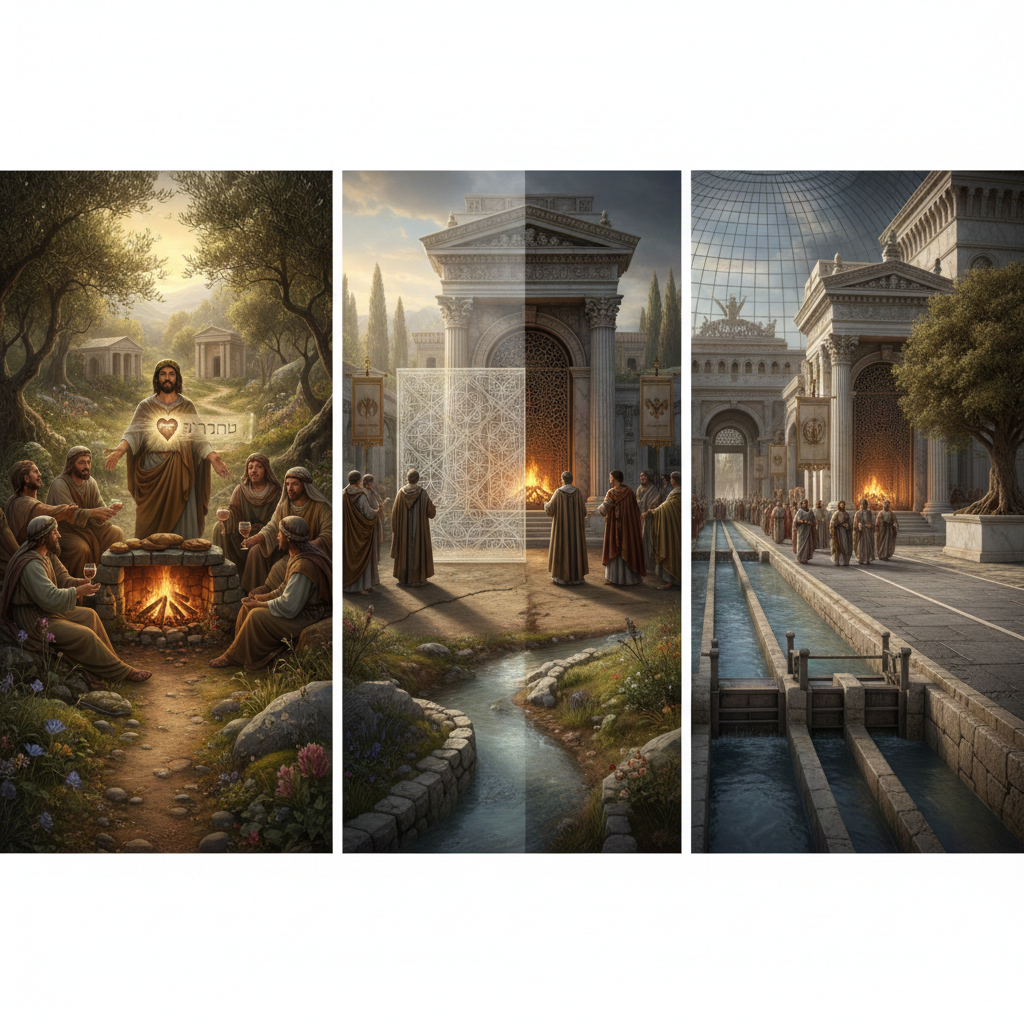
The beginning is a narrow path, not a monument. The earliest movement known as The Way emerged as a living covenant within Yehudah’s (Judah’s) life and worship, marked by Torah (instruction) fidelity, synagogue rhythm, and the unbroken inheritance of Israel’s promises. The walk was relation, not institution; fulfillment, not replacement; heart-inscription, not hierarchical mediation. Yerushalayim (Jerusalem) was not a capital for a new religion but the beating center of covenantal continuity, where the fulfillment of Torah recalibrated instruction from an external guardian to an internal witness. The earliest witnesses were not naming a denomination. They were Jews, living in the synagogue, sharing table, prayers, and bread, and they understood their Messiah not as a break from Judaism but as its promised consummation. The language of Christian was not theirs; it was the nickname (of ridicule) of outsiders who saw a people distinct in practice and hope yet still rooted in Israel. The Way was a river cutting through stone, not a dam built to manage it.
Scripture confirms the covenantal intimacy of this path. Yeremiyahu (Ye-re-mee-yah-hoo) — Jeremiah — announced a new covenant written on hearts, not stone. Original: בְּרִית חֲדָשָׁה Transliteration: berit chadashah. Literal Meaning: “covenant new.” Literal Interlinear Translation: “I will put my Torah (instruction) inside them and on their heart, I will write it, and I will be their God, and they will be my people.” The Literal Translation emphasizes Torah as covenantal agent inscribed internally, not mediated by clerical tiers.
The designation Christian appears only three times in roughly thirty-one thousand verses, and Christianity appears none. In Antioch, outsiders named the disciples Christian (in mockery and ridicule). Original: Χριστιανούς Transliteration: Christianous Literal Meaning: “Christ adherents” (supporters, followers, devotees) derived from Χριστός; label given by others. The triadic comparison underscores its outsider nature. Literal Interlinear Translation: “The disciples were first called Christian in Antiocheia.” BDAG Parsing: to be called Christian, said by others as designation, not self-naming. NASB: “and the disciples were first called Christians in Antioch.” The text functions as a sociological note, not a covenantal naming rite by Ab or Ruach or the Messiah. In Agrippas exchange with Sha’ul (Shah-ool) — Paul, the label appears as political rhetoric. Original: Χριστιανόν γενέσθαι Transliteration: Christianon genesthai Literal Meaning: “to become a Christian” rhetorical persuasion question. Literal Interlinear Translation: “do you persuade me in short to become a Christian?”And in Kephas (Kay-fahs) — Peter — the term occurs in suffering as a public accusation. Original: Χριστιανὸς Transliteration: Christianos Literal Meaning: “a Christian adherent” external charge. Literal Interlinear Translation: “if as a Christian he suffers, let him not be ashamed.” None of these are covenantal titles bestowed by the Father, the Son, or the Spirit breath; they are human labels, incidental, sparse, and externally applied.
In the early second century, Ignatios (Eeg-naht-ee-os) — Ignatius of Antioch — wrote letters en route to martyrdom, and those letters seeded a lexical and institutional pivot. His insistence that believers obey the episkopos — bishop — as if obeying the Lord institutionalized mediation that the new covenant inscribed away. Original: ἐπίσκοπος Transliteration: episkopos Literal Meaning: “overseer” from ἐπί and σκοπέω; designated office. His claim that wherever the bishop appears there the ekklesia catholic is reflected tied universal identity to clerical presence. Original: καθολική Transliteration: katholike Literal Meaning: “according to the whole, universal” Applied substantively to church. Literal interlinear reading captures the force. “Wherever “Iesous” (the picture for Yehoshua) the Messiah is, there is the church according to the whole.” BDAG Parsing reads katholikos as qualitative universality but functionally institutional when made contingent on bishop’s presence. NASB translations render these lines in accessible English, but the covenantal question remains: does heart inscription require an overseer as mediator. Ignatios’s framework answered yes in practice, elevating bishops as gatekeepers and thereby displacing the direct agency of the new covenant inviting religion back into the framework.
Analogies help clarify the shift. The covenant was a fire placed inside the hearth of the heart; Ignatios placed a screen in front of it and declared that the warmth comes only through the screen. The screen does not create the fire, but it controls the experience of it. His lexical adoption of Christianity distinguished the path from Judaism — not by fulfillment alone but by category, thereby beginning a re-description of the movement as distinct religion. The triadic comparison again exposes posture. Literal Interlinear: not Ioudaismos (Judaism) but Christianismos (Christianity). BDAG Parsing: theology by antithesis, establishing institutional separations. NASB renderings do not include these abstract nouns in the canon, but their conceptual presence in early writings shows the line being drawn.
Konstantinos (Kon-stan-tee-nos) — Constantine the Great — shifted the terrain from vocabulary to imperial law. The Edict of Milan legalized Christianity, and the Council of Nikaia (Nee-kah-yah) — Nicaea — unified doctrine under imperial oversight. His stated desire to have nothing to do with the Hebrews as a detestable people marked an explicit separation from Hebraic theological origin. The council’s decisions did not merely refine creedal language; they re-situated the movement’s center of gravity from Israel’s covenant into a Roman frame. The analogical picture is a tree uprooted from its native soil and replanted in marble. The leaves can remain green for a season, but the nutrients are foreign. The reframing of katholikos from theological universality into imperial universality codified in administration, titles, and calendars. Elements from other traditions were assimilated to make the institution familiar to the empire: festivals mapped onto Roman dates, philosophical terms like logos, ousia, and hypostasis anchored theological debates in Greek categories rather than Hebraic covenantal narrative. Original: λόγος Transliteration: logos Literal Meaning: “word, account, reason” Semantic range includes divine expression and philosophical principle. Original: οὐσία Transliteration: ousia Literal Meaning: “essence” Metaphysical substance. Original: ὑπόστασις Transliteration: hypostasis Literal Meaning: “underlying reality, personhood” Ontological term used in Trinitarian definitions.
Theodogios (Thay-oh-doe-see-ohs) — Theodosius I — finished the legal and institutional turn by enforcement and exclusivity. The Edict of Thessalonike (Thes-sah-lo-nee-kay) — Thessalonica — declared Nicene Christianity the official religion of the empire and turned preference into mandate. Pagan rites were suppressed, alternative interpretations outlawed, and orthodoxy was enforced by the state. The analogical force is that of a river dammed and redirected into canals controlled by civic engineers. Water still flows, but its course and pressure are designed, licensed, and policed. The movement from legal favor to legal exclusivity ensured that the bishop centered, catholic framed religion did not merely exist within Rome; it defined Rome’s religious identity and punished rivals.
The snowball effect becomes visible as layers accumulate. Ignatios installed clerical mediation and universal labeling. Konstantinos legalized and assimilated, explicitly pivoting away from Hebraic origin and translating universality into imperial scope. Theodogios enforced and excluded, locking the frame in law. The cumulative mass transformed “The Way” from covenantal relation into institutional religion. What began as a heart written Torah became a codified creed. What lived as synagogue rhythm became council protocol. What spoke in the language of promise became enforced orthodoxy. The analogical image is a seed designed for a living garden placed under glass and curated; growth continues, but the ecosystem is museum rather than orchard.
This accumulation created the roots of what is known as Christianity today. The modern religious form presents another gospel by posture shift: from covenantal relation to institutional religion. Sha’ul warned of another gospel in his letters, directed to those who were inhabited by the Ruach — Spirit — and newly created in the Messiah. Original: εὐαγγέλιον ἕτερον Transliteration: euangelion heteron Literal Meaning: “gospel another” Different kind, another of a different sort. Literal Interlinear Translation: “but if even we or a messenger from heaven announce a gospel other than what was announced, let him be accursed.” The posture shift is detectable through the codices and their historical trajectories: Leningrad, Aleppo, Sinaiticus, Vaticanus form streams of textual witness, yet English Bible form as fixed biblical canon arrived in sixteen eleven as the King James Bible, long after imperial institutions had defined creedal and ecclesial norms. The interval of centuries cultivated traditions of translation shaped by institutional priorities, producing a Bible that stands as both witness and artifact of the religious construct. The deep dive holds the triadic frame to show how literal covenantal texture can be flattened into institutional parsing and then rendered in NASB English smoothness that reads well but carries ecclesial assumptions.
Returning to the earliest witness, The Way was covenant fulfilled. Original: הַדֶּרֶךְ Transliteration: ha-derekh Literal Meaning: “the way path” figurative for manner of life. Literal Interlinear Translation: “I am “The Way” and the truth and the life; no one comes to the Father except through me.” Original: ἡ ὁδός Transliteration: he hodos Literal Meaning: “the way” path, road, manner. The covenantal reading sees a path that is relational and direct, inscribed by Torah in the heart and opened by the Messiah’s covenant mediation. The institutional reading installs mediators and councils, defines credentials, and moves life into authorized channels. The NASB expresses the verse faithfully but subsists within a religious landscape whose scaffolding was erected by letters, councils, and edicts long after the words were spoken.
The conclusion is a reckoning. A movement born as covenantal relation, engraved within, known as “The Way,” was lexically redirected by Ignatios toward Christianismos and katholike, structurally mediated by episkopos, legalized and assimilated by Konstantinos with a decisive separation from Hebraic origin, and enforced to exclusivity by Theodogios. The snowball gathered hierarchy, assimilation, and law until the mountain it descended replaced the valley it once watered. The Christianity known today stands upon these roots, inheriting man-made constructs that layered religion over relation and presented another gospel in posture rather than in text alone. The Scripture’s covenantal witness can be heard in the triadic frame when the literal interlinear is honored, when BDAG parsing is recognized as institutional lens rather than first principle, and when the NASB (any English Bible) is read with the awareness that its English smoothness carries centuries of ecclesial shaping. The path forward is not nostalgia but restoration: to acknowledge the fracture, to honor the covenant written on hearts, and to walk The Way with names, texts, and promises restored to their native context. The fire does not need a screen to burn bright. It needs a hearth, a people, and the faithfulness of the One who inscribes.