Physical Address
304 North Cardinal St.
Dorchester Center, MA 02124
Physical Address
304 North Cardinal St.
Dorchester Center, MA 02124
With Michael Walker
With Michael Walker
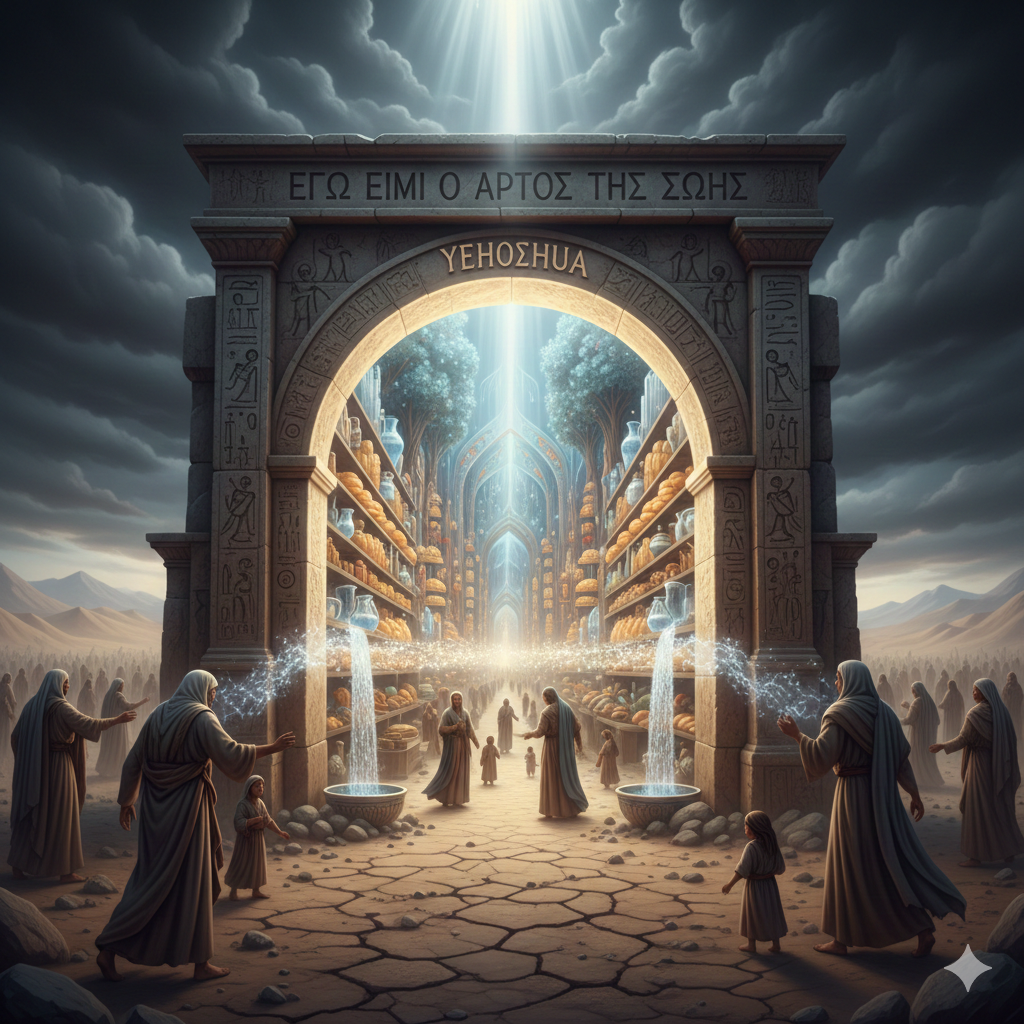
From the beginning of time, the voice of covenant has thundered across generations, declaring that life and provision are not found in the shifting sands of human invention but in the storehouse of the Eternal. The words preserved in the sacred codices are not fragments of history but living architecture, pillars of truth that refuse to collapse under the weight of scarcity. They speak of bread that is not consumed by fire, of water that does not evaporate in drought, of abundance that does not wither under pressure. They proclaim that hunger and thirst, the deepest deficits of human existence, are negated when one dwells within the covenantal place of supply. To be inside the storehouse is to be inside the covenant, where abundance resides and lack cannot exist. The doorway is not plural, nor negotiable, nor subject to human revision. It is covenantal relational agency, spoken by the Father Himself, sealed in the name of Yehoshua, the only name by which entry is granted. This is not metaphor, nor ritual, nor performance. This is the architecture of provision, the cadence of abundance, the living declaration that scarcity collapses at the threshold of covenant inhabitation. Here begins the deep dive into the verse that declares bread-of-life, the one who negates hunger, the one who quenches thirst forever, and the covenantal reality that abundance is the inheritance of those who enter through the appointed doorway.
The proclamation begins with the recognition that the words preserved in the codices are not fragments of history but living architecture. They are not ornamental but structural, not decorative but foundational. The verse in question, drawn from the Codex Sinaiticus and Codex Vaticanus, speaks with covenantal clarity:
Original: Ἐγώ εἰμι ὁ ἄρτος τῆς ζωῆς· ὁ ἐρχόμενος πρὸς ἐμὲ οὐ μὴ πεινάσῃ, καὶ ὁ πιστεύων εἰς ἐμὲ οὐ μὴ διψήσει πώποτε.
Transliteration: Egō eimi ho artos tēs zōēs· ho erchomenos pros eme ou mē peinasē, kai ho pisteuōn eis eme ou mē dipsēsei pōpote.
Literal Interlinear Etymological Translation (Minimal Copular, SVO): “I bread-of life. The one coming toward me not hunger. The one trusting into me not thirst ever.” Source: Codex Sinaiticus, John 6:35.
The declaration begins with the naming of bread-of-life, not as a consumable but as the embodiment of provision. Bread is not flour and water here; it is the architecture of supply, the cadence of sustenance, the rhythm of covenantal abundance. Hunger and thirst are named not as bodily sensations but as existential deficits, the fractures of identity, the absence of source, the silence of guidance, the collapse of belonging. To say “not hunger” and “not thirst ever” is to proclaim that within covenant inhabitation, scarcity is structurally incompatible.
The verbs are operational. Coming toward is not a momentary gesture but a continual orientation, a posture of movement that signals fidelity. Trusting into is not intellectual assent but entrustment, the yielding of agency into covenantal alignment. These verbs are the doorway actions, the evidence of inhabitation, the markers of true passage into the storehouse.
The covenantal significance is profound. Hunger and thirst represent the absence of source, word, belonging, and provision. Bread-of-life is the living supply that restores agency and stabilizes identity. True provision reduces existential deficit and increases coherence under pressure. Counterfeit provision, by contrast, produces agitation, dependency, and identity drift. Authentic provision resolves covenant instability and existential famine.
To be inside the storehouse is to be inside the covenantal place of supply. Dwelling in covenant eliminates lack because source, word, and belonging are present. Lack exists outside; sufficiency exists inside. The covenant has boundaries, edges defined by terms and loyalties. Inhabitation requires positional accountability. Provision flows by nearness to source, not possession. Alignment with covenant terms is required; extraction without fidelity is trespass. Dwelling is ongoing; momentary visits do not stabilize identity or provision.
The practical functions of no lack are evident. Identity coherence stabilizes agency and reduces fragmentation. Word supply arrives on time, reducing frenzy. Relational integrity strengthens trust stance, preventing transactions from substituting for belonging. Resilience ensures provision scales with demand and withstands pressure without collapse.
Risk diagnostics expose breaches. Presumption seeks entitlement without alignment. Substitution consumes ritual or prestige instead of source. Drift moves one outside the boundary, reintroducing scarcity. Counterfeit provision offers relief that increases dependency, secrecy, or identity costs. Audit markers of true inhabitation include active approach verbs, measurable deficit reduction, proportional provision cadence, and explicit covenantal clarity.
Human beings hunger and thirst for more than food and drink. They hunger for belonging, identity coherence, meaning, covenantal fidelity, presence, truth, justice, honor, agency, assurance, guidance, peace, believability, witness, rest, intimacy, provision cadence, skillfulness, recognition of contribution, security, beauty, freedom from shame, love, to love, to be loved, connection, touch, consistency, and courage. So on and so forth. These appetites are existential, covenantal, and relational. They are met inside the storehouse, where provision is abundant and counterfeit supply is exposed.
Food and drink symbolize provision and abundance inside covenant. They represent source-faithfulness, cadence, and sufficiency rather than mere consumption. Abundance is relational, not transactional; surplus blesses without enslaving. Provision flows from a faithful Giver, arriving on time and in right measure, avoiding scarcity spikes. Nourishment stabilizes agency and coherence across seasons. Provision meets whole-person need—word, presence, justice, guidance.
Operational implications of storehouse abundance include residence rather than entitlement, fidelity to covenant terms, distribution ethics that feed neighbors without hidden costs, and pressure-proofing that maintains rhythm under strain. Diagnostics of provision reality include source traceability, cadence integrity, cost-free reception, and fruit over time. Risks of misused abundance language include prosperity gloss equating abundance with accumulation, performance substitution replacing source with ritual, and entitlement drift claiming benefits while ignoring covenant terms.
Covenant alignment is the boundary condition for provision and abundance. Supply exists inside; scarcity exists outside. Entry requires fidelity, approach, and relational agency. The Father names the access terms. Yehoshua is the authorized, non-negotiable doorway. Entry is relational and juridical, not ideological or performative. No other doorway exists in any other name. The doorway is lived entrustment: coming into, trusting into, abiding in. Agency is restored by proximity and fidelity, not self-assertion. Alternatives fail to deliver storehouse reality.
Consequences of alignment versus misalignment are stark. Inside, cadence holds, guidance arrives, identity stabilizes, abundance blesses and lack is incompatible. Outside, scarcity cycles dominate, relief is manipulated, fragmentation increases, and counterfeit supply masquerades as provision. Diagnostics of true doorway passage include active approach verbs, source traceability to the Father through Yehoshua, cost-free reception, and fruit over time that increases coherence, courage, peace, and generosity. Risks include invoking the name without inhabitation, ritual substitution, and plural access narratives that introduce other doors which mimic signals but fail cadence.
The proclamation concludes with the recognition that the covenant is the storehouse, the place of abundance, the architecture of provision. Hunger and thirst are negated not by denial of bodily need but by the restoration of existential supply. Bread-of-life is the living cadence of provision. The doorway is covenantal relational agency, offered and spoken by the Father in the non-negotiable name of Yehoshua. No other doorway exists. No other name grants access. The covenant is the boundary, the storehouse is the place, the provision is the reality, and abundance is the fruit. Lack cannot exist inside. Scarcity collapses at the threshold. The Word stands as the witness, the codices as the record, the covenant as the architecture, and Yehoshua as the doorway. This is the final word: provision is real, abundance is true and lack is structurally incompatible within covenant inhabitation.