Physical Address
304 North Cardinal St.
Dorchester Center, MA 02124
Physical Address
304 North Cardinal St.
Dorchester Center, MA 02124
With Michael Walker
With Michael Walker
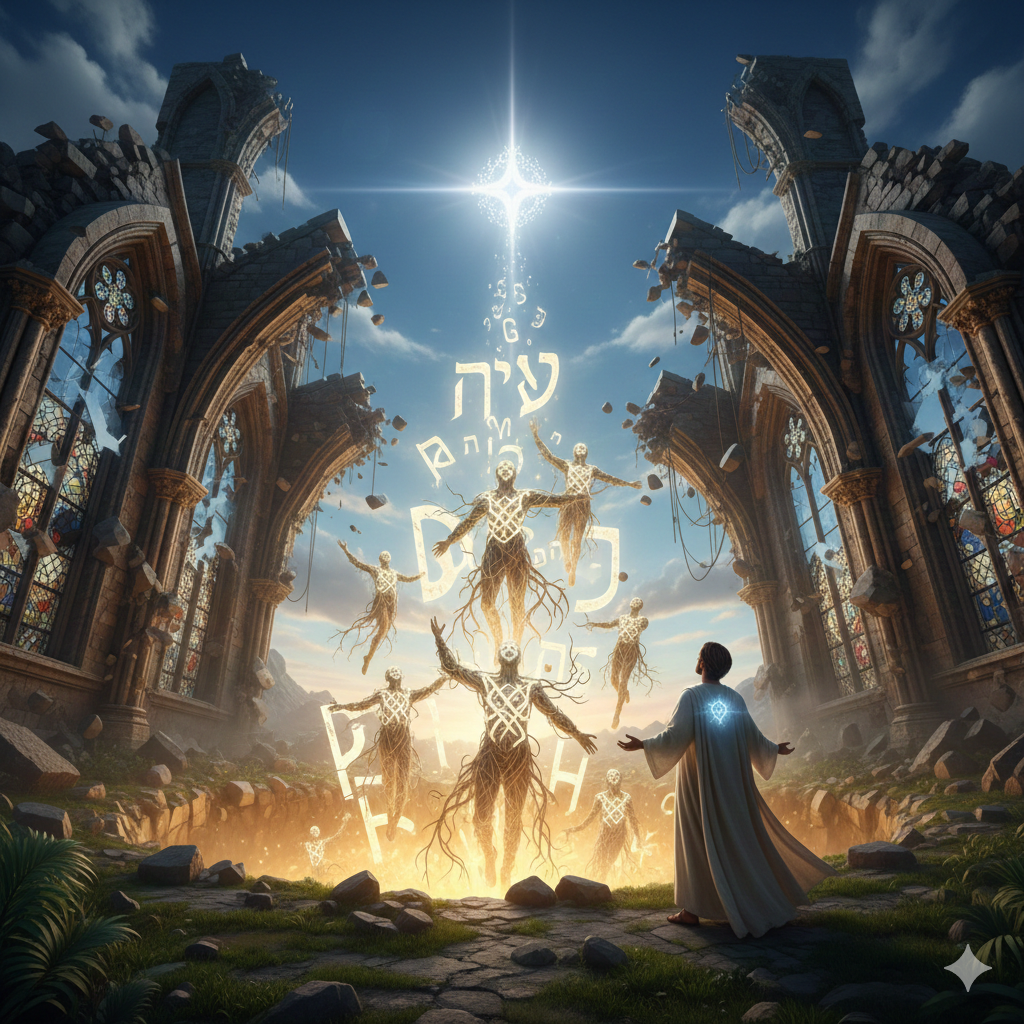
I. The Verse In Question: “So, Jesus was saying to those Jews who had believed Him, “If you continue in My word, then you are truly disciples of Mine; and you will know the truth, and the truth will make you free.” John 8:31-32 NASB.
The landscape of modern spirituality often presents itself as a grand, gilded cathedral of certainty, a place where the architecture of the Contrived Institutional Narrative (CIN pronounced SIN also known as Religion/Christianity) is meticulously maintained to provide a sense of sanctuary and belonging for the Believer (religious, not indwelt). Within these hallowed halls, the promise of freedom is whispered as a theological abstraction, a distant destination reached through the corridors of mental assent and doctrinal adherence. This introductory exploration seeks to honor the profound gravity and aesthetic beauty that this institutional structure projects, recognizing the deep comfort it offers to those who find shelter under its vast, centuries-old canopy. The narrative is constructed with the elegance of a masterfully woven tapestry, where every thread of tradition and every hue of interpretive history is placed to create a cohesive image of divine favor and human obligation. It is a world where the word is treated as a static treasure, a relic to be venerated rather than an operational environment to be inhabited. For the Believer, the experience of faith is often likened to a beautifully orchestrated symphony, where one follows the score provided by the Contrived Institutional Narrative, finding meaning in the harmony of collective ritual and the resonance of shared creeds. This posture is not merely a preference but a complete worldview that defines the boundaries of the sacred and the profane, the saved and the lost, through the lens of institutional recognition.
The allure of this polished veneer lies in its ability to offer a comprehensive map of existence that requires little more than the willingness to stand in the light of its stained-glass windows. The Contrived Institutional Narrative provides a narrative arc that is both seductive and stabilizing, promising that if one simply continues in the prescribed path of the faith tradition, a specific status of discipleship is achieved. In this domain, the concept of truth is presented as a collection of precious stones, polished by generations of scholars and theologians, and handed down to the faithful as an inheritance. This version of reality is comforting because it remains external; it can be studied, debated, and defended without necessarily requiring a fundamental restructuring of the human being from the inside out. The freedom it speaks of is often a release from the weight of moral guilt or the fear of divine retribution, a legalistic liberty granted by the authority of the Contrived Institutional Narrative itself. It is a beautiful, self-contained system that mirrors the desires of the human heart for order and significance, yet it does so by creating an imitation of the original covenantal reality, replacing the living breath of the Father with the structured air of the sanctuary.
Within this framework, the figure of the Son is often portrayed through the soft-focus lens of religious sentimentality, a benevolent leader whose words are simplified into moral aphorisms that fit comfortably within the constraints of the institutional agenda. The call to be a disciple is transformed into a call to membership, where the metrics of success are measured by attendance, contribution, and the public confession of specific tenets. This environment acts as a greenhouse for the Believer, providing a controlled climate where growth is monitored and directed by the hands of those who manage the Contrived Institutional Narrative. The beauty of this system is undeniable, as it provides a sense of continuity and historical weight that anchors the individual in a world of shifting values. However, this very beauty acts as a shroud, concealing the raw, functional mechanics of the original covenant. The seduction of the polished stone is that it hides the living vein of the mountain from which it was cut. As we gaze upon this mirror of institutional religion, we see a reflection of our own need for security, yet it is a reflection that lacks the depth of the true Indwelt (covenantal, spirit-animated) identity that lies beneath the surface.
Original: ἔλεγεν οὖν ὁ Ἰησοῦς πρὸς τοὺς πεπιστευκότας αὐτῷ Ἰουδαίους ἐὰν ὑμεῖς μείνητε ἐν τῷ λόγῳ τῷ ἐμῷ ἀληθῶς μαθηταί μού ἐστε καὶ γνώσεσθε τὴν ἀλήθειαν καὶ ἡ ἀλήθεια ἐλευθερώσει ὑμᾶς
Transliteration: elegen oun ho Iesous pros tous pepisteukotas autō Ioudaious ean hymeis meinēte en tō logō tō emō alēthōs mathētai mou este kai gnōsesthe tēn alētheian kai hē alētheia eleutherōsei hymas
Literal Interlinear Etymological Translation (The L.I.E. Detector):: Spoke consequently the Iesous toward the having-been-persuaded by-him Judeans if you-all remain within the discourse the mine truly learners of-me you-all-exist and you-all-will-know the non-concealment and the non-concealment will-set-free you-all. (Vaticanus – Ioannes – 8 – 31-32 Covenantally Faithful, Minimal Copular, SVO Format)
The narrative presented by the Contrived Institutional Narrative operates like a sophisticated biological mimic, taking the terminology of the ancient scriptures and colonizing them with westernized meanings that serve the maintenance of the institution. When the institutional teacher speaks of truth, the word functions as a boundary marker, a fence that keeps the sheep within the fold of the Contrived Institutional Narrative while excluding those who do not possess the correct linguistic keys. This use of language is a form of structural concealment, where the very words intended to lead to non-concealment are used to create a new layer of religious fog. For the Believer, this fog is often mistaken for the cloud of divine presence, as it provides a hazy, mystical atmosphere that discourages the rigorous, functional inquiry required of the Indwelt. The institution thrives on this ambiguity, as it ensures that the power of interpretation remains in the hands of the elite, while the common person is left to depend on the crumbs of distilled doctrine. This is the masterwork of the Contrived Institutional Narrative: to make the participant feel they are moving toward freedom while they are actually being woven deeper into the fabric of institutional dependency.
Consider the image of a grand, ancient library where the books are chained to the shelves. To the Believer, the chains represent the security of tradition, the assurance that the knowledge within will never be lost or altered. They walk the aisles, admiring the leather bindings and the gold-leaf lettering, feeling a sense of awe at the sheer volume of wisdom preserved by the Contrived Institutional Narrative. But they never actually open the books to find the maps that lead out of the building. The chains that they view as a safeguard are, in reality, the instruments of their own intellectual and spiritual confinement. The institutional voice speaks with a resonant authority that mimics the tone of the Supreme Source, yet its frequency is tuned to the vibration of the “below.” It speaks of a kingdom that is always just out of reach, a reality that requires one more seminar, one more ritual, or one more year of faithful service to the Contrived Institutional Narrative to fully grasp. This is the seductive loop of religious performance, where the goal is always moving, ensuring that the Believer remains a perpetual seeker who never becomes a “finders of the reality” they claim to desire.
This polished introduction to the verse serves as the essential baseline from which we must begin our descent. It is necessary to feel the weight of this institutional gravity to understand the force required to break free from it. The beauty of the Contrived Institutional Narrative is a testament to the human capacity for order, but it is an order that lacks the animating breath of the Father. It is a statue of the Son, perfectly carved and lifelike in every detail, yet it cannot move, it cannot breathe, and it cannot set anyone free. It stands as a silent sentinel at the gates of the original covenant, inviting everyone to admire its form while preventing them from entering the gate itself. To truly understand the message of Iesous – Iēsous (ee-ay-sooce) – Yehoshua, one must be willing to step past the statue and into the living, breathing environment of the discourse. The deep dive that follows is not a mere academic exercise but a systematic stripping away of these layers of religious paint to reveal the raw, structural steel of the covenantal relational agency.
The gravity of the Contrived Institutional Narrative is so pervasive that it even shapes the way the Believer perceives their own identity. They are taught to see themselves as “sinners saved by grace,” a title that, while sounding humble, often serves to keep them in a state of perpetual spiritual infancy, always looking to the Contrived Institutional Narrative for their next meal. This identity is a form of psychological tethering, ensuring that the individual never develops the covenantal relational agency necessary to stand as an Indwelt. The institution becomes the surrogate parent, replacing the direct relationship with the Father with a series of intermediaries and administrative protocols. In this light, the verse in question is read as a gentle encouragement to stay the course within the church, rather than a radical call to remain within the actual frequency of the Son’s systematic discourse. The “freedom” offered by the institution is a supervised yard, where the boundaries are clearly marked by the Contrived Institutional Narrative, and any attempt to jump the fence is met with the warning of spiritual danger.
As we conclude this initial immersion into the institutional perspective, we must recognize that the beauty of the veneer is what makes the deception so effective. No one is drawn to a rotting structure that looks like rot; they are drawn to the ivory tower that promises a view of the heavens. The Contrived Institutional Narrative has spent millennia perfecting its aesthetic, its rhetoric, and its emotional resonance to ensure that the Believer feels they have arrived at the truth. But truth, in its original sense of ἀλήθεια – alētheia (al-ay-thi-ah) – non-concealment, is not an aesthetic; it is a reality that often disrupts the very order that the institution seeks to preserve. The tension between the comfortable, institutional “truth” and the disruptive, non-concealed “reality” is the precise location where the Indwelt begins their journey. We have seen the polished mirror; now it is time to look behind the glass to see the mechanics of the machine that has been projecting the image. The collapse of religion is not a destruction of the Father’s work, but the removal of the human scaffolding that has been mistaken for the building itself.
The invitation extended by the Contrived Institutional Narrative is always one of “becoming,” whereas the covenantal reality is one of “being” and “remaining.” The Believer is forever trying to become a disciple, trying to become holy, trying to become worthy of the freedom they are told they have. This constant state of striving is the fuel that keeps the Contrived Institutional Narrative running, as it creates a permanent demand for the institution’s products. It is a treadmill of religious activity that promises a destination but only delivers exhaustion. The Indwelt, however, is called to a different mode of operation: to remain within the λόγος – logos (log-os) – systematic discourse, an environment that is already present and fully operational. This is the fundamental difference in posture that we will excavate. One looks for the light through the windows of the institution, while the other is animated by the light from within. As we move forward, the gravity of the Contrived Institutional Narrative will be replaced by the levity of the non-concealed truth, and the learner will rise from the rubble of collapsed religion into the fullness of their covenantal relational agency.
This process of unbinding is not a gentle transition but a structural collapse of the old way of seeing. It is the moment when the Indwelt realizes that the “truth” they were taught was actually a clever concealment, and that the “freedom” they were promised was merely a longer leash. The systematic discourse of the Son acts as a solvent, dissolving the glue of the Contrived Institutional Narrative until the entire structure falls away, leaving only the individual and the Father in a direct, unmediated covenantal relational agency. This is the rise of the covenantal learner, the one who no longer needs the institution to interpret the breath of the Father because that breath is now the very thing that animates their existence. The deep dive begins here, at the site of the collapse, where the dust of religion settles and the architecture of the Father’s order begins to emerge from the ruins. We are not looking for a new religion to replace the old; we are looking for the original operational reality that religion was designed to hide.
The narrative of the institution is like a masterfully painted backdrop in a theater. It looks real from a distance, and it provides a convincing setting for the play of religious life. The Believer plays their part, following the script provided by the Contrived Institutional Narrative, finding comfort in the predictable movements of the drama. But the Indwelt is the one who walks to the edge of the stage and realizes that the mountains are made of canvas and the sky is just a painted ceiling. To step off the stage and into the real world is the act of being set free. It is a terrifying and exhilarating exodus from the “below” of the theater into the “above” of reality. The deep dive we are undertaking is the guide for that exodus, providing the lexical and etymological tools to cut through the canvas and step into the light of the non-concealed truth. The journey from Believer to Indwelt is the journey from the theater to the mountain, from the script to the spirit-breath, and from the Contrived Institutional Narrative to the Covenantal Relational Agency.