Physical Address
304 North Cardinal St.
Dorchester Center, MA 02124
Physical Address
304 North Cardinal St.
Dorchester Center, MA 02124
With Michael Walker
With Michael Walker
II. The Anatomy of the Trough.
The entrance of a divine decree into the physical geography of the human experience necessitates a specific alignment of location and internal pressure that defies the convenience of man. When the witness of the ancient script declares that it came to pass within their existing in that place, it is announcing a convergence of sovereignty and geography. This existence in that place is not a passive waiting but a targeted occupation of a precise coordinate. Just as a seed must find the exact depth of soil and the specific temperature of earth to begin the violent process of cracking its shell, the revelation of the covenant required the specific atmosphere of Beth-Lechem (Bayt-Leh-khem) — Bethlehem to be present. The pressure of the census and the movement of the masses served as the mechanical gears of history, grinding against the path of the travelers to ensure they were positioned at the altar of the prophecy. In this state of existing, the environment begins to vibrate with the frequency of the coming change. Every movement within that place becomes a preparation for the rupture of the unseen into the seen. The travelers do not merely occupy a room; they occupy a moment of destiny that has been traveling toward them from the depths of antiquity.
The culmination of this incubation is marked by the periods of light being filled to the full. This is the biological clock of the Creator, where the time assigned for the hidden growth reaches its absolute capacity and can no longer contain the expansion of the promise. In the cultural etymology of the Greek witness, these periods of light are not just abstract segments of a day but are the active illumination that fuels the work of the birthing. When the light is filled, the shadow of the hidden state is cast out. It is the overflow of a cup that has received the final drop; the surface tension breaks, and the liquid must pour forth. This filling is the final signal that the season of concealment is over. Every revelation from the mouth of the Most High follows this pattern of saturation. There is a period of internal accumulation where the word is gathered and strengthened within the dark vessel of the womb or the mind, and then there is the inescapable moment where the light of manifestation demands an entry into the world. The time is not merely over; it is heavy, dense, and bursting with the weight of the male offspring.
The bringing forth of the male offspring, the first-born, is the primary act of covenantal inheritance. This title of first-born is not a mere chronological marker but a legal and spiritual status of supreme priority. In the ancient world, the first-born carried the strength of the father and the double portion of the legacy. To bring forth the first-born is to establish a new headship and a new line of authority in the earth. This male offspring, the symbolic graphical Yehoshua, emerges as the direct answer to the groaning of the previous age. The birth is the materialization of the covenantal voice. Just as the first ray of dawn pierces the thickest part of the night, the appearance of the first-born breaks the silence of the long incubation. This offspring is the tangible evidence that the filling of the light was not in vain. He is the physical anchor for the spiritual decree, the point where the eternal word becomes a breathing, reclining reality that can be handled and known.
The immediate response to this birth is the act of binding Him in binding strips. This is the first protective protocol of the new manifestation. In the cultural etymology of the era, the binding strips were not symbols of lack but instruments of order and preservation. A newborn limb is soft and unformed, capable of being distorted by the sudden transition from the tight womb to the vast open air. The binding strips act as an external skeleton, providing the necessary boundaries to ensure the offspring grows with straightness and strength. When a fresh revelation is birthed in the life of a seeker, it must be immediately bound in the strips of scriptural fidelity and covenantal discipline. Without this binding, the revelation remains a fluid, chaotic emotion that can be easily warped by the shifting winds of human tradition. The binding is the act of tethering the new life to the ancient standard, ensuring that as the provision grows, it maintains the exact image of the decree that birthed it. It is the security of the promise in a world that seeks to dilute its power.
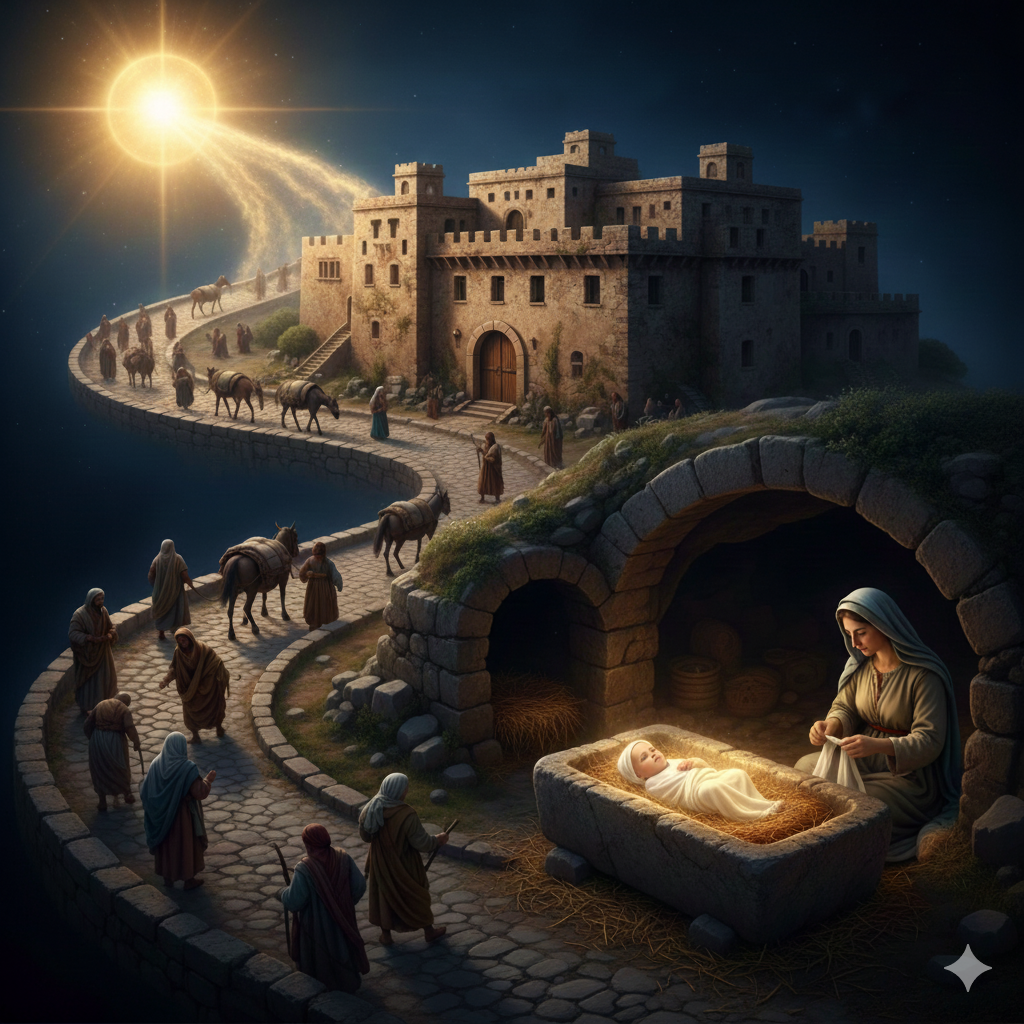
The placing of the first-born in a feeding trough is the most profound intersection of divine status and human necessity. To cause Him to recline is to treat the newborn as the master of the feast. This posture of reclining is the antithesis of the slave’s stance or the laborer’s seat. It is the position of the free man who has arrived at the place of rest and is ready to preside over the table. The feeding trough, the place of consuming, is transformed into the throne of the immediate. The institutional mind sees only the poverty of the animal quarters, but the covenantal eye sees the bread of life being served in the very vessel designed for those who hunger. The feeding trough is the location where the provision becomes accessible. If the offspring had been kept in the high places of the palace, He would have been a distant ruler. By being reclined in the trough, He becomes the substance that is within reach of the common traveler and the unyoked beast. The trough is the place where the divine decree is laid out to be eaten, internalized, and converted into the energy of the soul.
The reason for this placement is the total absence of space within the loosening-down place. This space, the topos of the Greek witness, is the specific room or coordinate within the established structures of man. The loosening-down place, the guest room where travelers sought to unyoke their burdens, was already saturated with the weight of the old world. The census, the tax, and the commercial interests of the age had filled every corner of the human lodging. This absence of space is a recurring theme in the manifestation of divine revelation. The new thing from God rarely finds a prepared seat at the table of the established order. The inn is too busy with its own survival and its own bureaucracy to accommodate the weight of the first-born. Therefore, the revelation is pushed into the margins, into the lower places where the beasts are kept. But it is in this very displacement that the revelation finds its true purpose. The rejection of the inn is the redirection to the trough. The lack of space in the loosening-down place ensures that the revelation is birthed in a space where it is not competing with the noise of the world but is instead the singular focus of those who have come to consume.
Then it came to pass within their existing in that place, the periods of light were filled for her to bring forth offspring. And she brought forth the male offspring of her, the first-born; and she bound Him in binding strips and caused Him to recline in a feeding trough, because no space was existing for them within the loosening-down place. (Codex Vaticanus – Loukas – 2 – 6 through 7, Literal Interlinear Etymological Translation, Covenant-ally Faithful, Minimal Copular, SVO Format).
As we examine this passage in depth, we see the movement of a master architect who uses the displacement of the world to position the provision of the covenant. The filling of the light leads to the filling of the trough. The binding of the limbs leads to the straightness of the path. The lack of space in the inn leads to the abundance of life in the stable. This is the blueprint for any revelation that seeks to enter the human heart. One must be willing to exist in the place assigned, to wait for the light to be filled to its capacity, and to accept the reclining posture in the midst of a world that offers no room. The feeding trough remains the destination for every true seeker. It is the place where the labor of the journey ends and the consumption of the truth begin. The word of God, validated by the ancient witnesses of the Sinaiticus and Vaticanus scripts, stands as the eternal testament to this process. It is a proclamation that the first-born is here, He is bound in the truth, and He is reclining in the place where you may come and eat.
The conclusion of this deep dive into the verse itself reveals that the birth of Yehoshua is the ultimate displacement of human tradition by divine reality. The loosening-down place was not meant to hold Him, for the guest rooms of men are too small for the King of the Covenant. He required the feeding trough because His purpose was not just to be a guest, but to be the very life of the world. As we look at the binding strips and the stone trough, we are looking at the mechanics of our own salvation and the pattern of every breakthrough we will ever receive. The provision is always reclined where the hunger is greatest. The revelation is always bound where the need for structure is most acute. We stand before the feeding trough not as spectators of a religious scene, but as participants in a covenantal feast. The invitation is to leave the crowded noise of the institutional inn and to descend into the quiet, potent space where the light has finally been filled and the bread of the first-born is ready for the taking.