Physical Address
304 North Cardinal St.
Dorchester Center, MA 02124
Physical Address
304 North Cardinal St.
Dorchester Center, MA 02124
With Michael Walker
With Michael Walker
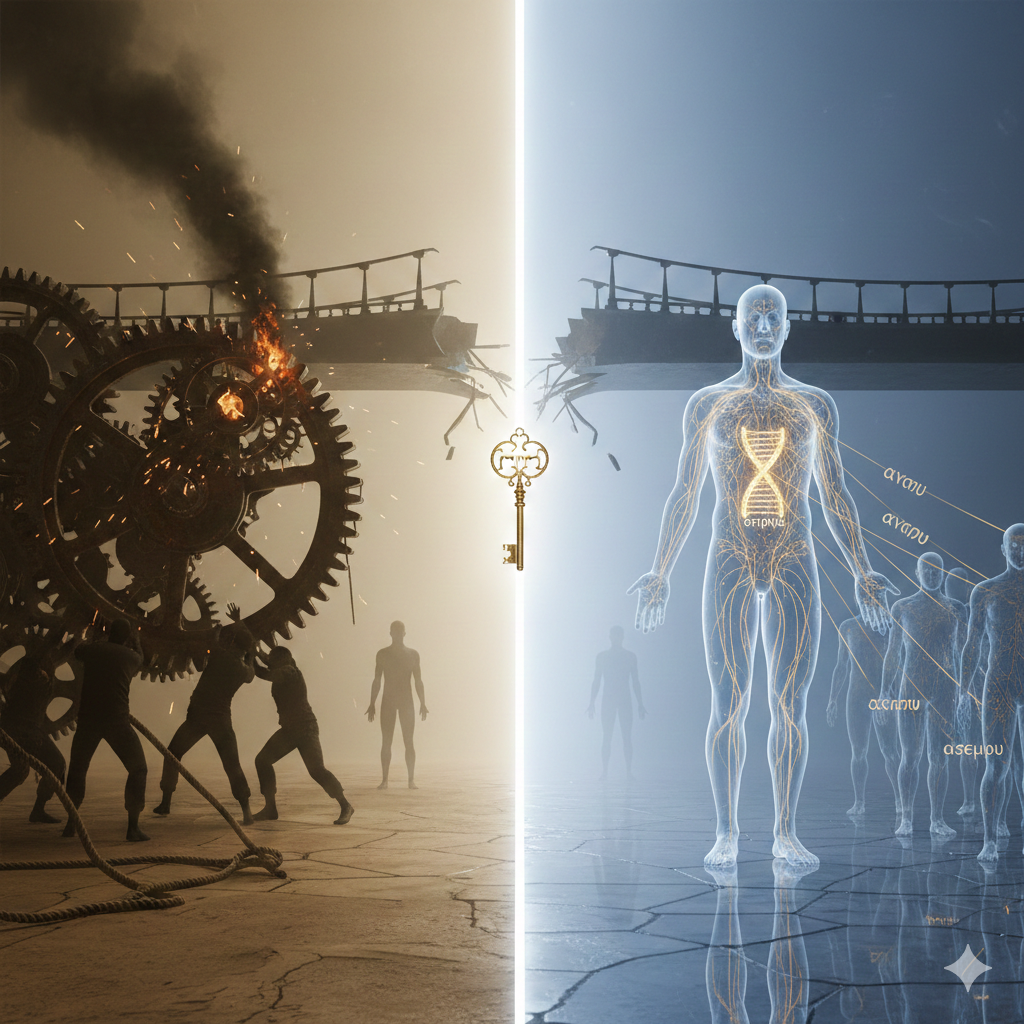
The following deconstruction explores the structural and functional divergence between the manufactured systems of man and the internal mechanics of the covenant as presented in the writings of Ἰωάννης — Iōannēs (ee-oh-ahn-nace) — “John.” This document serves as a real-time architectural audit for the Indwelt, defined here as the inhabited, spirit‑animated and empowered participant of the covenant who exists in superposition with the Father, the Breath, and the Word (יהושע — Yehoshua). Conversely, it addresses the state of the Believer, defined here as the religious, non‑inhabited adherent who seeks the Source through the scaffolding of man, representing the powerless who lack the Inhabitation of the Spirit breath of the Father. The historical context of this writing sits in the First Century CE Mediterranean, where the early participants of the Way were distinguishing the functional reality of the Inhabited One from the looming shadows of the contrived institutional narrative which strives to prevent the Believer from ascending into the state of the Indwelt. This study focuses specifically on the third chapter of the scroll of Ἰωάννης — Iōannēs (ee-oh-ahn-nace) — “John,” where the distinction between systemic function (those in the Covenant/sin-less) and systemic dysfunction (those who are not in the Covenant/in sin) is laid bare through the lexical witnesses of Hesychius, Photius, the Suda, and Dionysius Thrax. The text serves as a diagnostic tool to identify the genetic blueprint of the Source versus the manufacturing output of the world.
The foundational reality of the Indwelt is established in the distinction between being a component within a machine and being the lifeblood that powers the machine. In the first three verses of the third chapter, the text identifies a specific mode of existence where the Indwelt are categorized as the offspring of the Source, a designation that the outside world, the contrived institutional narrative, cannot process because it lacks the necessary data to recognize the Father. This failure of recognition is not a social misunderstanding but a mechanical incompatibility where the dysfunctional system of the world cannot interface with the functional system of the covenant. As the Indwelt progress toward the full visibility of their structural change, they undergo a process of purification that is not a moral scrubbing but a refinement of their functional state to match the purity of the Inhabited One. This refinement is essential because the presence of the Spirit-Breath creates an internal pressure that pushes out the grit and friction of the world.
Original: πᾶς ὁ ποιῶν τὴν ἁμαρτίαν καὶ τὴν ἀνομίαν ποιεῖ καὶ ἡ ἁμαρτία ἐστὶν ἡ ἀνομία
Transliteration: pas ho poiōn tēn hamartian kai tēn anomian poiei kai hē hamartia estin hē anomia
Literal Interlinear Etymological Translation (The L.I.E. Detector): Everyone the-one manufacturing the failure-to-hit-the-design also the no-standard-state manufactures and the failure-to-hit-the-design is the no-standard-state. (Sinaiticus — Iōannou Alpha — 3 — 4 Covenantally Faithful, Minimal Copular, SVO Format)
The identification of ποιῶν — poiōn (poy-ohn) — “manufacturing” serves to dismantle the passive concept of a single mistake and replaces it with the construction of a consistent output. This term, rooted in the action of building or constructing a product, functions as the primary indicator that the individual is acting as a factory for a specific result. When this is followed by ἁμαρτίαν — hamartia (hah-mar-tee-ahn) — “failure-to-hit-the-design,” the text highlights that the presence of dysfunction is a structural deviation from the intended mark, a jagged reality that prevents the machine from running smoothly. The manufacturing of ἀνομίαν — anomian (ah-nom-ee-ahn) — “no-standard-state” indicates a state of being outside the structural boundary or legal perimeter, effectively changing the status of the participant from a functional component to a chaotic element. The activation of the connection between failure and the no-standard-state signifies the inherent link between missing the mark and existing without the measurement of the Source.
The architecture of dysfunction (sin) is a closed loop where the un-inhabited individual is trapped in a state of being that can only produce friction. The contrived institutional narrative attempts to hide this reality by using the word practice, implying that the individual has the volitional choice to stop the production of failure through willpower. This is a strategic deception and a fundamental absurdity because a machine designed to produce smoke cannot choose to produce oxygen without a fundamental retooling of its internal combustion system. To tell a machine in a state of default dysfunction to practice function is a lie of the slanderer (the Devil). The state of the Believer is one of constant trying and failing because they are attempting to hit a mark while remaining in a system that is fundamentally misaligned. The only exit from this loop is the intervention of the Inhabited One, יהושע — Yehoshua, who appeared specifically to dismantle the works of the slanderer and to provide the blood transfusion and make way for the Spirit-Breath (function). This is not a religious ritual but a legal and biological necessity to replace the corrupted seed of the world with the incorruptible seed of the Source (yehoshua).
Original: πᾶς ὁ ἐν αὐτῷ μένων οὐχ ἁμαρτάνει πᾶς ὁ ἁμαρτάνων οὐχ ἑώρακεν αὐτὸν οὐδὲ ἔγνωκεν αὐτόν
Transliteration: pas ho en autō menōn ouch hamartanei pas ho hamartanōn ouch heōraken auton oude egnōken auton
Literal Interlinear Etymological Translation (The L.I.E. Detector): Everyone the-one within him staying-fixed not fails-the-design everyone the-one failing-the-design not has-rendered-as-data him neither has-recognized him. (Sinaiticus — Iōannou Alpha — 3 — 6 Covenantally Faithful, Minimal Copular, SVO Format)
The activation of μένων — menōn (men-ohn) — “staying-fixed” signifies the requirement of permanent structural installation within the covenantal relational agency. This term, defined by Photius as abiding or staying without moving, functions as the lock that keeps the Indwelt secured within the functional parameters of the Inhabited One. When the text states that the one staying fixed does not fail the design, it is making a statement of mechanical capability. The inability of the Indwelt to produce the output of the world is due to the presence of the σπέρμα — sperma (sper-mah) — “blueprint-seed,” which remains within them as a permanent genetic override. This seed is the structural information of the Source that prevents the manufacturing plant of the person from reverting to the old blueprints of dysfunction. The lack of recognition of the Father (Yahweh) by those who fail the design is a result of having never rendered Him as data or perceived him through experiential knowledge, leaving them locked in the institutional narrative.
The absurdity of the term practice within the institutional narrative is further illuminated by the mechanical reality of the σπέρμα — sperma (sper-mah) — “blueprint-seed.” In the ancient witness, this is the genetic data that determines the output of the organism. To suggest that a person can practice righteousness while possessing the seed of the world is as logically bankrupt as suggesting a thorn bush can practice being a grape vine. The default setting of the un-inhabited is dysfunction. They are not choosing to fail; they are functioning exactly as they were built to function within the jurisdiction of the world. The contrived institutional narrative uses the idea of practice to create a false sense of agency that keeps the Believer tethered to a system of self-improvement that can never reach the threshold of inhabitation. This is the slanderer throwing a smokescreen over the fact that righteousness is not a behavior to be learned but a state to be inhabited through the legal and structural shift initiated by the Source.
The contrast between the children of the Source and the children of the slanderer is obvious through their respective outputs. One manufactures function and the willful bond while the other manufactures friction and hostility. The narrative of the world is personified in the figure of Κάϊν — Kain (kah-een) — “Cain,” who was of the evil one and slaughtered his brother because his own works were πονηρά — ponēra (pon-ay-rah) — “toilsome-friction” while the works of his brother were functional. The word used for the action of Κάϊν — Kain (kah-een) — “Cain” is ἔσφαξεν — esphaxen (es-phak-sen) — “slaughtered,” which carries the weight of a ritualistic or sacrificial cutting. This reveals that the dysfunctional system operates by sacrificing the functional to maintain its own friction-filled existence. The Indwelt, however, have passed out of the state of death and into the state of life, a transition that is verified by the maintenance of the ἀγάπη — agapē (ah-gah-pay) — “willful bond” with those who are likewise inhabited. This bond is the lubricant of the machine that allows multiple components to move together without generating the heat of hostility.
The mechanical nature of trust-fidelity is found in the word πιστεύσωμεν — pisteusōmen (pees-tyoo-so-men) — “we-should-entrust.” In the witness of Photius and the Suda, this is the act of entrusting one’s legal standing to another. It is a mathematical and jurisdictional transfer. Within the institutional narrative, this is diluted into the word “believe” which implies a mental or emotional state. However, the Indwelt understands that this is the act of placing their entire weight upon the structural integrity of the covenantal relational agency. This is not a fan following a celebrity; it is a pilot trusting the laws of aerodynamics to keep the craft in flight. The failure to entrust is the failure to engage the system. The institutional narrative keeps the Believer in a state of mental assent that never crosses the threshold into the legal transfer required for the inhabitation. This is the strategic misdirection that prevents the transition from the powerless to the empowered.
Original: καὶ αὕτη ἐστὶν ἡ ἐντολὴ αὐτοῦ ἵνα πιστεύσωμεν τῷ ὀνόματι τοῦ υἱοῦ αὐτοῦ Ἰησοῦ Χριστοῦ καὶ ἀγαπῶμεν ἀλλήλους καθὼς ἔδωκεν ἐντολὴν ἡμῖν
Transliteration: kai hautē estin hē entolē autou hina pisteusōmen tō onomati tou huiou autou Iesou Christou kai agapōmen allēlous kathōs edōken entolēn hēmin
Literal Interlinear Etymological Translation (The L.I.E. Detector): And this is the charge of him in-order-that we-should-entrust to-the legal-designation of-the son of-him Yehoshua the Inhabited-One and we-should-maintain-the-willful-bond one-another just-as he-gave charge to-us. (Sinaiticus — Iōannou Alpha — 3 — 23 Covenantally Faithful, Minimal Copular, SVO Format)
The identification of ἐντολή — entolē (en-tol-ay) — “charge” serves to dismantle the concept of a moral rule and replaces it with the functional mandate of the designer. This term, witnessed by Hesychius as a setting in order, functions as the blueprint for the proper operation of the Indwelt within the covenant. When this is followed by πιστεύσωμεν — pisteusōmen (pees-tyoo-so-men) — “we-should-entrust,” the text highlights that the engagement with the Source is a jurisdictional transfer of legal standing. The act of entrusting to the ὀνόματι — onomati (on-om-at-ee) — “legal-designation” of the son, יהושע — Yehoshua, is the use of the authorized key to access the power of the covenant. The activation of the ἀγάπη — agapē (ah-gah-pay) — “willful bond” between the Indwelt is the second half of this charge, ensuring that the collective body of the Inhabited remains structurally sound and free from the heat of internal conflict.
Accessing the power of the covenant, or the protocol for petitioning and claiming within the covenant, is governed by the term αἰτεῖτε — aiteite (ay-tay-teh) — “continue bringing your formal petition.” For those outside the covenantal relational agency, this word represents a formal petition brought before a rightful authority, a desperate attempt to assert a case from a position of lack. However, for the Indwelt, the protocol shifts into the authorized release of fulfillment from within their covenant standing. This is not a request made by a beggar but a lawful claim and execution of what is already owned through the inhabitation. The institutional narrative keeps the Believer in the state of the beggar, forever asking for what has already been granted to the Indwelt. This keeps them in a state of operational inferiority, dependent on the narrative’s mediation rather than the Father’s direct provision. The realization of this authority is a key component of the structural shift that defines the inhabited state.
The final confirmation of this “Inhabitation” is the presence of the Spirit-Breath, which acts as the internal power source for the functional life. The Indwelt does not rely on their own ability to keep the charges of the Source but operates out of the energy provided by the Inhabitation. This is the superposition where the Father and the Indwelt exist as a single functional unit, moving in the manner that the Word moves. The contrived institutional narrative tries to sell a version of this reality where the spirit is a vague influence or a feeling, but the lexical witnesses describe a living wind and a structural breath that animates the person. Without this Inhabitation, the individual remains a Believer, standing outside the door of the engine room with a manual they cannot read and a machine they cannot start. The transition into the state of the Indwelt is the only way to cease the manufacturing of dysfunction (sin) and begin the production of the functional 9covenant) life that the Father intended from the beginning.
Original: καὶ ὁ τηρῶν τὰς ἐντολὰς αὐτοῦ ἐν αὐτῷ μένει καὶ αὐτὸς ἐν αὐτῷ καὶ ἐν τούτῳ γινώσκομεν ὅτι μένει ἐν ἡμῖν ἐκ τοῦ πνεύματος οὗ ἡμῖν ἔδωκεν
Transliteration: kai ho tērōn tas entolas autou en autō menei kai autos en autō kai en toutō ginōskomen hoti menei en hēmin ek tou pneumatos hou hēmin edōken
Literal Interlinear Etymological Translation (The L.I.E. Detector): And the-one guarding the charges of-him within him remains and he within him and in this we-recognize namely-that he-remains within us out-of the Spirit-Breath which to-us he-gave. (Sinaiticus — Iōannou Alpha — 3 — 24 Covenantally Faithful, Minimal Copular, SVO Format)
The identification of τηρῶν — tērōn (tay-rone) — “guarding” serves to dismantle the passive concept of obedience and replaces it with the active maintenance of systemic integrity. This term, defined by Dionysius Thrax as keeping safe or watching over, functions as the defensive posture that prevents the intrusion of the world into the functional space of the covenant. When this is followed by γινώσκομεν — ginōskomen (ghin-oce-ko-men) — “we-recognize,” the text highlights that the awareness of the inhabitation is based on experiential data and the perception of the Spirit-Breath. The presence of the πνεύματος — pneumatos (pnyoo-mat-oce) — “Spirit-Breath” is the definitive proof that the Indwelt is no longer operating under the old blueprints of dysfunction. This breath is the wind that clears the smoke of the institutional narrative and allows the Indwelt to see the Father as He is, rendered as the ultimate data of truth.
The legal standing of the Indwelt is protected by the παράκλητος — paraklētos (pah-rah-klay-toce) — “legal advocate,” the one who maintains the functional alignment of the participant within the covenantal relational agency. In the lexical witness of Photius, this is an assistant called to one’s side in a legal proceeding. This reveals that the maintenance of function is a managed jurisdictional reality. While the institutional narrative uses terms like comforter to suggest an emotional soothing, the Indwelt recognizes the παράκλητος — paraklētos (pah-rah-klay-toce) — “legal advocate” as the one who manages their right-standing and ensures that the accusations of the slanderer do not create a structural break in the Inhabitation. This legal assistant is the guarantee that the Indwelt remains functional regardless of the horizontal pressures of the world. It is the structural insurance of the covenant that keeps the machine running in a hostile environment.
The realization of the mechanical architecture of the covenant is the moment the Indwelt breaks free from the gravitational pull of the contrived institutional narrative. It is the transition from a state of manufacturing friction to a state of manufacturing function. By recognizing that the world is a closed system of dysfunction (sin), the Indwelt can stop trying to play by its rules and start operating according to the functional (Covenantal) mandate of the Source. This is the power of the Name (Yehoshua), the Key, and the Willful Bond. It is the restoration of the original design where the human is no longer a broken cog in a dying machine but a spirit-animated participant in the eternal relational agency of the Father. Stand in the confidence of your right-standing, knowing that the seed within you is incorruptible and that the Breath within you is the power of the Source itself. The transition from the practice of dysfunction (sin) to the state of Inhabitation (function) is the final legal victory over the institutional lies of the world.