Physical Address
304 North Cardinal St.
Dorchester Center, MA 02124
Physical Address
304 North Cardinal St.
Dorchester Center, MA 02124
With Michael Walker
With Michael Walker
I. The Deployment of the Inhabited Authority.
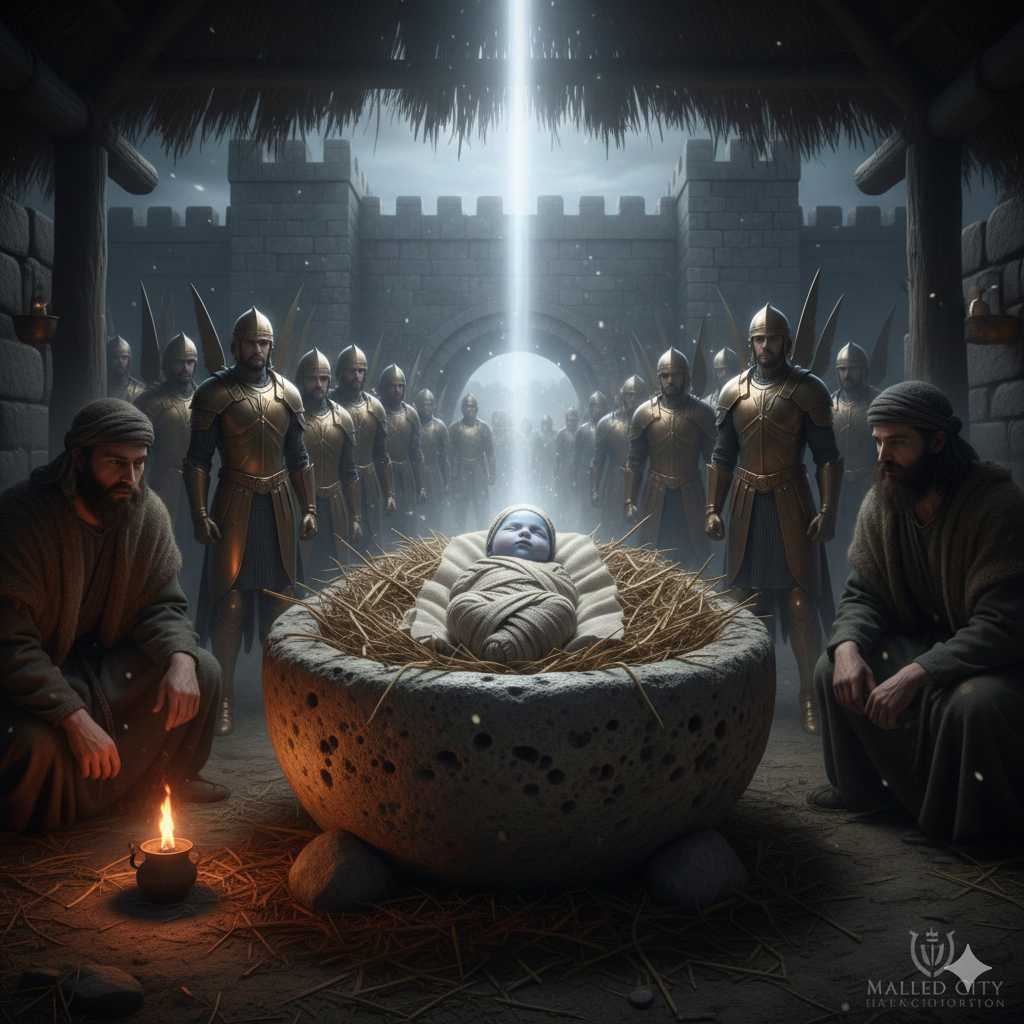
The arrival of the sovereign authority into the physical landscape of the earth is not a mere religious celebration or a sentimental historical marker, but the activation of a legal and jurisdictional protocol established before the foundations of the world. In the walled city of Dauid (Dah-weed) — David, the ancient boundaries of the covenant are re-occupied by the presence of a deliverer who emerges not from the systems of men, but from the direct intent and localized intervention of the Deity. This production of life is the emergence of a vessel that is inhabited by the very breath and spirit of the Father, standing as the master of the household and the possessor of all jurisdiction. The reality of Yehoshua (“Iesous”) is the reality of the Inhabited One, the human dwelling place of the celestial power, who comes to preserve and deliver the people from the peril of fragmentation and legal breach. To understand this production, one must view it through the lens of a sovereign restoration where the Architect of the universe decides to dwell within the blueprint He created. Just as a seed carries the structural blueprint of the entire forest, containing every branch, leaf, and root within a singular point of potential, this newborn child, bound in swaddling strips and placed within the feeding trough of a stall, carries the structural blueprint of a restored kingdom. This signal is the distinguishing mark for the envoys of the field, a token of verification that the high authority has bypassed the polished corridors of institutional palaces to establish a throne in the raw, accessible reality of the common soil.
Because on this day a deliverer was produced for you in the walled city of Dauid, who is Yehoshua (“Iesous”) the Authority, the Inhabited One. This is the signal for you: you will encounter a newborn child bound in swaddling strips and lying in a feeding trough. (Luke 2:11-12, Sinaiticus/Vaticanus, Covenantally Faithful, Minimal Copular, SVO Format).
The production of this deliverer within a walled city signifies the reclamation of legal territory. In the ancient world, a walled city was not merely a cluster of homes but a center of jurisdictional protection and economic order. By choosing the city of Dauid, the Deity is making a specific, non-anachronistic claim to the Davidic covenant, signaling that the promise of a perpetual throne is being physically substantiated. The use of the term deliverer or preserver highlights a functional agency; this is not a savior in the modern, abstract religious sense of “saving souls” for a distant hereafter, but a preserver of the community who prevents the total dissolution of the covenant people. He is the master of the house, the one who possesses the authority to govern the affairs of the land. When the text identifies Him as the Inhabited One, it points to the unique state of being where the celestial spirit occupies the human form. This inhabitation is the mechanism by which the authority is exercised. It is the habitation of the Creator within the creature, a union designed to execute the restoration of the earth. This is the ultimate posture of relational agency, where the ruler does not command from a distance but becomes the very life-blood of the governed territory.
The Identifying Signal of the feeding trough serves as a profound paradox to the institutional mind. To the religious elite of the time, a king was expected to be found in ivory halls, surrounded by the trappings of worldly power and excluding the common man through layers of bureaucracy. However, the signal of the trough—the place where the beasts of the field come to find their sustenance—is an intentional declaration of accessibility. It suggests that the Bread of Life has been placed in the most humble and reachable location so that even the lowliest and most unrefined can participate in the restoration. This trough is a functional tool of the kingdom, demonstrating that the authority of the Inhabited One is found in service and provision rather than in the hoarding of status. The swaddling strips, likewise, are not merely cloth but represent the binding of the celestial within the terrestrial, the voluntary restriction of the infinite into a finite form for the purpose of legal representation. By encountering the child in this state, the shepherds were not witnessing a tragedy of poverty but a strategic maneuver of a king who establishes his headquarters in the most unexpected and unprotected of places to prove that His authority is inherent, not manufactured by human ornament.
The atmospheric threshold between the seen and the unseen is suddenly breached by the manifestation of a celestial army, a disciplined military force of the loftiest regions that appears unexpectedly to announce a change in government. These are not merely singers of songs or ethereal figures of myth, but legal representatives of the heavenly court, the official diplomatic messengers whose very presence declares that the weight and splendor of the Deity have descended upon the land. In the ancient cultural context, the appearance of an army following a birth was the standard protocol for the coronation of a royal heir. Their proclamation is the announcement of a total restoration of wholeness, an era where the breach between the Creator and the created is closed for those of favorable will. This splendor is the tangible reputation of the Father being made manifest in the highest places and extending its reach to the dust of the earth. The army does not come to suggest peace as a temporary cessation of hostility, but to enforce the restoration of the covenantal order through the arrival of the inhabited authority. This is the moment where the celestial vault and the arable land intersect, signaling that the kingdom is no longer a distant concept but a present, governed reality.
Suddenly there appeared with the messenger a great number of a celestial army lauding the Deity and saying: Splendor to the Deity in the highest places, and upon the land peace among mankind of His favorable will. (Luke 2:13-14, Sinaiticus/Vaticanus, Covenantally Faithful, Minimal Copular, SVO Format).
The term for peace used in this witness is the restoration of wholeness, a functional state of being where every fragmented part of the human experience is re-integrated into the covenantal structure. This is not a peace of feelings but a peace of facts. It is the legal state of a land that has been cleared of rebels and returned to its rightful owner. The celestial army stands as the enforcement wing of this proclamation, indicating that the authority of Iesous is backed by the full military strength of the celestial realms. When they speak of the splendor of the Deity in the highest places, they are referencing the weight of his character. In the ancient mind, glory was not light, but weight—the heavy importance and undeniable reality of a person’s reputation. To give splendor to the Deity is to acknowledge that his character is the heaviest, most significant reality in existence. This weight now rests upon the land. The army’s message is a diplomatic ultimatum to the inhabitants of the earth: the rightful King has been produced, and his favorable will is now extended to those who will align themselves with his authority.
This celestial manifestation to shepherds—men who lived on the margins of the walled city—further emphasizes the shift from institutional religion to covenantal relation. The messenger did not go to the Temple in Yerushalayim (Yeh-roo-shah-lah’-yim) — Jerusalem to notify the high priests, for the institutional narrative had become a barrier to the very authority it claimed to serve. Instead, the announcement was made to those who were in direct contact with the land, the animals, and the raw elements of creation. This shows that the restoration of wholeness is intended for the entirety of the created order, starting from the ground up. The shepherds were the first to receive the diplomatic dispatch because their simplicity allowed them to recognize the signal of the trough without the interference of theological pride. They represent the first citizens of the newly announced government, those who recognize that the weight of the Deity is more real than the weight of the Roman occupation or the religious taxes of the day.
The unfolding of this record reveals that the Inhabited One is the definitive signal that the jurisdiction of the Father has moved from the abstract to the concrete. To find the child in the feeding trough is to recognize that the king is accessible to those who are starving for the restoration of their original purpose. The presence of the Inhabited One among the people is a permanent alteration of the human condition. It suggests that the spirit of the Father no longer hovers above the waters or speaks only through distant prophets but has taken up permanent residence within the human family. This introduction serves as the foundational stone for the deep dive into the nature of inhabitation, illustrating that when the spirit occupies a vessel, that vessel becomes the authorized agent of the kingdom. The messenger and the army serve as the heralds of this legal transition, inviting the inhabited of today to recognize their own role as envoys of the same authority.