Physical Address
304 North Cardinal St.
Dorchester Center, MA 02124
Physical Address
304 North Cardinal St.
Dorchester Center, MA 02124
With Michael Walker
With Michael Walker
III. Timeline: When Luke Enters the Story.
The chronological entry of Loukas (loo-kahs) — Luke into the historical record is not a sudden burst of light at the inception of the movement, but a gradual, calculated arrival that underscores his role as a forensic investigator rather than a primary participant. To understand the gravity of his mission, one must recognize the massive temporal chasm between the ministry of the Messiah and the first appearance of the physician. During the years of twenty-seven to thirty AD, the stage of Eretz Yisra’el (eh-rets yees-rah-ale) — the Land of Israel was occupied by the Twelve. These were the Jewish oracular transmitters, men like Shim‘on (shee-mohn) — Simon Peter and Yochanan (yoh-khah-nahn) — John, who walked in the physical dust of Galil (gah-leel) — Galilee. They were the primary witnesses to the life, the execution, and the resurrection of Yehoshua. In this foundational era, Loukas is entirely absent. He is not among the seventy, he is not at the table of the Pesach (peh-sakh) — Passover, and he is not standing at the empty tomb. He is an outsider to the experience, a man living in the silence of the nations while the roar of the resurrection was shaking the foundations of Yerushalayim (yeh-roo-shah-lah-yeem) — Jerusalem. This absence is a vital component of his credibility; he is not a man blinded by the initial euphoria of the event, but one who would later approach it with the cold, investigative eye of a scientist.
As the narrative progresses into the pivotal years of thirty-three to thirty-six AD, the scriptural record documents the radical conversion of Sha’ul (shah-ool) — Paul on the road to Damaskos (dah-mahs-kohs) — Damascus. Even here, as the movement begins to pivot toward the nations, Loukas remains off-stage. He is not a witness to the blinding light or the audible voice of the risen King that transformed the Pharisee. Throughout Paul’s early ministry from thirty-six to forty-eight AD—a decade of preaching, isolation in Arabia, and the first stirrings in Antiocheia (ahn-tee-o-khay-ah) — Antioch—the name of Loukas never surfaces. He is like a shadow waiting for the sun to reach a specific angle. The movement was being forged in the fires of Jewish persecution and early expansion, yet the man who would become its most prolific historian was still distant, perhaps practicing his craft of healing in the Hellenic world, unaware that he was being prepared as a vessel for a different kind of restoration.
The silence is finally broken between the years of forty-nine and fifty-one AD, marking a monumental shift in the literary structure of the record. In the document known as the Acts of the Apostles, specifically at the arrival in Troas (tro-ahs) — Troas, the narrative suddenly abandons the third-person “they” and adopts the first-person plural “we.” This subtle grammatical pivot is the footprint of Loukas entering the story. It is more than twenty years after the resurrection of Yehoshua when this physician finally joins the missionary team of Sha’ul. This two-decade gap is the distance required for a forensic scientist to operate; he arrives when the initial dust has settled but the witnesses are still alive, and their memories are sharp. He enters not as a founder, but as an archivist.
Original: ως δε το οραμα ειδεν ευθεως εζητησαμεν εξελθειν εις μακεδονιαν
Transliteration: hōs de to horama eiden eutheōs ezētēsamen exelthein eis makedonian
Literal Interlinear Etymological Transliteration: When but the vision he saw immediately we sought to go out into Makedonia. (Codex Vaticanus – Acts 16:10)
This transition into the “we” sections marks the beginning of Loukas’s ministry period from fifty to sixty-two AD. During these twelve years, he travels as the companion and physician of Sha’ul, witnessing the expansion of the word through the Greco-Roman world. He is present during the riots, the shipwrecks, and the long periods of imprisonment. Yet, it is during Sha’ul’s two-year legal detention in Kaisareia (kahee-sah-ray-ah) — Caesarea that the strategic genius of the Spirit’s timing is revealed. While the apostle was held in Roman custody, Loukas was granted a window of opportunity that would change the course of history. Being in the proximity of Yerushalayim, the physician could travel the short distances to interview the original oracular transmitters. He was the investigator taking depositions while the witnesses were still accessible. He could speak to Mariam (mah-ree-ahm) — Mary about the angelic visitation; he could find the aged shepherds; he could cross-examine the remaining members of the Twelve. This was not a mystical download, but a Spirit-guided investigation conducted by a man trained in medical observation and historical sequence.
Original: επειδηπερ πολλοι επεχειρησαν αναταξασθαι διηγησιν περι των πεπληροφορημενων εν ημιν πραγματων
Transliteration: epeidēper polloi epeicheirēsan anataxasthai diēgēsin peri tōn peplērophorēmenōn en hēmin pragmatōn
Literal Interlinear Etymological Transliteration Since indeed many took in hand to set in order a narration concerning the things having been fully carried among us matters. (Codex Vaticanus – Loukas 1:1)
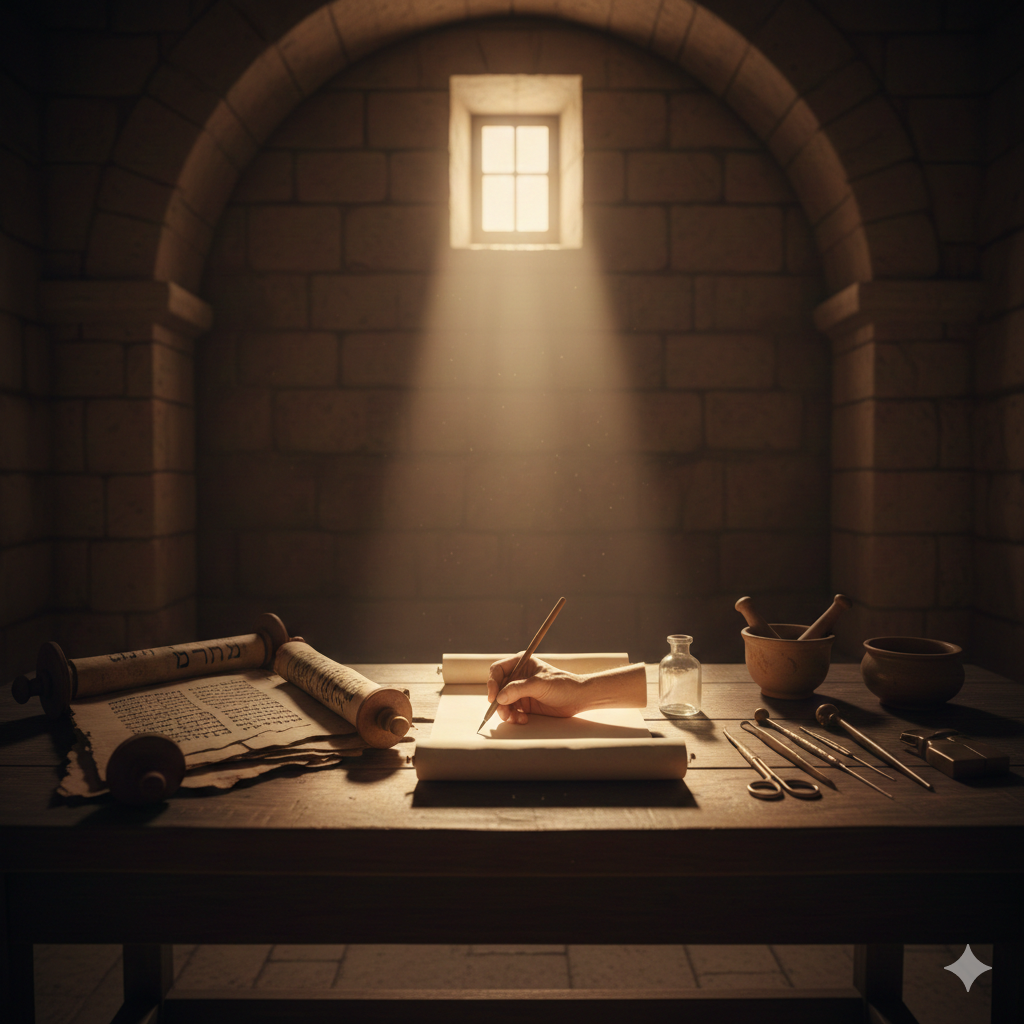
The writing period, spanning roughly sixty to eighty AD, is the culmination of this two-decade delay. Loukas does not write from the heat of the moment, but from the clarity of the archive. He functions as a historian, not an eyewitness of the Messiah’s earthly walk. This distinction is vital for the legal weight of his testimony. In a court of law, the primary witnesses provide the raw data, but the forensic investigator provides the “orderly account” that makes the data intelligible and irrefutable. By the time Loukas sets his reed pen to papyrus, he is compiling a case file for Theophilos (the-of-ee-lohs) — Theophilus that bridges the gap between the Jewish experience and the Gentile understanding. He is documenting how the inhabited word moved from the temple in Yerushalayim to the heart of the Roman Empire.
Original: εδοξε καμοι παρηκολουθηκοτι ανωθεν πασιν ακριβως καθεξης σοι γραψαι κρατιστε θεοφιλε
Transliteration: edoxe kamoi parēkolouthēkoti anōthen pasin akribōs kathexēs soi grapsai kratiste theophile
Literal Interlinear Etymological Transliteration: It seemed good also to me, having followed closely from above all things with precision, in order to you to write, most powerful Theophilos. (Codex Vaticanus – Loukas 1:3)
The timeline of Loukas reveals a divine pattern of intentional delay. Had he been an original disciple, his account might be dismissed as just another subjective memory of a devoted follower. But because he enters the story twenty years later, his work becomes a verified reconstruction. He is the prototype of every generation that would follow—those who did not see yet believe through the careful examination of the evidence. He proves that the inhabitation of the Spirit is not restricted to those who touched the physical hem of the garment of Yehoshua but is available to the investigator who searches the source with precision. His role as the Gentile historian of a Jewish movement is a strategic strike against the limitations of time. He ensures that as the original eyewitnesses began to pass from the scene, their testimony was preserved in a forensic format that would remain unchanged for millennia.
The conclusion of this chronological inquiry is the realization that Loukas was the instrument designed for the long-term preservation of the oracle. He was the archivist of the King. His late arrival was not a failure of timing, but a requirement of his office. He had to be an outsider to the events so that he could be the objective validator of the truth. His ministry as a physician allowed him to recognize the miraculous as a disruption of the natural order, and his skill as a writer allowed him to document that disruption with the clarity of a medical report. By the time he finishes his two-volume work, he has provided the nations with a bridge that spans the twenty-year gap, allowing the logic of the Greek mind to meet the reality of the Hebrew Messiah.
Loukas stands as the witness who arrived late but saw more clearly because he looked through the lens of evidence. He did not walk with Yehoshua, yet he knew Him with a forensic intimacy that he transmitted to the world. His timeline is our timeline; his method is our method. He remains the Spirit-Inhabited proof that the word of God is not a fleeting experience, but a historical certainty that stands firm long after the voices of the first witnesses have gone silent. He is the bridge across time, the historian of the Inhabited, and the man whose late entry into the story ensured that the story would never end.