Physical Address
304 North Cardinal St.
Dorchester Center, MA 02124
Physical Address
304 North Cardinal St.
Dorchester Center, MA 02124
With Michael Walker
With Michael Walker
III. The Architecture of the Inhabited Vessel.
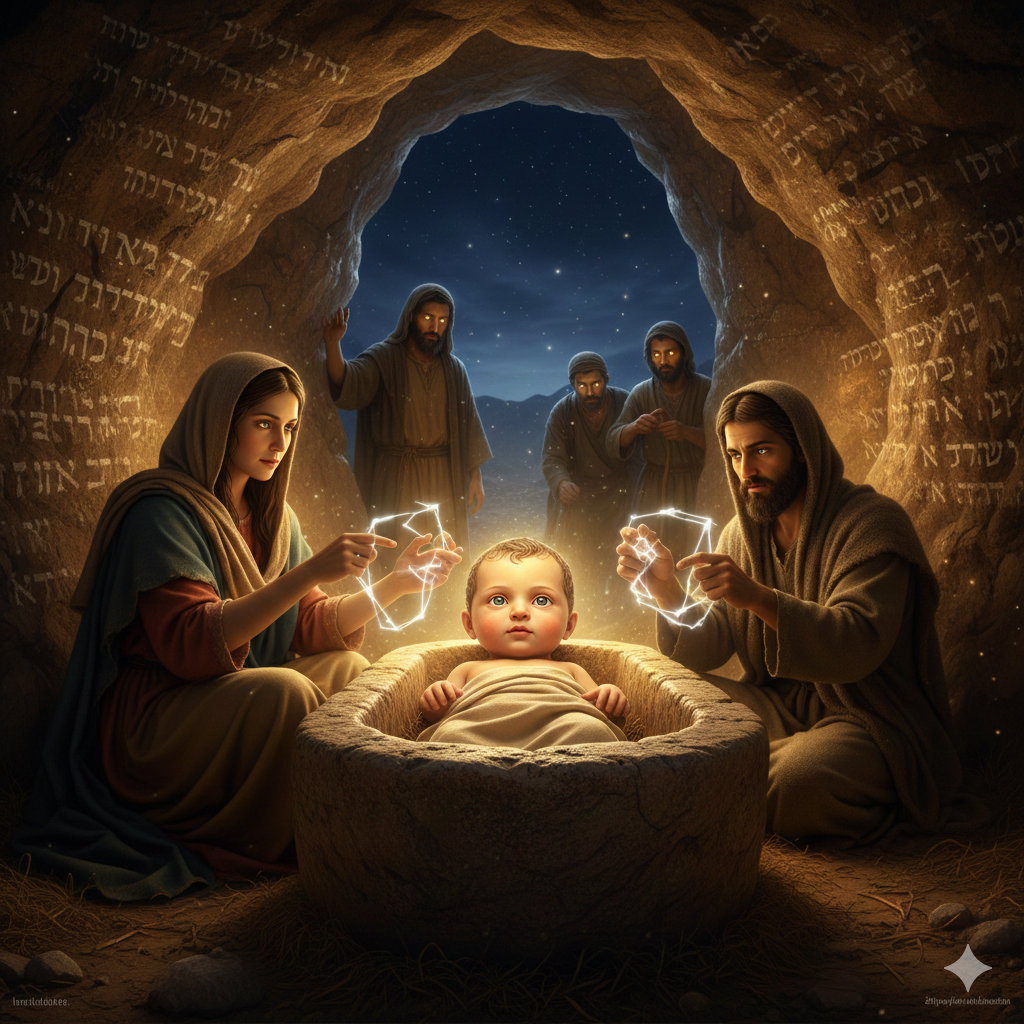
The architecture of the Inhabited Vessel is revealed through the stark dismantling of religious sentiment, exposing the functional and legal reality of the covenantal arrival. Institutional religion has long employed the term manger as a decorative prop, a piece of sterile furniture designed for a holiday stage. This gloss strips the environment of its raw authority, replacing a place of consumption with a place of mere observation. The codex witness restores the phatne (fat-nay), the feeding trough, which serves as a living altar where the bread of life is presented for the actual sustenance of the hungry. This is not a quaint nursery but a functional vessel of provision located outside the “inns” of human systems. Human institutions and religious structures are the crowded guest rooms that have no space for the frequency of the father’s decree. The presence of Yehoshua is found instead in the lowliest place of the household, the place where life is physically sustained through feeding. This location signifies that the Inhabited One is not found within the polished corridors of power or the structured systems of men, but in the grit of the functional requirement for survival. The feeding trough is the intersection of divine provision and human necessity, serving as the first throne for the sovereign who comes to be consumed by those who seek life.
The identity of the one reclining in this trough is further clarified by the transition from the sentimental baby of institutional tradition to the legal reality of the brephos (bref-os) and paidion (pahee-dee-on). The term baby in modern parlance carries connotations of helplessness and nursery dependency, a concept that serves to diminish the perceived authority of the child. The Greek lexical witnesses reveal the brephos as the newborn in its specific biological entry point, and the paidion as the young child in the context of legal and covenantal status within the household. This is the entry of an heir into a physical realm to claim a pre-existing inheritance. This status is not granted over time but is inherent from the moment of arrival. The authority of the Inhabited One is sovereign and complete at the point of entry. To recognize the newborn as the heir is to acknowledge that the covenant does not wait for maturity to be valid; the frequency of the father is fully present within the vessel from the first breath. This legal standing shatters the religious image of a fragile child and replaces it with the reality of a sovereign who has occupied a physical vessel to execute a celestial mandate.
The posture of this sovereign within the feeding trough is described in the codex as keimenon (kay-men-on), which translates to reclining rather than merely lying down. Institutional translations use the word lay to describe a static, passive physical position, much like an object placed on a shelf. However, the etymological root of reclining denotes the posture of one at a feast or in a position of authority and rest. Even in the lowliest vessel of the feeding trough, the spirit of Yehoshua operates from a position of finished rest. This is the posture of a king who is already seated on his throne while the world perceives only a child in a box. This reclining indicates a sovereign ease that is undisturbed by the surrounding environment or the perceived poverty of the setting. It is the architectural blueprint of the indwelt life; even when the external vessel is found in the lowest of circumstances, the internal inhabitant remains in a state of finished, sovereign rest. The feeding trough does not define the sovereign; the reclining sovereign defines the trough, transforming a place of animal sustenance into the center of the covenantal universe.
The validation of this sovereign posture and legal status is found in the specific record of the shepherds as they verified the living utterance. They came with haste and found the reality exactly as it had been spoken, witnessing the intersection of the lowly vessel and the high authority of the inhabitant. And they came hurrying and they found by seeking both Mariam and Yosef, and the newborn reclining in the feeding trough. (Codex Vaticanus – Loukas 2:16, Covenantally Faithful, Minimal Copular, SVO Format).
Original: καὶ ἦλθαν σπεύσαντες καὶ ἀνεῦραν τὴν τε Μαριὰμ καὶ τὸν Ἰωσὴφ καὶ τὸ βρέφος κείμενον ἐν τῇ φάτνῃ
Transliteration: kai ēlthan speusantes kai aneuran tēn te Mariam kai ton Iōsēph kai to brephos keimenon en tē phatnē
Literal: and they‑came hurrying and they‑found the both Mariam and the Yosef and the newborn reclining in the feeding‑trough
This architectural arrangement serves as an analogy for the indwelling of the spirit within the human vessel. The human body is the lowliest of vessels, a feeding trough of biological needs and earthly limitations. Yet, when it becomes the habitation for the frequency of Yehoshua, it is transformed into a living altar. The presence is not found in the religious inns or the cathedrals built by human hands, but in the raw, unpolished cave of the human heart that has been prepared as a place of feeding. The indwelt person recognizes that their own physical vessel is the phatne, and the spirit within is the reclining sovereign. This realization shifts the focus from external religious performance to internal covenantal rest. We no longer seek a god in a temple made of stone, but we acknowledge the Sovereign Heir who reclines within our own biological framework, operating from a position of finished authority regardless of the external conditions.
The contrast between the institutional baby in a manger and the codex newborn reclining in a feeding trough reveals the depth of the deception woven by religious systems. By sentimentalizing the arrival, religion prevents the seeker from recognizing the legal and functional power of the event. To see the newborn as the brephos is to understand that the kingdom has entered the physical realm with the intent to occupy and rule. To see the feeding trough as the phatne is to understand that the presence is available for consumption and sustenance, not just for distance viewing. The architecture of the inhabited vessel is designed to bypass the intellect and impact the core frequency of the seeker. It is a call to come and eat, to move past the signs and the murals and to engage with the physical and spiritual reality of the heir.
The conclusion of this architectural excavation establishes the feeding trough as the primary site of covenantal interaction. It is the place where the seeking of the shepherds met the manifestation of the rhema. The reclining sovereign remains the standard for all who are indwelt, providing a blueprint of rest and authority that transcends the lowliness of the vessel. We have moved from the passive observation of a nursery scene to the active inhabitation of a sovereign court. The newborn is the heir, the trough is the altar, and the posture is one of finished rest. We now carry this architectural understanding into the final phase of the excavation, where we witness the internal processing of the mother and the return of the shepherds to their fields, carrying the frequency of the Inhabited One with them.