Physical Address
304 North Cardinal St.
Dorchester Center, MA 02124
Physical Address
304 North Cardinal St.
Dorchester Center, MA 02124
With Michael Walker
With Michael Walker
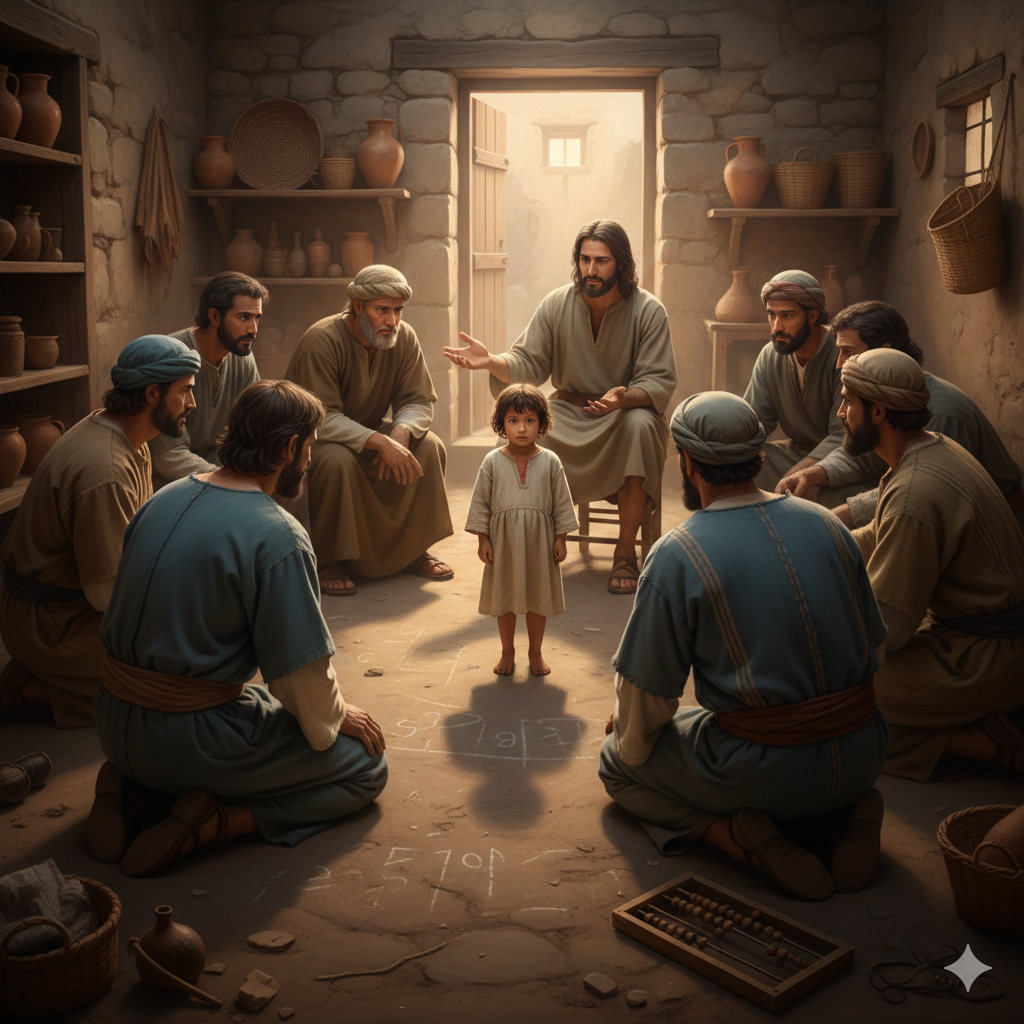
(Κατὰ Μάρκον — Kata Markon — Mark 9:33-37, Vaticanus/Sinaiticus)
The movement toward Kapharnaoum – (Village of Consolation) – signifies a critical transition from the mountain of transfiguration to the internal crucible of the dwelling, where the logic of the Indwelt is audited by the frequency of Yehoshua. This section functions as a structural diagnostic of the participant’s internal state, identifying the friction between the carnal desire for magnitude (greatness) and the covenantal law of descent (humility). The text initiates this audit by probing the calculations performed on the path, revealing that the Indwelt (by proximity) were occupied with a mathematical assessment of hierarchy rather than covenantal alignment. For the Indwelt of today (The Inhabited), who exists in superposition with the Father, the Breath, and the Word (Yehoshua), the pursuit of being greater is a return to the powerless scaffolding of man, whereas the descent into the role of the endmost attendant is the only valid mode of operation. The Believer, who operates through the contrived institutional narrative (CIN pronounced SIN also known as The World/Religion/Christianity), seeks to quantify value through comparison and rank, but the Indwelt remains in a state of direct reality where magnitude is found in the reception of the status-less. This discipline of service is mandated so that the participant does not fall into the competitive vacillation (refers to the act of wavering between options, positions, or decisions.) characteristic of the world system but instead mirrors the authorized agency of the Source through the welcoming of the child.
Original: καὶ ἦλθον εἰς Καφαρναούμ καὶ ἐν τῇ οἰκίᾳ γενόμενος ἐπηρώτα αὐτούς τί ἐν τῇ ὁδῷ διελογίζεσθε οἱ δὲ ἐσιώπων πρὸς ἀλλήλους γὰρ διελέχθησαν ἐν τῇ ὁδῷ τίς μείζων καὶ καθίσας ἐφώνησεν τοὺς δώδεκα καὶ λέγει αὐτοῖς εἴ τις θέλει πρῶτος εἶναι ἔσται πάντων ἔσχατος καὶ πάντων διάκονος καὶ λαβὼν παιδίον ἔστησεν αὐτὸ ἐν μέσῳ αὐτῶν καὶ ἐναγκαλισάμενος αὐτὸ εἶπεν αὐτοῖς ὃς ἂν ἓν τῶν τοιούτων παιδίων δέξηται ἐπὶ τῷ ὀνόματί μου ἐμὲ δέχεται καὶ ὃς ἂν ἐμὲ δέχεται οὐκ ἐμὲ δέχεται ἀλλὰ τὸν ἀποστείλαντά με
Literal Interlinear Etymological Translation (The L.I.E. Detector): And they-came into Kapharnaoum and in the dwelling having-arrived he-was-inquiring them what in the path you-all-were-calculating but the-ones they-were-keeping-silent toward one-another for they-conversed in the path who greater and having-sat-down he-summoned the twelve and he-says to-them if anyone desires first to-be he-shall-be of-all last and of-all an-attendant and having-taken a-child he-stood it in midst of-them and having-taken-into the-arms he-said to-them whoever one of-the such children accepts upon the name of-me me accepts and whoever me accepts not me accepts but the-one having-sent-as-agent me. (Vaticanus — Markon — 9 — 33-37 Covenantally Faithful, Minimal Copular, SVO Format)
The inquiry regarding what they were διελογίζεσθε — dielogizesthe (dee-el-og-id-zes-the) — “calculating or reasoning through a logic” serves to dismantle the psychological drive for vertical advancement. The term μείζων — meizōn (mide-zone) — “greater” identifies a preoccupation with magnitude and rank, which is the foundational currency of the contrived institutional narrative. The Indwelt recognizes that to resolve — θέλει — thelei (thel-i) — to be πρῶτος — prōtos (pro-tos) — “first or foremost” requires a structural collapse into the state of the ἔσχατος — eschatos (es-khat-os) — “last or endmost.” The command that the foremost must be a διάκονος — diakonos (dee-ak-on-os) — “attendant or one who executes the commission of another” indicates a return to the kinetic simplicity of the covenant. To seek rank is to admit a lack of internal inhabitation. The goal is to function as a clear conduit for the Source, where the status of the vessel is irrelevant to the execution of the commission. When the Indwelt accepts a child, the act must be a direct manifestation of the Spirit-Breath inhabiting the vessel, requiring no external validation of status.
The calculation of rank is a structural failure within the communication lines of the Indwelt. In the same way that a high-voltage line requiring internal resistors to manage heat reveals a struggle with the current, the need for rank reveals a struggle with the internal power of the Inhabitation. The Indwelt is a vessel of the Source’s authority, and as such, their standing is derived from the One who sent them, not from their position relative to their womb-brothers. To seek to be greater is an attempt to borrow magnitude from a human hierarchy, a tactic frequently employed by the Believer to mask the powerlessness of their own spiritual standing. The contrived institutional narrative thrives on these layers of rank and religious titles because they create a complex web of control that the system can use to keep the Believer in a state of dependency. However, the Covenantal Relational Agency operates on the principle of the endmost, where the last in the human order is the first in the frequency of the Breath.
The child is the biological etymology of the status-less, functioning as a living witness to the sovereignty of YHWH. When the participant attempts to calculate greatness, they are effectively trying to bypass the zero-point of the Father’s house to secure a human magnitude. This is a violation of the protocol of the Inhabitation. The Indwelt must perceive that their reception of the powerless carries the signature of the Father; therefore, to reject the lowly is to suggest that the Father’s presence is only found in the high-status enclosures of man. The reception structure is the binary of the Spirit-Breath. It allows no room for the shadows of the self to hide in the nuances of a complex hierarchy. To fall into the calculation of who is greater is to enter the sifting process where the inconsistency of one’s heart leads to a separation from the kinetic flow of the covenant. The Indwelt remains protected by keeping their focus on the attendant’s commission, refusing to construct the false ladders of the contrived institutional narrative.
The welcoming of the child is a tactical move to isolate the Indwelt from the manipulative patterns of the world system. The world system uses status and magnitude to bind individuals to its own decaying structures, creating a false sense of security through the scaffolding of man. But the Indwelt is bound only to the Source through the inhabitation of the Spirit-Breath. This bond requires no external rank because it is lived out in the reality of the superposition. The twelve are reminded that this protocol is of primary importance because the desire for greatness is the primary corruption of the internal center. If the output is corrupted by the need for magnitude, the entire vessel is compromised. The requirement to be the last of all is the sanitation protocol for the ambition, ensuring that every act of service is a reflection of the non-concealed reality of the covenant. By rejecting the ladder, the Indwelt stands in the freedom of the Source, where their value is as immutable as the name of Yehoshua.
The Master who sits in the dwelling is the one who weighs the density of the participant’s service. If an act is hollow, requiring the artificial weight of a title to seem significant, it will fail the audit of the Master. The Indwelt avoids this failure by ensuring their internal resolve is perfectly mirrored in their external descent. This alignment is the essence of being one-souled. The two-souled Believer fluctuates, needing the title to pin down their shifting identity, but the Indwelt is anchored in the presence of the one having sent them. The child and the attendant are not collateral; they are the environment of the covenant. To overlook them is an act of arrogance that the decider will not overlook. Therefore, the participant must cultivate a posture that is lowly, heavy, and transparent, removing the need for any human rank.
The integrity of the collective depends on the functional reliability of its individual members as attendants. If a womb-brother requires a title to be respected, the bond of the “agape” (to be warm, welcoming, to bond, to make one feel of value) is already under strain. The forming of a bond and making one feel of value requires a baseline of absolute humility that is only possible when the first is the last. The contrived institutional narrative uses titles to replace this bond with a system of prestige and deference, but the Covenantal Relational Agency replaces the title with the inhabitation of the Spirit-Breath. This inhabitation provides the internal constraint that makes the pursuit of rank unnecessary. The Indwelt is an attendant of the commission because they are a person of the Word. To seek greatness is to be found wanting in this essential alignment, where the ambition has strayed from the truth of the heart.
The child serves as the boundary of the Father’s activity, and by placing the child in the midst, Yehoshua is ensuring that the Indwelt does not overstep their position. The participant is a steward, not an owner, and they have no right to bind the members of the Father’s house to their own desire for prestige. This recognition of one’s place is the beginning of the lowliness that receives favor. The servant of all is the tool of the steward who simply executes the business of the Master. To add to this is to attempt to act as a master oneself, which is the root of the haughtiness that YHWH opposes. By staying within the role of the attendant, the Indwelt maintains the posture of the lowly, which is the only position that is safe from the corruption of the contrived institutional narrative.
The functional discipline of the Indwelt is the outward sign of their internal inhabitation. A mind that is cluttered with the need to prove its greatness through calculation is a mind that is still captured by the noise of the world system. The silence of the status is the volume of the truth. When the Indwelt serves simply, they are making space for the Spirit-Breath to resonate through their actions. This resonance is what gives the service its force and prevailing power. The Believer’s pursuit of rank is a loud clanging that signifies a lack of substance, but the Indwelt’s service to the child is a solid block of reality that needs no further support. The Master in the dwelling hears the resonance and recognizes the signature of the Father in the simplicity of the attendance.
The failure of leadership is a mechanical outcome of hierarchical complexity. Complexity is the hiding place of the missing-of-the-mark. When the Indwelt simplifies their existence to the binary of the servant and the child, they are removing the hiding places for error. This is the path of the righteous one who does not resist the descent but embraces it fully. The titles and ranks of the world will pass away, but the service rendered in the inhabitation remains as a witness to the completion. The Indwelt lives in this completion now, serving with the authority of those who know the outcome. Their service is not a hopeful climb but a covenantal certainty; their position as last is not a fearful rejection but a spirit-led boundary.
The twelve are called to this higher standard because they are the representatives of the Master’s presence in the dwelling. If their service is tainted by the desire for rank, the message of the Inhabitation is obscured. The world system is a hall of mirrors where greatness is always relative, and magnitude is used for manipulation. The Indwelt must be the point of clarity in the midst of the distortion, the place where the first is always the last. This clarity is the light that causes the slanderer to flee. The slanderer is the father of the hierarchy because he is the father of the pride that makes the rank necessary. By refusing the rank, the Indwelt is refusing the architect of the contrived institutional narrative and standing firm in the light of the Father.
The name is the vault of the Father’s authority, and the child is the platform of His activity. To receive the child on the basis of the name is to treat the Father’s realm as a place of reception, which is a structural requirement of the covenant. The Indwelt remains in the correct hierarchy by letting their activity be the simple reception of the sent one. This is the fulfillment of the agape bond where each womb-brother can rely on the other without the need for the fences of titles. The Master in the dwelling is watching the portals of our hearts, ensuring that no distorted desires for rank are allowed into the sanctuary of the assembly. The reception and the service are the passcodes of the Covenantal Relational Agency, the only frequencies that are compatible with the Spirit-Breath.
The falling into the competitive logic of the world is the weight of one’s own ambition coming back upon the head. The Indwelt avoids this weight by ensuring their service is light and true, carrying no hidden baggage of self-promotion. The ranks and magnitudes are not to be moved by the hands of men, but the hand of the Indwelt is moved by the breath that created the child and the attendant. This is the ultimate reality of the Mark 9 transmission: a return to the direct, unmediated connection between the Source and the participant. The rank is the scaffolding that is no longer needed when the inhabitation is complete. The Indwelt is the dwelling, inhabited by the Spirit, and their service to the child is the cornerstone of their presence in the world.